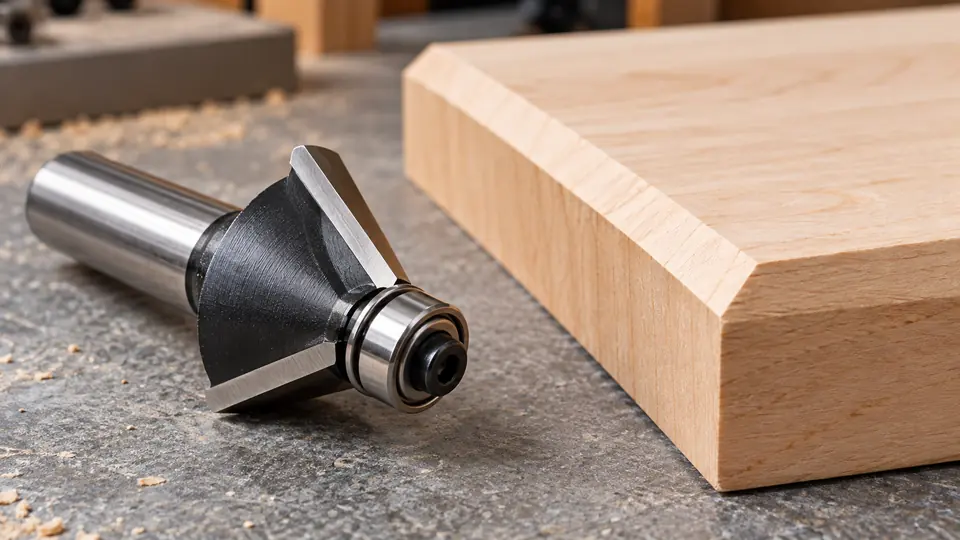
A chamfer bit can turn a harsh, splinter-prone corner into a crisp bevel, but the geometry has to match the job. A shallow 11.25-degree bevel creates a very different look from a bold 45-degree edge, while cutter height determines how much material the bit can actually shape. Buyers often focus on the angle alone and miss the shank diameter, bearing guide, cutter dimensions, or router clearance that decides whether the bit can be used safely.
For routine edge easing, a bearing-guided 45-degree bit is usually the practical starting point. Picture frames, boxes, cabinetry, and modern furniture may call for deeper chamfers or several angles, however. A compact trim router owner might prioritize a 1/4-inch shank and modest overall diameter, while a router-table user may prefer the stability and larger cutting capacity available from a 1/2-inch-shank bit.
The Freud 40-104 is the strongest overall match here because its documented dimensions cover common 45-degree edge work without drifting into an unusually large cutter. Its bearing guide, 1/4-inch shank, 1/2-inch carbide height, two cutters, and support for handheld or table-mounted routing form a useful middle ground. The other eight picks serve narrower needs, from multi-angle joinery to substantial 1-inch chamfers.
Quick Answer
- Best overall: Freud 40-104 combines a common 45-degree profile with a bearing guide, 1/4-inch shank, and manageable 1-11/32-inch diameter.
- Best compact option: Whiteside Router Bits 2292 has a documented 1-inch large diameter that fits through the base plate on small trim routers.
- Best multi-angle set: FivePears 6 PCS Chamfer Router Bit Set supplies six angles on 1/2-inch shanks, including 11.25, 15, 22.5, 30, 45, and 60 degrees.
- Best for a deep 45-degree chamfer: Freud 40-118 pairs a 2-1/2-inch overall diameter with a full 1-inch carbide height.
Best Chamfer Router Bit Comparison Table
| Product | Best For | Angle | Shank | Documented Cutter Details |
|---|---|---|---|---|
| Freud 40-104 | Everyday edge treatment | 45° | 1/4 inch | 1/2-inch carbide height, 1-11/32-inch diameter, bearing |
| YONICO 13106q | Straightforward 45° work | 45° | 1/4 inch | 1/2-inch cutting depth, C3 micro-grain carbide |
| Whiteside Router Bits 2292 | Small trim routers | 45° | 1/4 inch | 7/16-inch cutting length, 5/16-inch cutting height, bearing |
| Freud 40-114 | Larger furniture bevels | 45° | 1/2 inch | 5/8-inch height, 1-5/8-inch diameter, two cutters |
| FivePears 6 PCS Set | Broad angle selection | 11.25° to 60° | 1/2 inch | Six carbide-tipped bits with bearings |
| WSOOX 5PCS Set | Multi-angle work with 1/4-inch collets | 11.25° to 45° | 1/4 inch | Five C3 micro-grain carbide bits |
| KOWOOD Plus 4-Piece Set | Four 45° profile sizes | 45° | 1/4 inch | 1/4, 5/16, 3/8, and 1/2-inch cutting diameters |
| Whiteside Router Bits 2306 | Deep bearing-guided bevels | 45° | 1/2 inch | 1-1/16-inch cutting length, 3/4-inch cutting height, bearing |
| Freud 40-118 | Extra-large 45° chamfers | 45° | 1/2 inch | 1-inch carbide height, 2-1/2-inch diameter, bearing |
The detailed reviews below show where each profile makes practical sense and where its dimensions become a limitation.
1. Freud 40-104: 1-11/32-Inch Chamfer Bit — Best Overall

The Freud 40-104 hits a useful middle size for routine woodworking. Its 45-degree profile, 1/2-inch carbide height, 1-11/32-inch overall diameter, and 1/4-inch shank suit edge treatments that should look deliberate without swallowing a large portion of the board. A 1/2-inch bearing guides the bit along a straight or curved edge, which is handy on a tabletop corner where a fence cannot follow the shape.
Freud documents two cutters, an anti-kickback design, Perma-SHIELD coating, and compatibility with plywood, hardwood, softwood, and composition materials. Chamfer width can be changed by raising or lowering the bit, or by repositioning a router-table fence. That adjustability lets one cutter produce anything from a narrow glint along an edge to a fuller geometric bevel, provided the router and setup respect the bit’s dimensions and operating limits.
Pros
- Common 45-degree geometry works for decorative bevels and eased corners.
- 1/4-inch shank fits routers equipped with a matching 1/4-inch collet.
- Documented 1/2-inch carbide height offers useful adjustment range.
- Bearing guide supports edge-following work without a separate template fence.
- Suitable for both handheld and table-mounted routing.
Cons
- Limited to a 45-degree profile, so it cannot create shallower architectural bevels.
- Its cutting capacity is smaller than the 1/2-inch-shank Freud 40-114 and 40-118.
This bit fits woodworkers who want one bearing-guided cutter for cabinet edges, boxes, trim, and general furniture details. Buyers planning deep chamfers across thick stock should move toward a larger 1/2-inch-shank option, but the 40-104 is the more approachable all-around size.
To buy this product, click here.
2. YONICO Chamfer Router Bits Edge Forming 45 Degree 1/4-Inch Shank 13106q — Best Simple 45-Degree Bit

YONICO’s 13106q keeps the specification list focused: a 45-degree profile, 1/2-inch cutting depth, and 1/4-inch shank. That combination addresses familiar jobs such as removing a sharp corner, adding a clean shadow line, or cutting mating bevels for a mitered assembly. It can be used in handheld and table-mounted routers with the correct 1/4-inch collet.
The cutting edges are documented as C3 micro-grain tungsten carbide, while silver induction brazing joins them to the body. Those construction details matter more than flashy packaging because a chamfer cutter repeatedly presents its edge to the same corner of the workpiece. Still, a claimed 1/2-inch cutting depth should be treated as the cutter’s capacity, rather than an instruction to remove the full amount in one aggressive pass.
Pros
- Documented 1/2-inch cutting depth covers common edge-beveling tasks.
- 45-degree geometry can produce beveled edges or matching miter surfaces.
- 1/4-inch shank works with matching compact-router and full-size-router collets.
- C3 micro-grain tungsten carbide cutting edges are clearly specified.
- Approved for handheld and router-table use by the supplied product information.
Cons
- Only one angle is included, which limits joinery and decorative profile options.
- The supplied specifications do not clearly state the overall cutter diameter or bearing dimensions.
The 13106q suits someone who needs a straightforward 45-degree cutter rather than a box full of overlapping sizes. It is less informative dimensionally than the Freud 40-104, but its stated cutting depth and broad router-use support keep it relevant for ordinary beveling work.
To buy this product, click here.
3. Whiteside Router Bits 2292 Chamfer Bit with 45-Degree 7/16-Inch Cutting Length — Best for Trim Routers

The Whiteside 2292 is unusually easy to assess because its critical dimensions are clearly documented. It uses a 1/4-inch shank, measures 1 inch across at its large diameter, and provides a 7/16-inch cutting length with a 5/16-inch cutting height. That modest 1-inch diameter is specifically described as fitting through the base plate on small trim routers, making this the most targeted compact-router option among these picks.
A bearing guide sits at the end of the carbide-tipped cutter, allowing the profile to track the workpiece edge. The 5/16-inch cutting height is enough for restrained bevels and corner relief, yet it remains smaller than the 1/2-inch cutting ranges offered by several general-purpose alternatives. That is a sensible trade for small-router access where base openings and cutter clearance can become the deciding constraint.
Pros
- Documented 1-inch large diameter is suited to small trim-router base openings.
- 1/4-inch shank matches the collet size commonly associated with compact routing setups.
- Bearing guide follows straight and curved workpiece edges.
- Precise 7/16-inch cutting length and 5/16-inch cutting height are supplied.
- Carbide-tipped 45-degree cutter handles edge relief and decorative beveling.
Cons
- 5/16-inch cutting height is restrictive for a broad or deep chamfer.
- Its fixed 45-degree geometry cannot cover multi-angle miter work.
This is the sensible pick for a woodworker whose small router and base opening rule out bulky cutters. Larger furniture-scale profiles fall outside its sweet spot, but trim-router users gain unusually clear dimensional information before committing to the setup.
To buy this product, click here.
4. Freud 1-5/8-Inch Chamfer Router Bit 40-114 — Best Mid-Size 1/2-Inch-Shank Bit

The Freud 40-114 bridges the gap between compact edge-forming bits and imposing large-diameter cutters. Its 1-5/8-inch diameter, 5/8-inch cutting height, 45-degree angle, and 1/2-inch shank make it a plausible fit for furniture, cabinetry, and millwork where a small chamfer looks timid. Two cutters use Freud’s TiCo high-density carbide, with material support covering hardwood, softwood, plywood, and composites.
Chamfer size can be altered through bit height or fence position, so the full 5/8-inch profile does not have to appear on every edge. The documented maximum speed is 16,000 RPM, a critical setup detail because larger-diameter router bits generally carry lower operating limits than compact cutters. The router, collet, base opening, and workholding arrangement still need to support the bit before that broad silver of wood begins to peel away.
Pros
- 1/2-inch shank provides a clearly defined fit for routers with matching collets.
- 5/8-inch cutting height creates a larger bevel than compact 1/4-inch-shank options.
- Two-cutter 45-degree profile serves edge treatment and joinery applications.
- Chamfer width adjusts through cutter height or router-table fence position.
- Maximum rating of 16,000 RPM gives users a documented operating ceiling.
Cons
- Requires a 1/2-inch collet and cannot be installed in a 1/4-inch-only router.
- The 1-5/8-inch diameter requires more clearance than compact chamfer bits.
The 40-114 fits users seeking a noticeable 45-degree bevel without jumping to the 2-1/2-inch Freud 40-118. Its central trade-off is simple: greater cutting height and body diameter demand a suitably equipped router and a more deliberate setup.
To buy this product, click here.
5. FivePears 6 PCS Chamfer Router Bit Set 1/2 Inch Shank — Best Multi-Angle Set

FivePears offers the broadest angle range in this group: 11.25, 15, 22.5, 30, 45, and 60 degrees. That spread can support shallow decorative bevels, polygonal assemblies, box work, frame miters, and edge softening without forcing one 45-degree bit into every design. All six bits use 1/2-inch shanks, and the set arrives in a wooden storage box that keeps the different profiles identifiable.
The supplied dimensions list 1-inch cutting lengths for the 11.25, 22.5, and 30-degree bits, a 3/4-inch cutting length for the 45-degree bit, and a 9/16-inch cutting length for the 60-degree bit. YG6X carbide inserts, alloy bodies, bearings, and anti-kickback geometry are documented. These cutters support handheld and table-mounted routers, but their differing diameters and profiles make checking the marked RPM guidance and router clearance essential for each changeover.
Pros
- Six angles cover a much wider range of bevel and miter geometry than a single bit.
- 1/2-inch shanks provide consistent collet requirements across the set.
- Several cutting lengths are explicitly documented for planning profile capacity.
- Bearing-guided construction supports edge-following applications.
- Wooden box provides organized storage for all six cutters.
Cons
- The entire set requires a router with a proper 1/2-inch collet.
- Users needing only a routine 45-degree chamfer will carry five unnecessary profiles.
This set makes sense for builders who genuinely use several bevel angles, particularly for boxes, trim details, and multi-sided work. A one-angle cutter is simpler for repetitive edge easing, while FivePears rewards the user who plans joints and profiles around its broader geometry.
To buy this product, click here.
6. WSOOX 5PCS Chamfer Router Bits with 1/4-Inch Shank — Best Multi-Angle 1/4-Inch-Shank Set

The WSOOX set brings multi-angle capability to routers using 1/4-inch collets. Its five cutters cover 11.25, 15, 22.5, 30, and 45 degrees, a useful progression for decorative edge work and miter geometry. The absence of a 60-degree cutter separates it from the FivePears set, though many users will value the smaller shank requirement more than the extra angle.
Each bit is described as using C3 micro-grain tungsten carbide blades, and the series receives a heat-treatment process. The bits can add bevels or create angled mating surfaces, but accurate miter joints still depend on setup, stock consistency, test cuts, and controlled feeding. WSOOX identifies the 1/4-inch holder as suitable for major desktop router workbenches, while other compatibility details should be checked against the specific router and base opening.
Pros
- Five angles provide more design flexibility than a fixed 45-degree cutter.
- Every bit uses the same 1/4-inch shank size.
- Angle range includes shallow 11.25-degree and 15-degree options.
- C3 micro-grain tungsten carbide cutting edges are documented.
- Suitable for beveled edges and angled miter surfaces.
Cons
- No 60-degree cutter is included, unlike the six-piece FivePears set.
- Individual cutting lengths and overall cutter diameters are not clearly specified.
WSOOX is aimed at the woodworker who wants multiple angles but lacks a 1/2-inch collet. The trade-off is less dimensional detail than the FivePears listing provides, so careful inspection of each cutter and the supplied instructions matters before setup.
To buy this product, click here.
7. KOWOOD Plus 45 Degree Chamfer Router Bit Set — Best 45-Degree Size Set

KOWOOD takes a different approach to variety. Instead of changing the angle, this four-piece set keeps every cutter at 45 degrees and supplies 1/4, 5/16, 3/8, and 1/2-inch cutting diameters. That format helps when several projects need the same visual angle at different scales, such as a fine bevel on a small box followed by a wider edge detail on plywood furniture.
The bits use 1/4-inch shanks and KOWOOD C3 carbide, with heat treatment documented for the series. Supported materials include dense wood, laminate, particleboard, and plywood. The listing also identifies handheld routers, table routers, and CNC use, though actual installation still depends on the machine accepting the shank, cutter geometry, and physical diameter rather than brand name alone.
Pros
- Four profile sizes preserve a consistent 45-degree visual language.
- Cutting diameters are clearly listed from 1/4 to 1/2 inch.
- All four bits use 1/4-inch shanks.
- Documented material range includes dense wood, laminate, particleboard, and plywood.
- Supported machine categories include handheld, table-mounted, and CNC routing equipment.
Cons
- Every bit cuts the same 45-degree angle.
- The supplied information does not clearly list individual cutting lengths or bearing dimensions.
Choose this set when profile scale changes more often than bevel angle. It is poorly matched to polygonal joinery requiring 22.5 or 30 degrees, but it gives 45-degree edge work more sizing flexibility than a single general-purpose cutter.
To buy this product, click here.
8. Whiteside Router Bits 2306 Chamfer Bit with 45-Degree 1-1/16-Inch Cutting Length — Best for Deep Bearing-Guided Chamfers

The Whiteside 2306 shifts from subtle edge relief toward a strong architectural bevel. It has a 2-inch large diameter, 1-1/16-inch cutting length, 3/4-inch cutting height, and 1/2-inch shank. Those dimensions provide substantially more profile capacity than the compact Whiteside 2292, making the 2306 relevant for thick furniture components or bold contemporary edge details.
A bearing guide at the end of the carbide-tipped cutter follows the workpiece edge. The larger body changes the setup conversation, however. Router base clearance, collet size, bit extension, speed limits, and secure workholding deserve close attention before cutting. Multiple controlled passes can also reduce the amount of wood presented to the cutter at once, especially when the intended chamfer approaches the bit’s full height.
Pros
- 3/4-inch cutting height supports a pronounced 45-degree bevel.
- 1-1/16-inch cutting length is clearly documented.
- 1/2-inch shank matches routers equipped with a corresponding collet.
- Bearing guide supports direct edge following.
- Carbide-tipped construction is specified for the cutter.
Cons
- Two-inch large diameter demands more router and base clearance than compact bits.
- Cannot be used in routers limited to a 1/4-inch collet.
The 2306 fits substantial 45-degree edge work where a 5/16 or 1/2-inch profile would look undersized. Small routers and light trimming jobs call for the Whiteside 2292 instead, while this model belongs with a properly sized router and a measured, restrained cutting plan.
To buy this product, click here.
9. Freud 40-118: 2-1/2-Inch Chamfer Bit — Best Extra-Large Chamfer Bit

The Freud 40-118 is the heavyweight of this selection. Its 2-1/2-inch overall diameter and 1-inch carbide height can form a broad 45-degree surface that reads as a major design element rather than a faint edge treatment. A 1/2-inch shank, two cutters, and a 1/2-inch bearing complete the documented geometry, while the overall length reaches 2-7/8 inches.
Freud supports use in handheld and table-mounted routers, plus cutting in hardwood, softwood, plywood, and composition materials. Its Perma-SHIELD coating is also documented. Still, support for handheld use does not make every handheld router suitable. A cutter this large must remain within the router manufacturer’s diameter, base-clearance, and speed limits, with work secured and exposure kept appropriate to the profile being cut.
Pros
- Full 1-inch carbide height provides the largest documented chamfer capacity here.
- 2-1/2-inch diameter creates a broad 45-degree profile.
- 1/2-inch bearing guides the cutter along the workpiece edge.
- Suitable materials include hardwood, softwood, plywood, and composition stock.
- Chamfer width adjusts through bit height or router-table fence placement.
Cons
- Large 2-1/2-inch diameter significantly narrows suitable router and setup options.
- Oversized for subtle edge easing and small trim-router work.
This cutter is for woodworkers who already know they need a 1-inch-high 45-degree bevel. For ordinary cabinet edges, the Freud 40-104 is easier to accommodate, while the 40-118 makes sense when the chamfer itself carries the visual weight of the design.
To buy this product, click here.
Buying Guide
Choose the Angle Before the Brand
A 45-degree chamfer is the familiar choice for easing square corners, adding a geometric edge, and forming matching miter surfaces. Shallower cutters such as 11.25, 15, or 22.5 degrees remove material more gradually, producing a longer, quieter slope. Multi-angle sets are useful for polygonal projects and varied decorative work, while a dedicated 45-degree bit is easier to manage when every job calls for the same profile.
Match the Shank to the Actual Collet
A 1/4-inch shank belongs in a proper 1/4-inch collet, while a 1/2-inch shank requires a proper 1/2-inch collet. The sizes are not interchangeable, and an improvised sleeve is no substitute for manufacturer-approved hardware. Compact routers often accept 1/4-inch bits, while many larger routers support 1/2-inch cutters, but the specific router manual settles the question.
Separate Cutting Height From Overall Diameter
Cutting height describes the usable vertical portion of the edge, while overall diameter describes the widest sweep of the cutter. A bit may offer the desired chamfer height yet still be too wide for the router base opening. The Whiteside 2292 has a 1-inch large diameter for small trim-router clearance, whereas the 2-1/2-inch Freud 40-118 belongs in a very different physical setup.
Understand What the Bearing Does
A pilot bearing follows the workpiece edge and controls the cutter’s lateral relationship to that edge. This makes curved pieces and fence-free edge routing more practical, provided the bearing has a smooth, continuous surface to follow. The bearing does not control depth of cut, prevent every feeding error, or compensate for a rough and uneven reference edge.
Plan for Router-Table and Handheld Differences
Handheld routing brings the tool to the secured workpiece, which can make sense for large panels and installed components. A router table supports the cutter below the work and can provide better control over small pieces when guards, fence, and safe workholding are properly arranged. Bit exposure, feed direction, starting method, and hand placement differ between those configurations, so the router and table manuals should guide setup.
Respect Diameter and Speed Limits
Large cutters should never be treated like tiny edge-trimming bits. Check the bit’s marked maximum RPM and the router manufacturer’s limits, then confirm base and table openings provide adequate clearance. Freud documents 16,000 RPM as the maximum for the 40-114, while other cutters here require reference to their own markings or instructions rather than a guessed universal speed.
Use Controlled Passes and Test Stock
A chamfer can reveal tear-out, grain reversal, or an incorrect profile setting in seconds. Set up on scrap from the same material, verify the resulting bevel, and remove material through controlled passes where appropriate. Disconnect power before changing cutters, inspect the bit and bearing, secure the work, manage dust, and wear suitable eye and hearing protection before the router starts to whine.
Best Chamfer Router Bit FAQ
What Angle Is Best for a General-Purpose Chamfer?
A 45-degree bit is the most broadly useful choice for easing sharp corners and creating a recognizable beveled edge. Projects involving multi-sided boxes, unusual miters, or long shallow slopes may require 11.25, 15, 22.5, 30, or 60 degrees instead, so the drawing should dictate the geometry.
Can a Chamfer Bit Create a Miter Joint?
Yes, a suitable chamfer bit can cut angled mating surfaces, but the correct angle alone does not guarantee a tight joint. Bit height, fence position, stock thickness, straightness, feed control, and matching cuts all influence the seam. Scrap cuts are the sensible place to dial in that geometry.
Is a 1/2-Inch Shank Better Than a 1/4-Inch Shank?
Neither size is automatically better for every router or job. A 1/2-inch shank appears on larger cutters and requires a matching collet, while a 1/4-inch shank serves routers equipped for that size and supports many compact profiles. Router compatibility and cutter dimensions should lead the decision.
Can I Use a Large Chamfer Bit in a Compact Router?
Shank fit alone does not establish suitability. Check the router’s approved cutter diameter, collet, base opening, speed range, and operating instructions. The Whiteside 2292 is specifically described as fitting through small trim-router base plates, while the larger 2-inch and 2-1/2-inch cutters demand far more clearance.
What Is the Difference Between Cutting Height and Cutting Length?
Manufacturers may use these measurements to describe different portions of the cutter geometry. Cutting height typically refers to the vertical profile available at the edge, while cutting length may follow the sloped cutting surface. Use the supplied diagram or technical specifications rather than assuming the two figures are interchangeable.
Do I Need a Bearing-Guided Chamfer Bit?
A bearing is useful for following straight or curved workpiece edges without relying entirely on a fence. Fence-guided table work can still be possible with suitable bits and setups, but a bearing simplifies many edge-forming operations. It needs a clean reference surface and should rotate freely before use.
Can Chamfer Bits Cut MDF and Plywood?
Several picks here explicitly support MDF, plywood, particleboard, composites, or related composition materials. Product-specific material guidance still matters, particularly with abrasive sheet goods. Dust control and respiratory protection also deserve attention because routing these materials can generate fine airborne debris.
How Deep Should a Chamfer Be Cut in One Pass?
There is no universal depth that fits every cutter, router, material, and grain orientation. Broad profiles may call for several controlled passes rather than exposing the entire cutting edge immediately. Follow the router and bit instructions, secure the stock, and confirm the setup on scrap before touching the finished component.
Final Verdict
The Freud 40-104 is the best overall chamfer router bit for broadly useful 45-degree work. Its 1/4-inch shank, 1/2-inch carbide height, bearing guide, two cutters, and 1-11/32-inch diameter balance usable profile capacity with less bulk than the largest bits. It also carries enough dimensional information to plan collet fit, cutter exposure, and clearance with confidence.
For a small trim router, the compact Whiteside 2292 is the sharper match. The FivePears six-piece set serves users who need several angles on 1/2-inch shanks, while the Freud 40-118 handles an unusually deep 45-degree profile. Match the bit to the required angle first, then verify shank, cutter diameter, cutting height, bearing arrangement, router limits, and base clearance before making the first pass.
