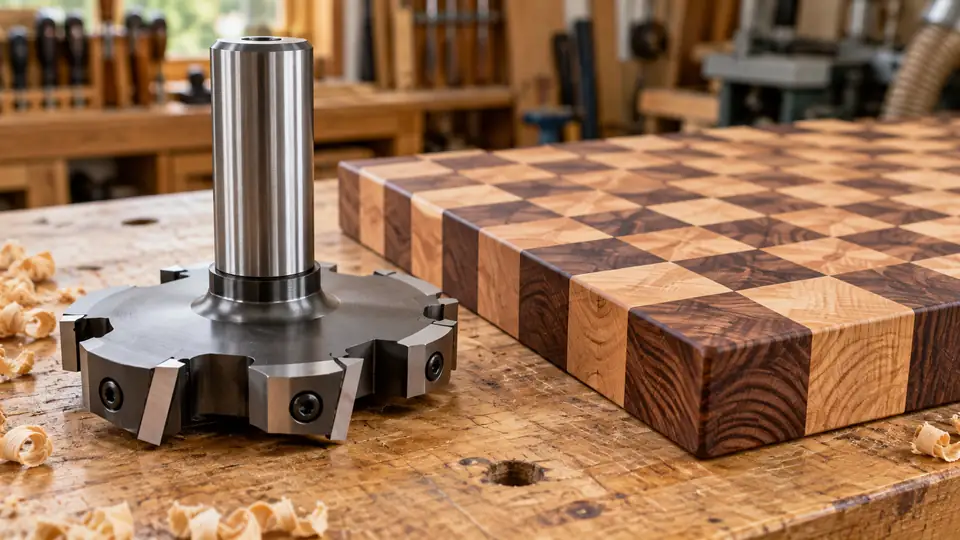
An end-grain cutting board can look dead flat after glue-up, then reveal tiny ridges the moment low-angle light skims across it. A planer is a poor answer because exposed end grain can chip or tear, while a jointer is the wrong shape and setup for a wide board. A router sled and flattening bit offer a controlled path forward, shaving the high spots through repeated, shallow passes until the surface is ready for sanding.
The cutter matters as much as the sled. A broad 3-inch insert bit clears material quickly, but its mass, speed limit, 1/2-inch shank, and router requirements can make it excessive for a modest kitchen board. A compact 1/4-inch-shank cutter moves more slowly yet fits many palm routers and feels less unwieldy over a smaller workpiece. Buyers often focus on cutter diameter alone, overlooking shank compatibility, maximum RPM, insert condition, sled rigidity, and the faint ridges that appear when the router is tilted out of plane.
The Ultra-Shear US2750CSP is the strongest overall match because its 3/4-inch carbide head was specifically developed for flattening end-grain cutting boards, and its 1/4-inch shank suits compact routers. Larger boards, frequent surfacing, and CNC work may justify a wider insert cutter from SICWOOD, BINSTAK, Akylin, or Whiteside. The nine options below cover those different priorities without pretending that the widest cutter is automatically the smartest one.
Quick Answer
- Best overall: Ultra-Shear US2750CSP, a compact cutter explicitly intended for end-grain cutting boards.
- Best coated insert option: SICWOOD DLC-Coated 1-1/2-Inch Bit, with replaceable four-sided inserts and an 18,000 RPM ceiling.
- Best premium fixed-edge cutter: Whiteside 6220, a carbide-tipped, four-wing bit with a 2-inch cutting diameter.
- Best for wide surfaces: Akylin 3-Inch 6-Wing Bit, provided the router and flattening setup can safely support a large 1/2-inch-shank cutter.
Best Router Bit For Flattening End Grain Cutting Board Comparison Table
| Product | Best For | Shank | Cutting Diameter | Cutting System |
|---|---|---|---|---|
| Ultra-Shear US2750CSP | End-grain cutting boards | 1/4 inch | 3/4 inch | Three-flute carbide head |
| SICWOOD DLC-Coated 1-1/2-Inch Bit | Coated replaceable inserts | 1/4 inch | 1-1/2 inches | 2+2 DLC-coated inserts |
| BINSTAK 1-3/8-Inch Insert Bit | Serviceable 1/4-inch setup | 1/4 inch | 1-3/8 inches | 2+2 four-edged inserts |
| Whiteside 6220 | Carbide-tipped fixed edges | 1/2 inch | 2 inches | Four-wing carbide-tipped |
| SICWOOD 2-Inch 6-Wing Bit | Documented speed guidance | 1/2 inch | 2 inches | Six four-edged inserts |
| BINSTAK 2-Inch 6-Wing Bit | TiN-coated inserts | 1/2 inch | 2 inches | Six replaceable inserts |
| Akylin 3-Inch 6-Wing Bit | Wide panels and spoilboards | 1/2 inch | 3 inches | Six wings plus two inserts |
| BINSTAK 1-Inch 3-Wing Bit | Compact, straightforward surfacing | 1/4 inch | 1 inch | Three-wing carbide-tipped |
| BINSTAK 3-Inch Insert Bit | Fewer passes over broad surfaces | 1/2 inch | 3 inches | Four four-edged inserts |
The detailed reviews explain where each cutter fits and which setup demands deserve extra attention.
1. Ultra-Shear US2750CSP — Best Overall

The Ultra-Shear US2750CSP addresses this roundup’s exact job instead of approaching it as a scaled-down slab-flattening exercise. Its 3/4-inch cutting diameter, three-flute carbide head, and 1/4-inch shank create a compact package intended for leveling end-grain cutting boards with a sled. The 3/8-inch cutting length is ample for shallow surfacing passes, where removing a whisper of wood at a time is preferable to burying the cutter deeply in exposed fibers.
That modest diameter means more side-to-side passes than a 2-inch cutter, yet it also makes sense around palm and trim routers that accept 1/4-inch shanks. A removable pattern bearing adds useful flexibility after the board is flat. The bit can clean dado bottoms or extend suitable Forstner-bit holes, while the bearing can be removed when the sled operation does not need it. At 2 inches overall, this is a compact specialist rather than a hulking flycutter hanging beneath the router.
Pros
- Explicitly intended for flattening end-grain cutting boards.
- 1/4-inch shank fits many compact and palm-router collets.
- Three-flute carbide head has a 3/4-inch cutting diameter.
- Removable bearing expands its usefulness beyond sled flattening.
- Compact 2-inch overall length keeps the cutter relatively restrained.
Cons
- The 3/4-inch diameter requires more passes than wider surfacing bits.
- Replaceable cutting inserts are not part of the documented design.
This is the natural pick for a woodworker flattening cutting boards with a compact router and a properly squared sled. Skip it if production speed over very broad panels matters more than compact-router compatibility. Its central trade-off is simple: slower coverage in exchange for a cutter sized around the actual job.
To buy this product, click here.
2. SICWOOD DLC-Coated 1-1/2-Inch Bit — Best Coated Insert Option

SICWOOD takes a different route with a 1-1/2-inch cutting diameter and a 2+2 insert arrangement. The top and side positions use different documented insert dimensions, and each carbide insert has four usable edges. Rotate a worn edge into service rather than discarding the entire cutter body. The Diamond-like Carbon coating is intended to reduce friction and resist wear, a practical feature for anyone expecting repeated surfacing sessions.
The 1/4-inch shank makes this cutter relevant to routers without a 1/2-inch collet, but the larger head still demands careful compatibility checks. Shank fit alone does not establish that a router can safely clear or drive a particular cutter. SICWOOD lists an 18,000 RPM maximum, so the router must allow operation within the bit’s limit. Its listed materials include hardwood, softwood, plywood, MDF, acrylic, plastic, and epoxy, which broadens its role beyond cutting-board work.
Pros
- 1/4-inch shank paired with a relatively broad 1-1/2-inch cutter.
- Four-sided inserts can be rotated before replacement.
- DLC coating is specified for the carbide cutting edges.
- 2+2 insert layout provides top and side cutting positions.
- Maximum speed is clearly listed at 18,000 RPM.
Cons
- The router must support the cutter diameter and its documented speed ceiling.
- Different top and side insert sizes add detail to replacement ordering.
This model fits users who want replaceable inserts while remaining in a 1/4-inch-shank format. It can cover a cutting board faster than the 3/4-inch Ultra-Shear, though it lacks the Ultra-Shear’s explicit end-grain-board specialization. Careful sled alignment and light cuts remain vital because extra width magnifies any router tilt.
To buy this product, click here.
3. BINSTAK 1-3/8-Inch Insert Bit — Best Serviceable 1/4-Inch Cutter

The BINSTAK 1-3/8-inch bit lands in a useful middle ground. It covers substantially more width per pass than a 3/4-inch compact cutter, while its 1/4-inch shank avoids the automatic need for a 1/2-inch collet. Four cutting positions are arranged in a 2+2 layout, giving the head both bottom and side-cutting capability for surfacing and related planing tasks.
Maintenance is the headline feature here. The solid-carbide inserts have four usable edges, so a dulled edge can be turned to expose fresh carbide. That is appealing when abrasive glue lines, epoxy accents, or sheet materials form part of the workload. BINSTAK lists hardwood, softwood, particleboard, MDF, plywood, laminate, and acrylic among its supported materials, and identifies the bit for CNC, automatic, handheld, and table-mounted portable routers.
Pros
- 1/4-inch shank works with an appropriately sized 1/4-inch collet.
- 1-3/8-inch cutting diameter balances coverage and compactness.
- Four cutting positions use a 2+2 insert arrangement.
- Four-edged carbide inserts can be rotated and replaced.
- Documented for hardwood, softwood, composite panels, laminate, and acrylic.
Cons
- A maximum RPM is not clearly specified in the supplied information.
- A 1/4-inch collet alone does not confirm router clearance for the wide head.
Choose this BINSTAK if replaceable edges and a moderately wide path matter more than a purpose-built end-grain design. It suits cutting boards, glued panels, and spoilboard resurfacing when the router manufacturer permits the cutter size. Users who want explicit speed guidance should look more closely at the SICWOOD options.
To buy this product, click here.
4. Whiteside 6220 — Best Premium Fixed-Edge Cutter

The Whiteside 6220 uses familiar carbide-tipped construction rather than small indexable inserts. Its four-wing head spans 2 inches, with a 1/2-inch cutting length and matching 1/2-inch shank. That broad sweep means fewer sled passes than compact bits, which becomes noticeable across a large butcher block or wide glued panel where every additional lane adds setup time and another opportunity for overlap marks.
Whiteside identifies the bit for slab flattening and CNC spoilboard resurfacing, with natural wood, composite wood, hard plastic, and epoxy listed as suitable materials. The four-flute configuration is intended to leave a smooth, flat upper surface. There are no insert screws to inspect or individual knives to rotate, which simplifies the cutter body, although restoring dull cutting edges is less convenient than indexing a fresh insert face.
Pros
- 2-inch cutting diameter reduces the number of surfacing lanes.
- Four-wing carbide-tipped head is intended for smooth surfacing.
- 1/2-inch cutting length provides useful planing capacity.
- Documented for natural wood, composites, hard plastics, and epoxy.
- Fixed carbide-tipped edges avoid insert alignment and screw checks.
Cons
- Requires a true 1/2-inch collet.
- Cutting edges cannot be indexed like four-sided replaceable inserts.
The Whiteside 6220 fits a substantial router or CNC setup where a 2-inch cutter is supported and a conventional carbide-tipped head is preferred. It is less appealing for palm-router owners or anyone prioritizing replaceable knives. For broad cutting boards and panels, its width offers a sensible step up from compact cutters without jumping to a 3-inch head.
To buy this product, click here.
5. SICWOOD 2-Inch 6-Wing Bit — Best Documented Speed Guidance

This SICWOOD cutter combines a 2-inch diameter with six indexable carbide inserts and a 1/2-inch shank. Each insert measures 12 by 12 by 1.5 mm and offers four cutting edges, letting the user rotate the carbide before buying replacements. Six wings create many cutter contacts per revolution, but they also create six points that must be seated, aligned, and tightened correctly.
The unusually useful part of the listing is its setup guidance. SICWOOD states an 18,000 RPM maximum, calls for a router rated at least 2 HP, and recommends an initial test below 10,000 RPM before a gradual increase. It also warns that a small insert-height discrepancy can cause vibration. Those directions underline a broader truth: a big surfacing head is a precision assembly, and loose screws or uneven inserts can turn a routine pass into a rattling mess.
Pros
- Six-wing head provides six carbide cutting positions.
- Four-sided inserts can be indexed as edges become dull.
- 2-inch diameter covers boards efficiently without reaching 3-inch scale.
- 18,000 RPM maximum is explicitly documented.
- Supplied guidance addresses router power, test speed, and insert inspection.
Cons
- SICWOOD specifies a router with at least 2 HP for this cutter.
- All six inserts require careful, even seating to control vibration.
This is a strong fit for a rigid sled or CNC and a capable 1/2-inch-collet router whose specifications align with SICWOOD’s requirements. It rewards a patient setup more than a casual install-and-go approach. Buyers using compact routers should stay with one of the smaller 1/4-inch-shank options rather than forcing compatibility.
To buy this product, click here.
6. BINSTAK 2-Inch 6-Wing Bit — Best TiN-Coated Inserts

BINSTAK’s six-wing cutter shares the useful 2-inch working diameter of the SICWOOD but uses 10 by 10 by 2.2 mm carbide inserts. Those inserts carry a titanium nitride coating and have four usable edges. When one edge loses its bite, it can be rotated outward, keeping the steel body in service and reducing the need to replace a complete cutter.
The manufacturer lists the bit for slab flattening, spoilboard resurfacing, and planing hardwood, softwood, particleboard, MDF, plywood, laminate, and acrylic. It can be used in CNC, automatic, handheld, and table-mounted portable-router contexts where the machine safely supports its dimensions. A six-wing body promises broad, busy cutting action, yet the payoff depends heavily on every insert sitting flat and every fastener being properly secured.
Pros
- Six replaceable cutting inserts are supplied with the cutter.
- TiN coating is documented on the carbide inserts.
- Each insert provides four indexable cutting edges.
- 2-inch head offers efficient coverage over wide glued surfaces.
- Listed for solid wood, engineered panels, laminate, and acrylic.
Cons
- The supplied information does not clearly state a maximum RPM.
- Six insert positions require more inspection than a fixed-edge head.
Pick this model for a serviceable six-wing design with coated inserts, provided the router manual supports the 2-inch head and a suitable operating speed is confirmed. The SICWOOD six-wing model supplies clearer speed and power guidance, while this BINSTAK places more emphasis on coating and insert thickness.
To buy this product, click here.
7. Akylin 3-Inch 6-Wing Bit — Best For Wide Panels

At 3 inches across, the Akylin is built to sweep a wide lane. Its head carries six wings plus two additional inserts, for eight insert pieces in total, and each indexable carbide knife offers four edges. The cutter body is specified as 42CrMo4 steel with a black-bronzed surface, while the inserts are identified as K10/YG6X carbide. This is a sizeable assembly hanging from a 1/2-inch shank, so secure mounting and controlled operation are central concerns.
Akylin lists 12,000 RPM for the cutter and supplies a screwdriver for rotating or replacing inserts. The bit is presented for router sleds, CNC machines, automatic routers, and suitable portable-router arrangements, with spoilboards and large glued panels among its intended jobs. A 3-inch head can shorten the surfacing pattern dramatically, but a poorly trammed sled will carve broader ridges with every pass. Width amplifies setup errors along with productivity.
Pros
- 3-inch cutting diameter covers broad panels with fewer passes.
- Eight total insert pieces provide multiple cutting positions.
- Four-edged inserts can be rotated or replaced individually.
- 12,000 RPM operating specification is supplied.
- Intended for spoilboards, large glued panels, sleds, and CNC machines.
Cons
- The large head is excessive for many compact cutting-board setups.
- All insert screws must be inspected and tightened before operation.
This Akylin suits users flattening wide panels or spoilboards with a rigid machine that can accept a 1/2-inch shank and safely handle the cutter. For a single medium cutting board, its scale may create more setup burden than benefit. Its advantage appears when broad coverage genuinely saves repeated traverses.
To buy this product, click here.
8. BINSTAK 1-Inch 3-Wing Bit — Best Compact BINSTAK Option
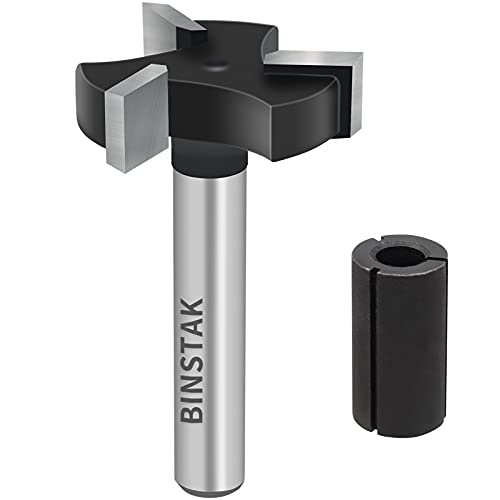
BINSTAK’s smaller carbide-tipped cutter has a 1-inch diameter, 1/4-inch cutting length, three wings, and a 1/4-inch shank. Those dimensions make it less intimidating than the broad 2-inch and 3-inch heads, while still clearing a wider strip than the 3/4-inch Ultra-Shear. Its hardened steel body has an anti-kickback form and a heat-resistant Teflon coating intended to limit resin accumulation and simplify cleanup.
The bit is listed for surfacing, trimming, slotting, and grooving in solid wood, MDF, laminate, particleboard, plywood, and acrylic. It is also identified for CNC, automatic, handheld, and table-mounted portable routers. For cutting-board flattening, the 1/4-inch cutting length is sufficient for restrained skim passes. The fixed carbide-tipped wings keep maintenance uncomplicated, although they lack the rotate-and-continue convenience of indexable inserts.
Pros
- 1-inch cutting diameter is manageable for smaller surfacing jobs.
- 1/4-inch shank fits the corresponding collet size.
- Three-wing carbide-tipped configuration is straightforward.
- Teflon coating is intended to reduce resin buildup.
- Documented for solid wood and several common panel materials.
Cons
- The supplied specifications do not identify a maximum RPM.
- Fixed carbide-tipped edges cannot be rotated like indexable inserts.
This cutter fits occasional flattening and smaller boards where a compact cutting path is welcome. It gives up the Ultra-Shear’s explicit end-grain focus and removable bearing, but gains a slightly wider 1-inch sweep. Confirm router clearance and operating-speed requirements before installation rather than relying on shank size alone.
To buy this product, click here.
9. BINSTAK 3-Inch Insert Bit — Best Four-Insert Wide Cutter

This BINSTAK pares the wide-cutter concept down to four cutting inserts arranged around a 3-inch body. The 1/2-inch shank and broad sweep position it for substantial surfacing setups, where reducing the number of passes across a slab, glued panel, or spoilboard has real value. Each 12 by 12 mm solid-carbide insert offers four edges, allowing individual indexing rather than whole-bit replacement.
BINSTAK identifies a high-strength steel body with an anti-kickback design and lists the cutter for hardwood, softwood, MDF, particleboard, plywood, laminate, and acrylic. CNC, automatic, handheld, and table-mounted portable routers are named as possible machine types, though actual suitability still depends on the router’s cutter-diameter allowance, collet, speed range, and base clearance. A 3-inch head can feel wonderfully efficient on a broad surface, but it leaves little room for a casual or flexible sled.
Pros
- 3-inch cutting diameter reduces passes across broad workpieces.
- Four inserts provide a simpler layout than higher-count wide heads.
- Each carbide insert has four usable cutting edges.
- Individual inserts can be replaced without discarding the steel body.
- Listed for solid woods, engineered boards, laminate, and acrylic.
Cons
- No maximum RPM is clearly documented in the supplied specifications.
- The 3-inch head requires a suitably capable router and rigid setup.
This model makes sense for broad surfaces where four serviceable inserts and a wide path are more attractive than a compact cutter. Cutting-board makers working with a palm router should look elsewhere. Users with an adequately supported 1/2-inch-collet machine may appreciate its simpler four-insert arrangement compared with the eight-piece Akylin head.
To buy this product, click here.
Buying Guide
Match The Shank To The Actual Collet
A 1/4-inch shank belongs in a proper 1/4-inch collet, while a 1/2-inch shank requires a genuine 1/2-inch collet. The two sizes are not interchangeable, and an improvised sleeve is no substitute for manufacturer-supported compatibility. A compact router owner will naturally gravitate toward the Ultra-Shear, SICWOOD DLC, or smaller BINSTAK cutters, while a full-size router may support the 1/2-inch options if its manual permits their diameter and intended application.
Collet fit is merely the first checkpoint. A router can accept a shank while lacking enough base opening, speed control, or mechanical capacity for the cutter head. Picture a 3-inch disc beneath a narrow router base and the conflict becomes obvious. Verify cutter clearance with the router unplugged, then follow both the router and bit instructions before any wood chips begin to fly.
Choose Cutter Diameter By Board Size And Router Capacity
A small head takes more passes, but it can be an intelligent match for a cutting board. The 3/4-inch Ultra-Shear creates a narrower cutting lane that suits compact sleds and palm routers. If a board is around typical countertop-board proportions rather than dining-table size, a compact head may feel controlled and predictable, with each shallow pass producing a thin curl of dust rather than a heavy bite.
Two-inch and 3-inch cutters shine on wide panels, spoilboards, and repeated production work. Their broad sweep also exaggerates sled errors. If the router axis is slightly tilted, one edge of a wide cutter sits lower and carves visible scallops. The sanding stage then becomes a sweaty attempt to erase ridges that accurate tramming could have prevented.
Fixed Carbide Edges Versus Indexable Inserts
Fixed carbide-tipped cutters such as the Whiteside 6220 and smaller BINSTAK three-wing bit avoid insert screws and alignment checks. Their geometry is straightforward, but a dull or damaged edge cannot be refreshed by turning a tiny carbide square. Sharpening or cutter replacement becomes the next step, depending on the bit and available service options.
Indexable cutters trade that simplicity for serviceability. Four-sided inserts can be rotated to expose fresh edges, which is handy around abrasive glue lines and mixed-material projects. Every insert must sit cleanly in its pocket, at the same effective height, with its fastener tightened according to the maker’s directions. One poorly seated knife can produce vibration, chatter, or an uneven surface.
Observe Speed Limits And Router Requirements
Cutter diameter and safe RPM are closely connected, yet there is no single speed that suits every flattening bit. The SICWOOD six-wing cutter lists an 18,000 RPM maximum and specific startup guidance, while the Akylin lists 12,000 RPM. Those numbers apply to those individual products. They should never be copied onto a different cutter whose limit has not been established.
Where the supplied product information does not state a maximum speed, consult the current manufacturer instructions before use. Large-diameter bits generally call for more caution than slender cutters because their outer edges travel farther during each revolution. Disconnect the router before installation or insert adjustment, inspect the cutter, and never exceed the documented limit.
Keep The Sled Flat, Rigid, And Square
A premium bit cannot rescue rails that sag under router weight. Both sled rails should be straight, supported, parallel, and firmly fixed. The board must remain motionless below them, with enough clearance for the cutter to pass across the entire face without touching clamps. A thin shim under one rail can show up as a broad taper across the board, so setup precision matters before the router switch is touched.
Tramming deserves equal attention. The router’s axis should sit perpendicular to the work surface in both directions. Test the setup on scrap or a sacrificial area and inspect the overlapping lanes under low light. If each pass leaves a sharp step on one side, correct the sled or router alignment rather than trying to bury the evidence with a deeper cut.
Use Shallow, Controlled Passes On End Grain
End grain exposes thousands of wood fibers like the ends of tightly packed straws. Aggressive cuts can bruise, chip, or tear those fibers, especially near unsupported edges. Start with a conservative depth, secure the board, and let the cutter remove high spots gradually. The exact depth depends on the cutter, router, wood, and manufacturer guidance, so universal pass figures would be misleading.
Plan a consistent traversal pattern with overlapping lanes. Avoid pausing in one spot while the cutter spins, since heat and burn marks can appear quickly. Dust extraction, eye protection, hearing protection, and respiratory protection all matter because flattening produces a floating cloud of fine particles rather than a tidy ribbon of shavings.
Best Router Bit For Flattening End Grain Cutting Board FAQ
Can I Run An End-Grain Cutting Board Through A Thickness Planer?
A router sled is generally the more controlled choice for this task because a planer can catch and damage exposed end grain, particularly near the trailing edge. End-grain boards also contain many glue joints and short exposed fibers, creating a demanding cut. If another machining method is being considered, follow the machine manufacturer’s guidance and assess the workpiece carefully rather than assuming ordinary face-grain planing rules apply.
Is A 1/4-Inch-Shank Flattening Bit Large Enough?
Yes, provided the bit is intended for surfacing and the router supports its complete cutter dimensions. The Ultra-Shear uses a 1/4-inch shank and 3/4-inch head specifically for end-grain cutting boards. A smaller cutter takes more lanes, but it can be a sensible partner for a compact sled and appropriately compatible palm router.
Will A 3-Inch Bit Flatten A Board Faster?
A 3-inch head covers more width per pass, so it can reduce the number of traverses across a broad surface. That does not mean it is faster in every workshop. Setup, router capability, safe operating speed, sled rigidity, and tramming become more demanding. For a modest cutting board, a smaller cutter may reach a sand-ready surface with less fuss.
Are Replaceable Inserts Better Than Carbide-Tipped Wings?
Each format has a practical appeal. Replaceable inserts can be rotated, extending service before a new set is required, and individual damaged knives can be replaced. Fixed carbide-tipped wings avoid insert screws and seating alignment. The better choice depends on maintenance preference, workload, supported router setup, and whether replacement inserts are readily identifiable.
Why Does A Flattening Bit Leave Ridges?
Parallel ridges often point to a router that is not perpendicular to the board. One side of the cutter sits lower, so each overlapping lane leaves a tiny step. Rail sag, board movement, excessive depth, uneven inserts, and inconsistent feed can contribute too. Check mechanical alignment first because a wider cutter makes even small angular errors painfully visible.
How Much Should The Passes Overlap?
The supplied product information does not prescribe a universal overlap, and one figure would not suit every cutter. Use enough overlap to maintain continuous surface coverage without making each pass redundant. Watch the first shallow lanes on a secured test area, then adjust the pattern according to the cutter instructions, sled behavior, and visible surface.
Can A Flattening Bit Remove Epoxy Along With Wood?
Several cutters here are explicitly listed for epoxy, including the Whiteside 6220 and SICWOOD models. Product-specific material support still matters, since a bit labeled for wood alone should not automatically be treated as epoxy-compatible. Mixed wood-and-epoxy surfaces also reward sharp edges, controlled passes, effective dust collection, and careful attention to heat.
What Safety Checks Matter Before The First Pass?
Disconnect power while installing the bit, verify the correct collet, confirm adequate shank insertion according to the router instructions, and check head clearance. Inspect carbide edges, insert screws, sled rails, clamps, and the workpiece. Confirm the bit’s RPM limit and router compatibility, then use eye, hearing, and respiratory protection while keeping hands clear of the cutter path.
Final Verdict
The Ultra-Shear US2750CSP is the best overall router bit for flattening an end-grain cutting board because its dimensions and stated purpose line up directly with that job. The 1/4-inch shank, 3/4-inch carbide head, three flutes, and removable bearing create a compact tool that makes sense for controlled sled work. It will take more passes than a wide flycutter, but its scale is a virtue for many cutting-board projects.
For faster coverage with replaceable edges, the SICWOOD DLC-Coated 1-1/2-Inch Bit is the strongest 1/4-inch-shank alternative. The Whiteside 6220 suits buyers who prefer a 2-inch, four-wing carbide-tipped cutter, while the Akylin 3-Inch Bit targets wide panels and capable 1/2-inch-collet setups. Match the cutter to the router, observe its speed limit, square the sled painstakingly, and favor shallow passes. That careful setup will influence the final surface far more than chasing the biggest head on the table.
