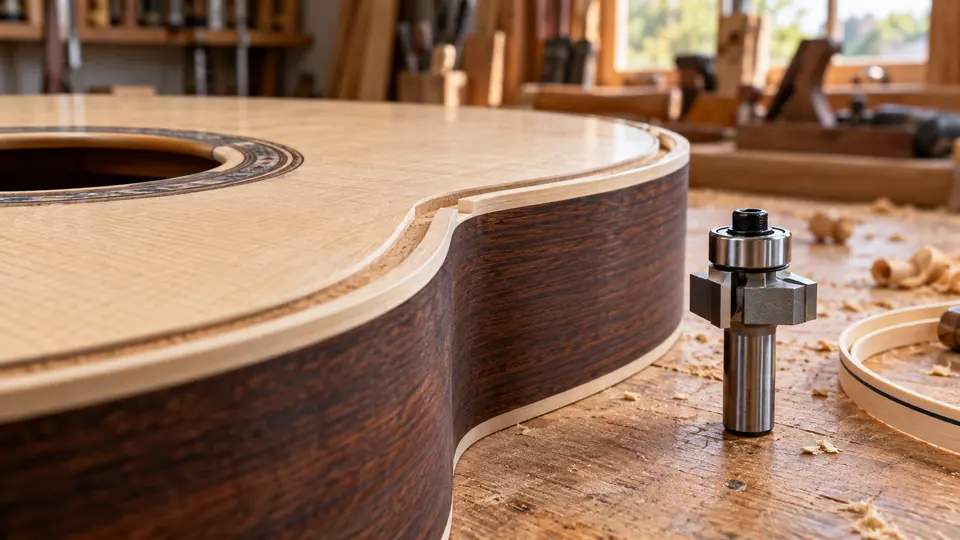
A guitar binding channel is a tiny ledge with nowhere to hide a mistake. Cut it a hair too deep and the binding sinks below the plate. Let the router tip across an arched top and the ledge can wander like a crooked pencil line. Buyers searching for the best router bit for guitar binding therefore need more than a sharp cutter. Bearing control, channel offset, shank compatibility, cutter geometry, and the ability to follow a body contour all shape the result.
The most common buying error is treating every rabbeting, flush-trim, or spiral bit as interchangeable. A bearing-guided binding cutter establishes a ledge around the instrument body, while a flush-trim bit brings installed binding level with an adjacent surface. Spiral bits serve narrower jobs involving channels, purfling, or cleanup with a suitable jig. Those are different operations, and choosing by shank size alone can produce an expensive pile of curly wood and regret.
Different builders have different priorities. A repair bench may need several bearing offsets, while an occasional kit builder may prefer a simpler set. The StewMac Standard Binding Router Bit Set is the strongest overall package here because its carbide-tipped, 1/4-inch-shank cutter comes with nine binding-specific bearings, a flush bearing, an extension bushing, an Allen wrench, and instructions. Builders who regularly juggle varied binding and purfling combinations should look closely at the expanded 19-bearing version.
Quick Answer
- Best overall: StewMac Standard Binding Router Bit Set, with nine depth-of-cut bearings and a flush bearing.
- Best premium set: StewMac Expanded Binding Router Bit Set, which increases the bearing selection to 19 sizes.
- Best three-flute binding bit: Amana Tool 49346 Binding/Rabbeting Bit, with a documented 20 mm diameter and 1/4-inch shank.
- Best for trimming installed binding: Amana Tool 47116 Flush Trim Bit, a compact three-flute option with a 1/2-inch cutting height.
Best Router Bit for Guitar Binding Comparison Table
| Product | Best For | Profile | Shank | Guidance or Geometry |
|---|---|---|---|---|
| StewMac Standard Binding Router Bit Set | Most guitar binding jobs | Binding cutter | 1/4 inch | Nine bearing sizes plus flush bearing |
| StewMac Expanded Binding Router Bit Set | Broad binding and purfling selection | Binding cutter | 1/4 inch | Nineteen bearing sizes plus flush bearing |
| Amana Tool 49346 Binding/Rabbeting Bit | Specified three-flute cutting geometry | Binding/rabbeting | 1/4 inch | 20 mm diameter, three flutes |
| Guitar Binding Router Bit With Bearing Sets | Adjustable channel offsets | T-cutter | Not clearly specified | Interchangeable bearing set |
| Guitar Binding Routing Tool With Multiple Bearings | Repair and channel correction | T-style cutter | Not clearly specified | Multiple ball-bearing guides |
| Amana Tool 47116 Flush Trim Bit | Trimming installed binding | Flush trim | 1/4 inch | 1/2-inch diameter, three flutes |
| Freud 50-102 Top-Bearing Flush Trim Bit | Longer flush-trimming cuts | Top-bearing flush trim | 1/4 inch | 1-inch carbide height, two cutters |
| SpeTool Downcut Spiral Router Bit | Jig-guided channels and top-edge control | Downcut spiral | 1/4 inch | 1/4-inch cutter, 1-inch cutting length |
| SHARPRO Spiral Upcut Router Bit | Plunging and chip evacuation | Solid-carbide upcut spiral | 1/4 inch | 1/4-inch cutter, 1-inch cutting length |
The detailed reviews below show which cutters establish binding ledges, which trim installed material, and which belong in more specialized jig-guided work.
1. Best Overall: StewMac Binding Router Bit Set, Standard Set With 9 Bearing Sizes

The Standard Set tackles the central problem in binding work: controlling how far the cutter reaches into the guitar body. Its nine depth-of-cut bearings are sized for binding routing, so changing the bearing changes the ledge offset without replacing the core cutter. That is handy when one instrument needs a narrow plastic strip while another uses a wider binding and purfling stack. The supplied carbide-tipped cutter has a 1/4-inch shank, a common size for compact routers and rotary-tool router bases that accept that exact shank.
StewMac also includes a flush bearing for a second stage of the job. After the binding is glued and protruding slightly, flush trimming can bring it closer to the top, back, or side before careful scraping. The extension bushing, Allen wrench, and instructions make this a more complete system than a loose cutter with vaguely documented bearings. You still need to verify the selected bearing against actual binding thickness using scrap, since finish thickness, purfling, and glue-line decisions can alter the intended ledge.
Pros
- Nine bearing sizes support multiple binding-channel offsets.
- Carbide-tipped cutter is specifically intended for clean binding ledges.
- Documented 1/4-inch shank simplifies router-collet verification.
- Flush bearing supports trimming glued binding and assembled plate edges.
- Includes an extension bushing, Allen wrench, and instructions.
Cons
- Nine bearings provide less adjustment range than the expanded StewMac set.
- The complete system is more elaborate than an occasional single-size project may require.
This set fits builders who want one coherent package for routing common binding combinations and handling subsequent flush-trimming work. Its main trade-off is range. Nine bearings cover less territory than the 19-bearing version, but the smaller selection may be easier to organize for a bench that handles a limited group of standard builds.
To buy this product, click here.
2. Best Premium: StewMac Binding Router Bit Set, Expanded Set With 19 Bearing Sizes

The Expanded Set takes the same binding-focused approach and pushes adjustment much further with 19 bearing sizes. That larger assortment matters when a bench sees varied purfling stacks, restoration work, or custom binding combinations that do not land neatly on a few familiar offsets. Instead of trying to force one bearing into several jobs, the builder can choose among more depth-of-cut options while retaining the same carbide-tipped cutter.
The package uses a 1/4-inch shank and includes a flush bearing, extension bushing, Allen wrench, and instructions. That flush bearing broadens its role beyond cutting the initial ledge, since it can assist with trimming glued bindings and newly assembled tops or backs. The pile of bearings does demand discipline, though. Labeling, measuring, and making a scrap test are far less exciting than watching a crisp ledge appear, but they prevent two nearly similar bearings from turning a careful setup into a nasty surprise.
Pros
- Nineteen bearing sizes provide the broadest documented offset selection in this roundup.
- Binding-specific bearings suit varied binding and purfling combinations.
- Carbide-tipped cutter uses a documented 1/4-inch shank.
- Flush bearing supports post-glue trimming and plate-edge work.
- Package includes setup tools, an extension bushing, and instructions.
Cons
- The larger package may be excessive for builders repeating one binding size.
- More bearings create additional sorting and setup work at the bench.
Frequent builders and repair shops are the natural audience, particularly where channel dimensions change from instrument to instrument. The Standard Set remains the more restrained choice for recurring sizes. Pick the Expanded Set when the extra ten bearings solve a real variation problem rather than merely filling a drawer with shiny possibilities.
To buy this product, click here.
3. Best Three-Flute Binding Bit: Amana Tool 49346 Binding/Rabbeting Bit
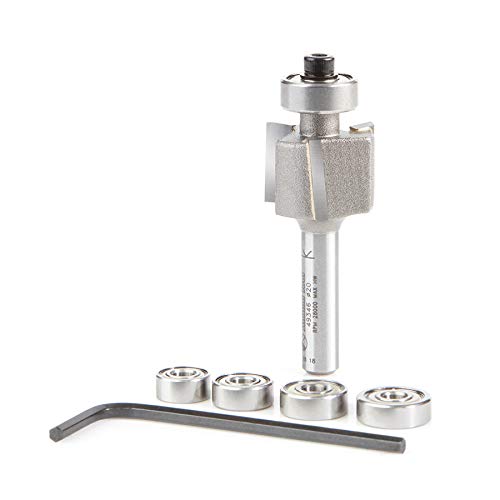
The Amana Tool 49346 is a precisely specified binding and rabbeting cutter rather than a large bearing kit. Its cutter measures 20 mm (51/64 inch) in diameter, with a 13.5 mm (17/32 inch) cutting height, a 1/4-inch shank, and an overall length of 2-1/8 inches. Those dimensions make compatibility easier to assess before the bit ever approaches a guitar body, which is refreshingly concrete in a category full of generic descriptions.
Three flutes distinguish its cutter geometry from the two-cutter Freud flush-trim option below, though flute count alone does not determine the final surface. Router stability, body contour, grain direction, feed control, and depth strategy still matter. The supplied information does not identify a collection of alternate bearings, so buyers requiring many channel offsets should compare package contents carefully. This is the bit for someone who values a documented cutter size and profile, then builds the surrounding setup deliberately.
Pros
- Binding and rabbeting profile directly matches channel-cutting work.
- Documented 20 mm cutter diameter supports careful setup planning.
- 13.5 mm cutting height is clearly identified.
- Three-flute configuration provides a defined cutter arrangement.
- Uses a documented 1/4-inch shank.
Cons
- No multi-size bearing assortment is documented in the supplied package details.
- Its specified dimensions may offer less setup flexibility than a complete binding set.
This Amana bit suits a builder who knows the required cutting geometry and prefers a single, clearly specified cutter. Anyone expecting a ready-made library of channel offsets should favor one of the StewMac sets. Before routing, confirm the bearing arrangement, cutter clearance, and intended ledge on scrap matching the instrument material.
To buy this product, click here.
4. Best Adjustable Alternative: Guitar Binding Router Bit With Bearing Sets

This guitar binding cutter combines a T-cutter profile with interchangeable ball-bearing guides. The bearing follows the body edge while the cutter removes material at a controlled offset, which is the basic mechanical relationship needed for a consistent binding ledge. Swapping bearings allows setup changes for different channel dimensions without replacing the main cutting body, a practical arrangement for repairs and instruments using more than one edge treatment.
The listing positions the tool for channel routing, edge trimming, refinishing preparation, and maintenance work. Those are relevant tasks, but several purchasing details remain unclear in the supplied information. The shank diameter, exact cutter dimensions, individual bearing sizes, and cutting material are not documented here. That means this option demands more pre-purchase verification than the StewMac sets or dimensioned Amana bit. A bearing assortment sounds appealing, but mystery sizes are no help when a binding strip is waiting on the bench.
Pros
- T-cutter profile is intended for binding-channel preparation.
- Ball-bearing guidance follows the instrument edge during routing.
- Interchangeable bearings permit changes in channel offset.
- Suitable applications include binding routing and edge correction.
- Core bit structure remains in place while bearings are changed.
Cons
- Shank diameter and cutter dimensions are not clearly specified.
- The supplied information does not list the individual bearing sizes.
This cutter best fits a buyer who can confirm its dimensions and router compatibility before ordering. It offers the right general mechanism for guitar binding, but the undocumented measurements make it a less confident pick for tightly planned work. Builders who need published bearing choices straight from the package should move toward either StewMac set.
To buy this product, click here.
5. Best for Repair Setups: Guitar Binding Routing Tool With Multiple Bearing Sizes
This T-style binding cutter is paired with interchangeable ball-bearing guides that control the lateral offset from the guitar body. That layout is useful during channel correction or repair, where following an existing contour matters as much as removing fresh material. The listing also describes a rigid shank and balanced cutter profile intended to limit vibration, although it does not provide measured vibration data or the dimensions needed for direct comparison.
Bearing variation supports several binding thickness requirements, and the product is presented for guitar body binding, edge trimming, modification, and new assembly. Compatibility is described broadly for standard router and trim-router collet systems, but “standard” is too loose for a safe purchasing decision. Collets require an exact shank match. Confirm the actual shank diameter, bearing dimensions, cutter clearance, and router limits before installation rather than assuming the bit fits because the tool is compact.
Pros
- T-style cutting profile is intended for guitar binding channels.
- Interchangeable bearings alter the channel offset.
- Bearing contact supports contour-following around instrument edges.
- Listed uses cover installation, correction, repair, and edge trimming.
- One cutter body can support several bearing-guided setups.
Cons
- Exact shank diameter is not provided in the supplied specifications.
- Individual cutter and bearing dimensions are not clearly documented.
Repair work is the strongest case for this model, particularly where a bearing-guided tool must follow an established body shape. Its central trade-off is documentation. Buyers comfortable confirming every critical measurement may find the format useful, while anyone ordering around a fixed binding recipe will appreciate the clearer specifications of the higher-ranked options.
To buy this product, click here.
6. Best for Trimming Installed Binding: Amana Tool 47116 Carbide-Tipped Flush Trim Bit

The Amana Tool 47116 belongs after the binding has been installed, rather than at the beginning of channel routing. It is a carbide-tipped flush-trim bit with a 1/2-inch diameter, 1/2-inch cutting height, 1/4-inch shank, three flutes, and a 2-inch overall length. In a suitable guided setup, that compact cutting section can bring protruding material level with an adjacent reference surface before the final scraping and sanding stages.
Its clearly identified replacement bearing, model 47706, is a welcome maintenance detail. Bearings collect dust and glue residue around binding work, and knowing the replacement part removes some guesswork later. Still, a flush-trim bit does not establish a binding ledge with selectable offsets. Treating it as a substitute for a rabbeting or binding set would confuse two separate operations. It is a finishing-stage companion, and that distinction is the whole story here.
Pros
- Flush-trim profile suits leveling protruding installed binding.
- Compact 1/2-inch cutting height is clearly documented.
- Three-flute cutter uses carbide-tipped cutting edges.
- Documented 1/4-inch shank aids collet matching.
- Replacement bearing model 47706 is identified.
Cons
- It does not provide selectable offsets for cutting the initial binding channel.
- The 1/2-inch cutting height offers less reach than the Freud 50-102.
Choose the Amana 47116 for controlled flush-trimming tasks where its 1/2-inch cutter height matches the work and the bearing can follow a safe reference. Skip it as a primary channel cutter. Thin binding can be unforgiving, so secure the instrument, protect finished surfaces, and leave enough material for careful hand scraping where router access becomes risky.
To buy this product, click here.
7. Best Longer Flush-Trimming Bit: Freud 50-102 Top-Bearing Flush Trim Bit

Freud’s 50-102 offers a 1-inch carbide height, twice the documented cutting height of the compact Amana flush-trim bit. It has a 1/2-inch cutter diameter, 1/2-inch top bearing, two cutters, a 1/4-inch shank, and an overall length of 2-5/8 inches. The top-bearing arrangement follows a template or reference positioned above the cutting section, so the location of that reference must fit the actual trimming setup.
The bit is listed for hardwood, softwood, plywood, and composition materials, and it can run in hand-held or table-mounted routers that meet the necessary fit and operating requirements. Freud’s Perma-Shield coating is another documented feature, though no guitar-specific performance claim should be inferred from it. For binding work, the key question is whether the one-inch cutter and top-bearing layout suit the accessible reference surface. More cutting length is useful only where the setup can control it safely.
Pros
- One-inch carbide height supports longer flush-trimming cuts.
- Top bearing provides template-following guidance above the cutter.
- Documented 1/4-inch shank fits matching collets.
- Suitable materials include hardwood, softwood, plywood, and composites.
- Specified for both hand-held and table-mounted router use.
Cons
- Top-bearing geometry requires a suitable upper reference surface.
- It cannot create selectable binding-channel offsets by itself.
This Freud bit suits builders who need greater trimming reach and have a setup that works with a top bearing. The shorter Amana 47116 may feel more proportionate for compact trimming jobs. Neither should be mistaken for a multi-bearing binding-channel system, so buy this for flush work rather than for establishing the ledge itself.
To buy this product, click here.
8. Best Downcut for Jig-Guided Channels: SpeTool 1/4-Inch Downcut Spiral Router Bit

The SpeTool is a 1/4-inch-diameter downcut spiral bit with a 1-inch cutting length, 1/4-inch shank, and 2-1/2-inch overall length. Downcut geometry pushes cutting action toward the upper surface, a conceptual advantage where preserving a clean visible top edge matters. The listing supports hardwood, softwood, plywood, laminate, oak, and MDF, with use in CNC and hand-held routers equipped with a matching 1/4-inch collet.
This is not a bearing-guided guitar binding cutter. It will not follow a guitar body automatically or establish a ledge from an interchangeable bearing offset. Its place is in a properly constrained jig, template, or CNC operation for straight or programmed channels, inlay work, and related cuts where spiral geometry is useful. Downcut action can pack chips deeper into a groove, so extraction, pass depth, and cutter visibility deserve attention rather than blind enthusiasm for a tidy upper edge.
Pros
- Downcut spiral geometry favors the upper edge of a routed channel.
- Solid dimensions include a 1/4-inch cutter and 1-inch cutting length.
- Documented 1/4-inch shank matches common compatible collets.
- Listed for CNC and hand-held router use.
- Supported materials include hardwood, softwood, plywood, laminate, and MDF.
Cons
- No bearing is provided for following a guitar-body perimeter.
- Downcut geometry can direct chips into the channel rather than lifting them out.
Buy this SpeTool bit for jig-guided channel work where its exact diameter matches the intended cut, rather than as a substitute for a bearing-controlled binding set. It can complement a luthier’s routing kit, particularly for straight purfling or inlay operations, but curved perimeter ledges require a guidance system that the bit itself does not supply.
To buy this product, click here.
9. Best Upcut for Plunge Work: SHARPRO 1/4-Inch Solid-Carbide Spiral Upcut Router Bit

The SHARPRO uses solid-carbide upcut geometry with a 1/4-inch cutter diameter, 1-inch cutting length, 1/4-inch shank, and 2-1/2-inch overall length. Upcut spirals pull chips toward the router, which can help clear a plunging cut or deeper groove. The product is listed for hardwood, softwood, plastic, hand-held routers, and CNC plunging machines, placing it closer to inlay and guided channel work than to freehand perimeter routing.
Manufacturer-supplied details cite a surface roughness below Ra 0.8 micrometers and dimensional error controlled within minus 0.02 mm. Those manufacturing claims describe the tool, but they do not guarantee a clean guitar edge under every routing condition. Upcut action can lift fibers at the visible surface, especially where grain changes direction. A firm template, shallow trial cuts, secure workholding, and a scrap sample remain far more valuable than trusting a specification to rescue a shaky setup.
Pros
- Solid-carbide construction is explicitly documented.
- Upcut geometry assists chip movement away from a plunging groove.
- Uses a 1/4-inch cutter diameter and matching 1/4-inch shank.
- One-inch cutting length supports deeper jig-guided operations.
- Listed for wood, plastic, hand-held routers, and CNC machines.
Cons
- No bearing is included for contour-following binding channels.
- Upcut geometry can pull fibers toward the visible surface of the work.
This SHARPRO bit is the specialized pick for plunging, inlay, and template-guided channels where chip evacuation takes priority. The SpeTool downcut is more appealing when the upper edge is the main concern. For the curved outer ledge of a guitar body, a binding-specific bearing cutter remains the more direct tool.
To buy this product, click here.
Buying Guide
Match the Cutter to the Binding Operation
Start by naming the actual job. Cutting a recessed ledge around the guitar body calls for a binding or rabbeting cutter with controlled offset. Bringing glued binding level with the top or side calls for a flush-trim bit. Routing a straight purfling groove with a template may call for a spiral cutter. One bit can occasionally participate in several stages, but its guidance method determines where it truly belongs.
A builder cutting a perimeter ledge around a shaped acoustic body gains clear value from interchangeable bearings. Someone cleaning excess binding from a flat, accessible reference surface may care more about bearing position and cutter height. That small distinction prevents the classic mistake of buying a sharp, well-made bit that solves the wrong problem.
Understand Bearing Offset
On a bearing-guided binding cutter, the difference between cutter radius and bearing radius determines how far the cutter reaches into the body. A larger bearing generally produces a shallower ledge, while a smaller bearing permits a deeper offset. Use the manufacturer’s documented dimensions and measure the actual binding stack rather than relying on labels alone.
Binding plus purfling can change the required channel width dramatically. Finish layers and glue clearance may affect the final plan as well. Make a test cut in scrap with a similar edge profile, then seat a short piece of the actual binding in the channel. A dry fit that sits properly is much cheaper than repairing an oversized ledge around an instrument.
Verify Shank and Collet Compatibility
A 1/4-inch shank requires a true 1/4-inch collet. Metric collets and fractional-inch shanks are not interchangeable merely because they look close under workshop dust. The StewMac, Amana, Freud, SpeTool, and SHARPRO options reviewed above document 1/4-inch shanks, while the two generic T-cutter listings do not clearly provide the exact diameter in the supplied details.
Insert the bit according to the router manufacturer’s directions and avoid bottoming the shank against the collet bore. Inspect the cutter and bearing, disconnect power before adjustments, and confirm that the router base clears the cutter throughout the planned movement. Tiny ledges still involve a cutter spinning at router speed, so the small scale does not make casual setup harmless.
Account for Arched Tops and Backs
A bearing can follow the side of a guitar while the router base reacts to the top or back. On an arched plate, those two references may shift relative to one another, causing the router to lean and the channel depth to vary. A suitable binding-routing jig or support system can help keep the cutter orientation controlled as the body contour rises and falls.
Flat-bodied instruments present fewer geometric headaches, but cutaways and tight waist curves can still challenge base clearance. Before switching on the router, move the unplugged setup around the entire perimeter and watch for collisions, loss of bearing contact, and unstable support. The awkward spot near the neck joint is a terrible place to discover that a fixture cannot complete the route.
Choose Upcut or Downcut Geometry Deliberately
Downcut spirals push cutting forces toward the top surface and tend to favor that visible edge, but chips can remain in the groove. Upcut spirals lift chips out more readily, while their upward action can disturb surface fibers. Neither geometry automatically produces a flawless channel across every species and grain direction.
For guitar perimeter binding, spiral bits generally need a jig, template, or CNC toolpath because they lack a contour-following bearing. Their strongest role here is supplementary work, such as inlay channels or constrained grooves. Keep that distinction clear and they become useful specialists rather than disappointing replacements for a binding cutter.
Use Controlled Passes and Test Pieces
A full-depth pass can place unnecessary load on the cutter and make grain changes harder to manage. Controlled passes, where the setup permits them, give the operator more time to monitor bearing contact and body support. Follow the router and cutter manufacturers’ operating limits rather than applying one universal depth or speed rule.
Scrap tests should reproduce the real setup as closely as practical, including the same binding stack and a representative edge. Check width, depth, and the way the bearing approaches curves. That dry little rehearsal can feel slow, yet it is faster than filling a ledge that wandered halfway around a guitar.
Best Router Bit for Guitar Binding FAQ
What Type of Router Bit Cuts a Guitar Binding Channel?
A bearing-guided binding or rabbeting cutter is the most direct option for cutting a ledge around a guitar body. The bearing follows the side while the cutter creates an offset channel. Interchangeable bearings are particularly useful because different bearing diameters produce different ledge widths.
Can a Flush-Trim Bit Cut the Initial Binding Ledge?
A standard flush-trim bit follows a reference and cuts the work flush with it, so it does not create the selectable offset normally required for a binding ledge. Its more natural role is trimming installed binding or matching an edge to a template. Use a binding or rabbeting system for the recessed channel.
Is a 1/4-Inch Shank Suitable for Guitar Binding Work?
Many binding cutters use a 1/4-inch shank, including the documented StewMac and Amana options in this roundup. Suitability still depends on the router, collet, bit dimensions, base clearance, and manufacturer limits. Match the shank to an exact 1/4-inch collet rather than an approximately similar metric size.
How Do I Select the Correct Bearing Size?
Measure the combined width of the binding and any purfling layers, then consult the cutter system’s bearing dimensions or channel chart. Confirm the choice with a test cut and dry-fit the actual materials. A labeled bearing should begin the setup process, not replace physical verification.
Can I Route Binding Around an Arched Guitar Top?
Yes, but the router must remain properly oriented while the bearing follows the body and the base moves around the curved plate. A binding-routing jig or other suitable support can help manage that changing geometry. Check the full unplugged travel path before routing, especially around cutaways and neck joints.
Should I Use an Upcut or Downcut Spiral Bit for Binding?
For the main perimeter ledge, a bearing-guided binding cutter is usually the clearer choice. A downcut spiral favors the upper channel edge, while an upcut spiral clears chips toward the router. Both require a suitable guidance method for binding-related channels because neither follows the guitar contour on its own.
How Can I Reduce Tear-Out Near Changing Grain?
Use a sharp, undamaged cutter, secure the body, maintain stable bearing contact, and take controlled passes supported by the tool manufacturer’s directions. Scrap testing helps reveal how the cutter reacts to the material. Grain around guitar curves changes quickly, so slowing the setup process is wiser than attempting an improvised corrective cut.
Do I Still Need to Scrape Binding After Flush Trimming?
Often, yes. Flush trimming can remove the bulk of protruding material, while scraping provides fine control near finished surfaces and delicate curves. Leave a manageable amount for hand refinement rather than trying to make the router perform every final cosmetic step.
Final Verdict
The StewMac Standard Binding Router Bit Set is the best overall recommendation for most guitar builders. Its carbide-tipped 1/4-inch-shank cutter, nine binding-specific bearings, flush bearing, extension bushing, wrench, and instructions form a coherent system for common channel and trimming tasks. It provides meaningful adjustment without the larger inventory of the expanded package, making it a sensible center point for a small lutherie bench.
The StewMac Expanded Set is the premium choice for varied binding and purfling combinations, while the Amana Tool 49346 appeals to buyers wanting a clearly dimensioned three-flute binding/rabbeting bit. Choose the Amana 47116 or Freud 50-102 for flush-trimming rather than initial ledge cutting, and reserve the spiral bits for properly guided specialty channels. Above all, match the cutter profile, bearing arrangement, shank, and fixture to the exact operation, then prove the setup on scrap before that spinning edge meets the guitar.
