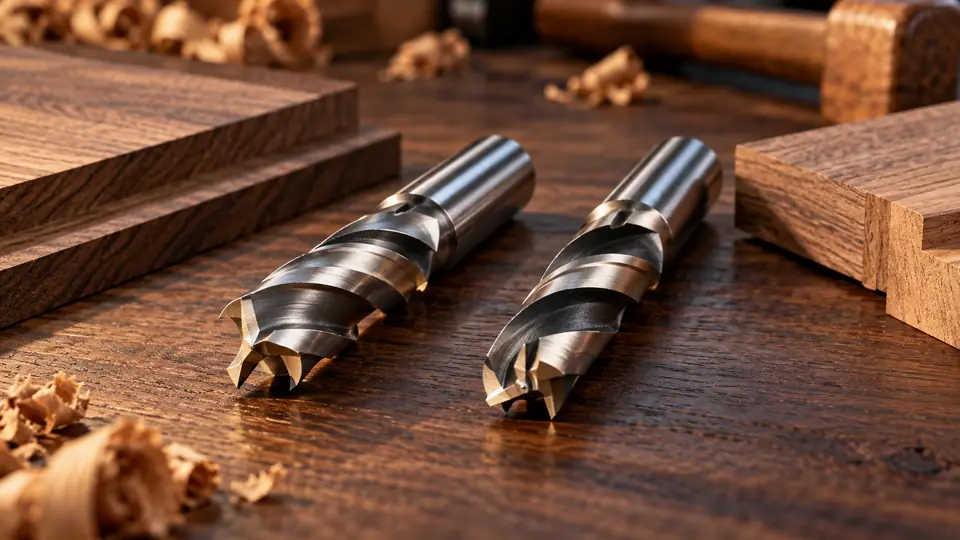
Upcut and downcut router bits use opposing spiral geometries to move chips and cutting forces in different directions. An upcut bit pulls chips upward and away from the cut, which improves evacuation and works well for deep slots, grooves, and pockets. A downcut bit pushes chips downward, helping protect the top surface of plywood, laminate, and other layered materials from tear-out.
Neither design is universally better. The suitable choice depends on the material, the visible surface, the required cutting depth, dust removal, and whether chip evacuation or surface-fiber support matters most.
Upcut and Downcut Router Bits Compared
| Feature | Upcut bit | Downcut bit |
|---|---|---|
| Spiral direction | Moves chips upward | Moves chips downward |
| Main advantage | Efficient chip evacuation | Cleaner top-surface edges |
| Common applications | Deep grooves, pockets, mortises, and CNC-style open cuts | Shallow grooves, dados, lettering, templates, and surface-sensitive cuts |
| Typical limitation | Can increase tear-out on the top face | Can trap chips and generate heat in deep cuts |
| Surface behavior | Often leaves a cleaner lower edge | Often leaves a cleaner upper edge |
| Chip control | Strong chip lifting action | Chips are pressed toward the workpiece |
How an Upcut Router Bit Works
An upcut spiral bit has flutes that pull the chips toward the router. The lifting action clears loose material from the bottom of a groove or pocket and carries it toward the opening. This can reduce chip packing around the cutter, especially when the cut is deep enough that chips cannot easily escape sideways.
Upcut bits are useful for operations such as:
- Cutting deep grooves and slots.
- Routing mortises and pockets.
- Removing material from a cavity.
- Clearing chips from a cut where dust extraction is effective.
- Cutting materials where evacuation is more important than a pristine top edge.
The upward cutting action can lift unsupported surface fibers. On plywood, veneered panels, and solid wood with tear-out-prone grain, this may leave a rougher upper edge. Secure workholding and a suitable feed direction remain important, but they do not change the bit’s basic lifting action.
Advantages of Upcut Bits
- Good chip evacuation from slots and pockets.
- Less tendency to compact chips at the bottom of a deep cut.
- Useful for substantial material removal when the cutter and router are appropriately rated.
- Often easier to clear with dust extraction because chips are lifted toward the collection area.
Limitations of Upcut Bits
- May produce more tear-out on the upper face of layered or splinter-prone materials.
- Can pull a lightly secured workpiece upward or toward the cutter.
- May leave a less clean top edge on plywood and veneered boards.
How a Downcut Router Bit Works
A downcut spiral bit directs chips toward the workpiece. This downward force helps hold surface fibers in place as the cutter passes through the material. It is often useful when the top face is visible and edge quality matters more than rapid chip removal.
Downcut bits are commonly used for:
- Shallow dados and grooves.
- Sign lettering and decorative routing.
- Template routing where the top surface needs support.
- Cutting plywood, laminate, and veneered panels with a visible upper face.
- Operations where a clean top edge is the primary concern.
The same force that supports the top fibers can push chips into the groove. In a deep pocket or enclosed cavity, those chips may restrict the cutter, increase friction, and contribute to heat buildup. A downcut bit therefore requires suitable cutting depth, feed behavior, and chip clearance for the operation.
Advantages of Downcut Bits
- Helps support fibers on the upper surface.
- Can reduce visible top-edge tear-out in plywood and laminated panels.
- May leave clean edges around shallow grooves, lettering, and recesses.
- Can help keep a workpiece pressed against a support surface in some setups.
Limitations of Downcut Bits
- Chips can accumulate in deep or enclosed cuts.
- Dust extraction may be less effective because material is pushed into the work.
- Heat can increase if the cutter becomes packed with chips.
- The lower exit edge may still chip when the cut passes completely through the material.
Which Bit Gives the Cleaner Edge?
The answer depends on which edge is visible and whether the cut is open or enclosed. A downcut bit generally supports the top surface and can produce a cleaner upper edge. An upcut bit generally clears the cut more effectively and may leave a cleaner lower edge.
Neither bit guarantees a tear-out-free result. Grain direction, plywood construction, cutter sharpness, workpiece support, cutting depth, and feed direction all affect the finish. A test cut in scrap from the same material is a reliable way to check the result before routing the finished part.
Routing Plywood and Veneered Panels
For a shallow cut in plywood where the top face is visible, a downcut bit may help reduce splintering on that face. The bit still needs room to clear chips, and the plywood’s veneer quality and internal layers can change the result.
For a deep pocket or enclosed recess in plywood, an upcut bit may evacuate chips more effectively. If the upper edge is prone to splintering, a shallow scoring pass, masking tape, a sacrificial surface, or a different cutter design may help. These methods should be tested on scrap before use on the final panel.
Routing Solid Wood
Solid wood responds strongly to grain direction. An upcut or downcut spiral does not eliminate the need to plan the cut around grain changes. Areas near knots, reversing grain, and unsupported corners may still tear out.
Make lighter passes when substantial material must be removed, keep the workpiece secure, and inspect the bit before use. A dull or resin-coated cutter can produce poor results regardless of spiral direction.
Upcut vs Downcut Bits for Deep Cuts and Pockets
Upcut bits are usually better suited to deep slots and pockets because their flutes lift chips out of the cut. This does not mean an upcut bit should be used at any depth or feed rate. The router, bit, material, and cutter manufacturer’s limits still apply.
Downcut bits can work in deep cuts when the setup provides adequate chip clearance, but their downward action can pack material into the cavity. Watch for rising resistance, burning, unusual noise, or a visible buildup of chips. Stop the router and disconnect power before clearing a packed cut or inspecting the bit.
Substantial material removal should generally be handled with multiple passes appropriate to the bit, router, and material. Do not treat the router’s available plunge travel as a safe single-pass cutting depth.
What Is a Compression Router Bit?
A compression bit combines sections of upcut and downcut geometry. The lower portion may lift chips while the upper portion pushes chips downward. With the correct cutting depth, the opposing forces meet within the material and help protect both faces of a sheet.
Compression bits are especially associated with plywood, laminates, and other sheet goods, but their performance depends on the relationship between the bit’s geometry and the material thickness. If the cut is too shallow or too deep for the compression section, one face may still show tear-out.
A compression bit also does not solve every chip-clearance problem. Follow the bit manufacturer’s intended use and speed limits, and test the actual material before committing to a finished cut.
Feed Direction Still Matters
Upcut and downcut describe the spiral’s axial cutting action. They do not determine the correct feed direction around the workpiece. For ordinary handheld routing, move the router in the conventional direction so the rotating cutter tends to press into the work rather than pull itself along the edge.
The correct movement changes with the routing configuration. Outside-edge routing, inside-edge routing, template work, and router-table operations have different reference points. At a router table, the workpiece moves against the cutter in the conventional feed direction, and the fence and guard must be set for the specific operation.
Climb cutting reverses the normal relationship between cutter rotation and feed. It can make the router self-feed suddenly and cause loss of control. It should not be used as a routine solution for tear-out. If a specialized cut requires it, use a controlled setup based on reliable instructions and adequate workholding.
How to Choose Between an Upcut and Downcut Bit
Use the following practical questions before selecting a spiral bit:
- Which surface must look clean? A downcut bit may better support a visible top face. An upcut bit may better clear a deep cut and protect the lower edge.
- Is the cut shallow or deep? Downcut geometry often suits shallow grooves and recesses. Upcut geometry generally provides better evacuation in deeper pockets.
- Is the material layered? Plywood, laminate, and veneered panels may benefit from downcut or compression geometry, depending on the cut.
- Can chips escape? Enclosed cuts need effective evacuation. A downcut bit can pack chips, while an upcut bit can lift them into the work area.
- Is the workpiece secure? The axial forces from either bit can affect a poorly supported workpiece. Use suitable clamps, a jig, or other secure support.
- Does the bit match the router? Verify the shank size, collet compatibility, cutting diameter, cutting length, and maximum rated speed.
Safe Use of Upcut and Downcut Router Bits
Inspect the bit before installation. Do not use a cutter with a damaged cutting edge, bent shank, damaged bearing, cracked component, or other visible defect. Disconnect a corded router from power before changing bits. For a cordless router, remove the battery according to the manufacturer’s instructions.
- Use the correct collet for the bit shank. A 1/4-inch, 1/2-inch, and 8 mm shank are different sizes and are not automatically interchangeable.
- Insert and tighten the bit according to the router and bit manufacturer’s instructions. Do not bottom out the shank against the end of the collet unless the instructions specifically require it.
- Keep the workpiece firmly supported and secure small pieces with an appropriate jig or fixture.
- Set the router speed within the bit manufacturer’s stated limits. Larger-diameter cutters may require lower speeds.
- Use eye and hearing protection, and use effective dust extraction. MDF and similar sheet goods can produce substantial fine dust.
- Do not reach near a rotating cutter to remove chips or adjust the setup.
- Stop immediately if the router vibrates abnormally, the bit slips, the cut becomes difficult to control, or the cutter shows signs of damage.
Can a Straight Bit Be Upcut or Downcut?
A conventional straight bit has straight flutes rather than a spiral lifting or pressing geometry. It is therefore not classified as an upcut or downcut spiral bit in the same way. Straight bits can still cut grooves, dados, and rabbets, but their chip evacuation and surface-fiber behavior differ from spiral bits.
Bit profile, shank size, cutting diameter, and intended operation must be evaluated separately. A flush-trim bit, pattern bit, round-over bit, or rabbeting bit should not be selected solely because it resembles an upcut or downcut cutter. The bearing position and profile determine how those bits are used.
Frequently Asked Questions
Are downcut router bits better for plywood?
They can produce a cleaner top edge in some plywood cuts because the downward spiral supports the upper veneer fibers. The result depends on plywood quality, cut depth, feed direction, cutter condition, and whether chips can escape. A compression bit may be more suitable when both faces of a sheet need protection and the bit is used at its intended depth.
Are upcut bits better for cutting pockets?
Upcut bits are often useful for pockets because they lift chips out of the cavity. Deep cuts still require suitable passes, workholding, dust collection, and attention to heat and cutter loading.
Can a downcut bit be used for a through-cut?
It can, but the downward cutting action may compress chips and can affect the lower exit edge. A sacrificial backing board may help support the material at the exit, but the setup should be tested first.
Do spiral bits prevent tear-out?
No. Spiral geometry can influence fiber support and chip movement, but grain direction, material construction, feed direction, cutter sharpness, and workpiece support remain significant factors.
Practical Takeaway
Choose an upcut router bit when chip evacuation from a groove, slot, or pocket is the priority. Choose a downcut router bit when supporting the top surface and controlling upper-edge tear-out matters more. For sheet goods where both faces need protection, a properly selected compression bit may offer a useful compromise.
Whichever bit you use, verify its shank and speed compatibility, secure the workpiece, follow the conventional feed direction for the routing configuration, and make a test cut before routing the finished part.
