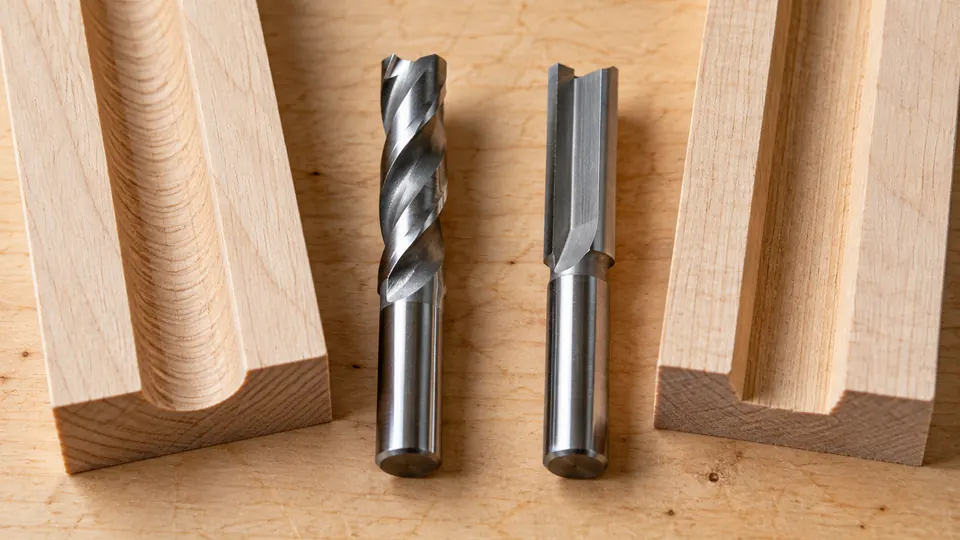
Neither spiral nor straight router bits is universally better. A spiral bit usually provides smoother cutting, better chip evacuation, and cleaner results in plywood and other layered materials. A straight bit is simpler, often less expensive, and well suited to dados, grooves, rabbets, and general-purpose work in solid wood and sheet goods.
The better choice depends on the cut, material, router setup, and finish required. Bit diameter, shank size, cutting length, router speed, feed rate, and workpiece support matter as much as the flute style.
Spiral Bits and Straight Bits Compared
| Feature | Spiral bit | Straight bit |
|---|---|---|
| Cutting action | Helical flutes shear into the material progressively | Flutes cut across the bottom and sides in a more direct action |
| Surface quality | Often produces a cleaner finish with less splintering | Can leave more tear-out, especially in plywood and cross-grain cuts |
| Chip removal | Depends on the upcut, downcut, or compression design | Chips may clear less efficiently, especially in deep cuts |
| Plunge cutting | Generally well suited, particularly with an upcut design | Possible with an appropriate bit, though chip clearing may be less effective |
| Common uses | Template routing, mortises, dados, plywood, MDF, and fine edge work | Dados, grooves, rabbets, mortises, and general stock removal |
| Cost and maintenance | Often more expensive and may require specialized sharpening | Usually simpler to maintain or replace |
How Straight Router Bits Cut
A straight bit has cutting edges arranged parallel to the shank. As the router moves, the edges remove material across the bottom and sides of the cut. Straight bits are available in many diameters and cutting lengths, which makes them useful for common operations such as:
- Cutting dados and grooves
- Routing rabbets
- Trimming material within a guide or jig
- Removing stock in shallow passes
- Cutting mortises with a suitable setup
A straight bit is often a practical choice for a router table or handheld router. Its simple geometry makes it easy to use for routine joinery, provided the bit is sharp, properly installed, and matched to the router’s collet.
Straight bits can produce a good cut in many materials, but the flat-ended cutting action may create more impact and friction than a helical cutter. Tear-out is more likely where the cut crosses changing grain or a plywood face veneer. Deep pockets can also hold chips around the bit, increasing heat and friction.
How Spiral Router Bits Cut
Spiral bits use helical cutting edges that enter the material progressively. This shearing action can reduce the abrupt impact associated with a conventional straight bit. Spiral bits are commonly identified by the direction in which they move chips.
Upcut spiral bits
An upcut bit pulls chips upward and away from the bottom of a dado, groove, mortise, or plunge cut. This improves chip evacuation and can reduce heat buildup in deep or enclosed cuts. Upcut bits are useful for:
- Plunge routing
- Deep dados and grooves
- Mortises
- Template routing where chip removal is important
- Materials that generate substantial chips or dust
The upward cutting action can lift fibers on the top surface. On plywood or veneered panels, this may increase the risk of splintering on the visible face.
For sign lettering, the cutter profile should match the desired line: small spiral cutters can clear grooves, while V-groove bits create angled lettering. Compare these and other options in our guide to router bits for engraving letters.
Downcut spiral bits
A downcut bit pushes chips downward and tends to press surface fibers against the workpiece. This can improve the appearance of the top face, especially during template routing or shallow pocket work.
Downcut bits can pack chips into a groove or pocket because their cutting action does not carry debris upward. Use effective dust extraction and clear chips safely between passes. Never reach near a rotating bit to remove packed material.
Compression spiral bits
A compression bit combines upcut and downcut sections. The geometry is intended to manage fibers on both the top and bottom surfaces of suitable sheet material. Its performance depends on the material thickness and how much of each cutting section is engaged.
A compression bit is not automatically suitable for every plywood panel or cutting depth. Follow the bit manufacturer’s guidance for the intended material and engagement range.
Which Bit Produces the Cleaner Cut?
Spiral bits generally have an advantage where surface quality and tear-out control are priorities. Their shearing action can leave cleaner edges in plywood, MDF, laminates, and some hardwood applications. The result still depends on grain direction, bit sharpness, feed behavior, cutting depth, and workpiece support.
A straight bit can also produce a clean cut. A sharp cutter, shallow passes, proper feed direction, and a sacrificial backing board often make a substantial difference. A dull spiral bit can perform worse than a sharp straight bit.
For plywood, the best flute direction depends on which surface needs protection. An upcut design usually clears chips well but can disturb the top veneer. A downcut design can preserve the top face but may require more attention to chip evacuation. A compression design may be appropriate for through-cuts or specific sheet thicknesses when its geometry is correctly engaged.
Which Bit Is Better for Dados and Grooves?
Both types can cut dados and grooves. A straight bit is often adequate for shallow or moderate-depth joinery, particularly in solid wood. It is also useful when the groove width matches an available bit diameter or when several passes will establish the final width.
An upcut spiral bit can be preferable for deeper dados, mortises, and grooves because it moves chips out of the cut. This can help reduce packing and heat. A downcut bit may be useful where the top surface needs to remain clean, but the setup must provide suitable chip clearance.
For a wide dado, do not assume that one large bit or one aggressive pass is appropriate. Use a guide, fence, or jig that keeps the router stable, and make multiple controlled passes when the operation requires substantial material removal.
Which Bit Is Better for Plunge Routing?
An upcut spiral bit is generally well suited to plunge routing because its flutes lift chips from the entry point. This makes it useful for mortises, stopped grooves, and template-guided openings.
A straight bit can also plunge if its design permits the operation and the router is controlled correctly. Some straight bits have limited bottom-cutting ability, so the manufacturer’s instructions and the cutter geometry matter. Do not assume that every straight bit is intended for plunging.
Start with the workpiece secured, the router base supported, and the cutting depth set appropriately. Deep cuts should usually be made in stages rather than in one aggressive plunge.
Which Bit Is Better for Edge Routing?
For edge profiles such as round-overs and chamfers, use the dedicated profile bit rather than choosing between a straight and spiral bit. Straight and spiral bits are primarily used for removing material, cutting grooves, or following a template.
For flush trimming or pattern routing, a spiral flush-trim or pattern bit can provide a clean shearing cut. A bearing-guided straight cutter can also work well when the bearing and cutter are correctly matched to the template or workpiece. Verify the bearing location, cutting length, and workpiece support before routing.
For hardwood template work, compare our flush-trim router bit picks for hardwood by bearing position, cutter length, and shank size.
Material-Specific Differences
Solid wood
Straight bits perform well for many solid-wood joinery operations. Grain direction has a major effect on tear-out. A spiral bit may provide a smoother edge during cross-grain cuts or template routing, but it does not eliminate the need for correct feed direction and support.
Plywood
Plywood’s alternating veneer layers can expose a straight bit to frequent changes in grain direction. Spiral or compression geometry may reduce splintering, but results vary with plywood grade, veneer quality, bit sharpness, and cutting depth.
MDF and particleboard
These materials can be cut with either bit style when the cutter is appropriate and sharp. MDF creates fine dust, so use effective dust extraction, adequate ventilation, eye protection, hearing protection, and respiratory protection suited to the conditions and manufacturer guidance. Spiral bits may clear chips efficiently, while straight bits may be adequate for shallow cuts and routine joinery.
Plastic and laminate
Plastic and laminate can melt, chip, or crack when cutting conditions generate excessive heat. Bit geometry, material type, router speed, feed rate, and chip removal all matter. Follow guidance for the specific plastic or laminate rather than applying a wood-routing setting automatically.
When trimming a laminate overhang, a flush-trim bit with a suitable bearing can follow the substrate edge. Our guide to the best flush-trim router bits for laminate compares options for that specific task.
Router Compatibility and Setup
Both straight and spiral bits are available for handheld routers and router tables, but the specific cutter must be suitable for the setup. Check these details before installation:
- Shank size: Match the bit shank to a compatible router collet. Common sizes include 1/4 inch, 1/2 inch, and 8 mm in some markets. These sizes are not interchangeable.
- Bit diameter: Confirm that the router, base, table opening, and intended operation can accommodate the cutter.
- Cutting length: Make sure the cutting edges can reach the required depth without excessive exposure.
- Speed rating: Never exceed the bit manufacturer’s maximum RPM. Larger-diameter cutters may require lower speeds.
- Router configuration: Check whether the operation is suitable for a fixed-base router, plunge router, compact router, or table-mounted setup.
- Workholding: Secure the workpiece and provide a stable reference surface, fence, guide, or template where needed.
Disconnect a corded router from power before changing bits. For a cordless router, remove the battery according to the manufacturer’s instructions. Inspect the bit for damage, place the correct shank into the matching collet, follow the required insertion depth, and tighten it using the manufacturer’s procedure. Do not use damaged cutters or improvised shims.
Feed Direction and Safety
For ordinary handheld routing, move the router so the bit’s rotation pushes the tool toward the workpiece rather than pulling it away from the edge. The exact direction depends on whether you are routing an outside edge or the inside of an opening, so establish the viewing position and cutting path before starting.
With a router table, the workpiece moves against the cutter’s rotation. The fence, bit location, and edge being routed determine the correct feed path. Follow the table and router instructions for the specific configuration.
Climb cutting should not be used as the default method. It can cause the router to self-feed and move unexpectedly. Stop the router before making adjustments, keep hands away from the cutter, use eye and hearing protection, manage dust, and stop immediately if the tool vibrates unusually or the bit slips.
Choosing Between a Spiral and Straight Bit
Use a straight bit when the task involves straightforward stock removal, a dado, a groove, or a rabbet and the material does not demand special tear-out control. It is often a sensible general-purpose cutter for routine joinery.
Use a spiral bit when chip evacuation, plunge performance, or surface quality is a higher priority. Select the flute direction according to the surface and material requirements. An upcut bit favors chip removal, a downcut bit favors top-surface fiber control, and a compression bit is intended for specific sheet-material applications.
The practical answer to “Spiral vs Straight Router Bits: Which Is Better?” is therefore task-specific. A sharp, correctly rated bit used with the proper router, feed direction, cutting depth, and workpiece support will usually outperform a theoretically superior bit used in the wrong configuration.
