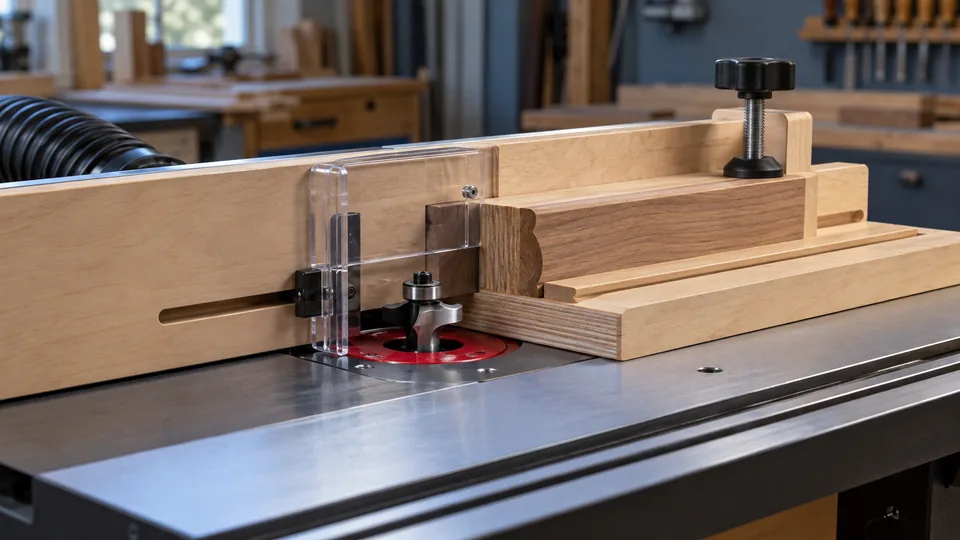
A cope cut across the end of a narrow cabinet-door rail can go sideways in a heartbeat. The router bit tugs at exposed end grain, the short workpiece feels awkward near the cutter, and the trailing corner can splinter with a sharp little crack. A coping sled addresses that sketchy setup by clamping the rail square, supporting its fibers with a sacrificial backer, and giving your hands substantial handles away from the bit.
The most common buying mistake is assuming every sled fits every job. Stock capacity varies from 5-inch rails to broad 10-inch workpieces, while bases range from compact fence-guided platforms to hefty phenolic sleds with adjustable miter bars. Clamp count matters too. One toggle clamp can handle ordinary door rails, while two or three clamps distribute pressure more evenly across wider stock that might otherwise lift or twist.
Different shops have different priorities. A hobbyist making one set of cope-and-stick doors may favor a compact, approachable jig, while a cabinet shop may need a broad base, movable clamps, and support for repeated cuts. The POWERTEC 71765 is the best overall match here because its clear fence guide, two handles, sacrificial block, padded clamp, and practical 5-by-1-1/4-inch capacity cover the jobs most buyers have in mind without swallowing the router table.
Quick Answer
- Best Overall: POWERTEC 71765 Rail Coping Sled combines a clear fence guide, two handles, and a sacrificial block in a manageable package.
- Best Premium: Woodpeckers Router Table Coping Sled uses two repositionable clamps and an adjustable top plate to control lifting.
- Best for Large Stock: Woodhaven 525 Large Coping Sled accepts stock up to 10 inches wide and uses three movable toggle clamps.
- Best Fence-and-Sled Package: POWERTEC 72032 Deluxe Fence and Coping Sled supplies a 24-inch fence system alongside the jig.
Best Coping Sled for Router Table Comparison Table
| Product | Best For | Stock Capacity | Base or Guidance | Clamping |
|---|---|---|---|---|
| POWERTEC 71765 | Most Home Shops | Up to 5 x 1-1/4 inches | Clear fence-guided design | One padded toggle clamp |
| O’SKOOL Rail Coping Sled | Moisture-Resistant Base | Up to 5-1/2 x 1-5/8 inches | Phenolic base | One padded toggle mechanism |
| Rockler Rail Sled | Comfortable Handling | Not clearly specified | Phenolic base and abrasive strip | One lever clamp |
| Woodpeckers Coping Sled | Premium Workpiece Control | Material up to 5-1/2 inches | Clear fence guide | Two movable clamps |
| PRO Rail Guide Coping Sled | Compact Cabinet-Door Work | Up to 5 x 1-1/4 inches | Clear elevated reference fence | One padded toggle clamp |
| Woodhaven 525 Large | Wide Stock and Production Runs | Up to 10 x 1-3/4 inches | 15-3/4-inch phenolic base and miter bar | Three movable 500-pound clamps |
| POWERTEC 72032 Package | Fence-and-Sled Upgrade | Sled capacity not clearly specified | 24-inch aluminum fence system | Sled clamp included |
| Woodhaven 526 | Medium Production Work | Up to 6 x 1-3/4 inches | 1/2-inch phenolic base and miter bar | Two movable 500-pound clamps |
| Woodhaven 528 Small | Compact Heavy-Duty Setup | Up to 6 x 1-3/4 inches | 1/2-inch phenolic base and miter bar | One movable 500-pound clamp |
The detailed reviews below show how those capacities, clamps, and guidance systems affect actual router-table work.
1. POWERTEC 71765 Rail Coping Sled — Best Overall

The POWERTEC 71765 brings together the parts that matter on routine cabinet-door work without turning a short rail into a complicated fixture. Its clear acrylic guide rides against the router-table fence and remains 2 inches above the table. That elevated position helps keep the guide away from the cutter while providing a visible reference for maintaining a parallel path through the cut.
A large rubber-padded foot on the hold-down toggle presses stock against the platform, while fixed and adjustable fences establish the rail’s position. The sled accepts pieces up to 5 inches wide and 1-1/4 inches thick, a useful range for many door rails and drawer fronts. Two substantial handles provide balanced control, and the supplied sacrificial block supports the trailing end grain where a crisp edge is most vulnerable to that telltale splintering snap.
Pros
- Clear acrylic guide tracks against the router-table fence.
- Handles stock up to 5 inches wide and 1-1/4 inches thick.
- Sacrificial block supports the trailing edge during end-grain routing.
- Two handles provide control from both ends of the sled.
- Padded toggle-clamp foot spreads pressure without bare metal contacting the workpiece.
Cons
- The 5-inch width limit is restrictive for broad rails and panel components.
- Its single hold-down clamp provides less distributed pressure than dual-clamp designs.
This model fits furniture makers and home woodworkers producing ordinary cope-and-stick doors, tenons, or drawer fronts. Its central trade-off is capacity: the compact footprint feels sensible on a modest router table, but wide work belongs on a larger Woodhaven sled. For common rails, the feature mix is remarkably practical.
To buy this product, click here.
2. O’SKOOL Rail Coping Sled — Best Phenolic Value
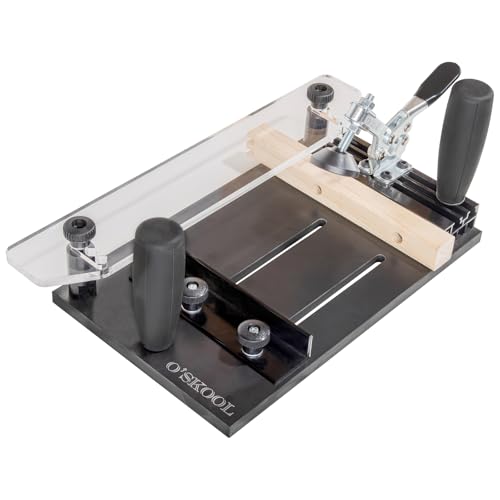
The O’SKOOL takes a welcome step beyond basic MDF construction by using a phenolic base, a material selected here for resistance to moisture, wear, and warping. That matters when a sled lives in a workshop where humidity swings and dusty tabletops are part of the deal. Its stated capacity of 5-1/2 inches wide by 1-5/8 inches thick also edges past the smaller POWERTEC and PRO designs.
The clamping arrangement pairs a quick-acting toggle mechanism with a broad rubber-padded foot. A retaining bracket helps keep the stock from shifting, while the sacrificial fence backs the cut to reduce unsupported fibers at the exit edge. The jig is intended for stile-and-rail joints, raised-panel components, half-lap work, and end-grain profiling such as chamfers or roundovers, so its utility reaches beyond one cabinet-door bit set.
Pros
- Phenolic base resists moisture and workshop wear better than ordinary MDF.
- Accommodates stock up to 5-1/2 inches wide and 1-5/8 inches thick.
- Rubber-padded clamp foot distributes pressure across the workpiece.
- Retaining bracket helps limit lateral movement during the pass.
- Sacrificial fence supports the exit edge to reduce tear-out risk.
Cons
- It uses one main toggle mechanism rather than two independently positioned clamps.
- Specific router-table fence dimensions and mounting requirements are not clearly stated.
Pick the O’SKOOL if you want a compact coping sled with a documented phenolic base and slightly more stock room than typical 5-inch models. It makes particular sense for mixed joinery where rails vary in thickness. Buyers handling long, broad pieces may still prefer the clamping spread and larger platform of a Woodhaven model.
To buy this product, click here.
3. Rockler Rail Sled for Router Table — Best Handling

Rockler’s sled focuses on the physical feel of guiding a narrow rail past a cutter. Tall, round handles offer several comfortable grip angles, which is useful when the router table sits high or the operator approaches from slightly off-center. Beneath the workpiece is a phenolic base intended to slide smoothly, while the lever clamp presses the rail against the fence for a square end-grain pass.
Small workpieces can creep beneath a clamp as cutter pressure builds, so Rockler includes an abrasive strip to add grip where the rail meets the jig. A sacrificial piece backs the exit side, and the package includes fixed and adjustable fences, mounting hardware, spacers, knobs, handles, washers, and a manual. That complete hardware list removes much of the scavenger hunt that can make jig assembly unnecessarily fiddly.
Pros
- Tall round handles support several comfortable hand positions.
- Phenolic base supplies a smooth, stable sliding surface.
- Abrasive strip helps resist workpiece wandering beneath the clamp.
- Replaceable sacrificial piece supports vulnerable end grain.
- Package includes the fences, clamp, handles, fasteners, and assembly hardware.
Cons
- Maximum supported workpiece width and thickness are not clearly specified.
- One lever clamp offers less pressure distribution than two-clamp premium sleds.
The Rockler is a compelling fit for cope-and-stick door rails and narrow drawer-front components where grip comfort and stock retention take priority. Its undocumented capacity makes it less straightforward for unusually thick or broad pieces, so buyers with oversized stock should choose a sled with explicit limits. For ordinary rails, the abrasive strip is a small but thoughtful touch.
To buy this product, click here.
4. Woodpeckers Router Table Coping Sled — Best Premium

The Woodpeckers design handles the lifting problem differently from common single-toggle sleds. Its slotted top plate traps the board between the plate and fence, while two clamps can move toward the center of the workpiece. That arrangement spreads restraint across the rail instead of concentrating pressure at one point, an appealing setup for stock that wants to tip as the cutter engages.
A transparent guide runs along the router-table fence, so the sled does not depend on a miter slot for tracking. That is useful on tables where the slot sits too far from the cutter or is absent altogether. Adjustment supports material up to 5-1/2 inches, although the supplied information does not clearly identify whether that figure represents width, thickness, or another setup dimension. This USA-made jig commands premium consideration primarily through its two-clamp, top-plate architecture.
Pros
- Two clamps can move toward the workpiece center to oppose lifting.
- Adjustable top plate traps the board against the fence.
- Clear guide follows the fence without depending on a miter slot.
- Slotted plate accommodates changes in workpiece setup.
- Made in the USA.
Cons
- The meaning of the stated 5-1/2-inch material adjustment is not fully detailed.
- Its more elaborate dual-clamp construction may be excessive for occasional narrow-rail work.
This sled suits buyers who prioritize distributed clamping and who regularly encounter rails that lift under a single toggle foot. The top plate introduces more setup than a basic clamp-and-backer jig, but that additional restraint is the reason to buy it. A casual user making a few conventional doors may find the POWERTEC 71765 simpler.
To buy this product, click here.
5. PRO Rail Guide Coping Sled — Best Compact Alternative

The PRO Rail Guide follows a familiar and sensible formula: hold the stock at 90 degrees, ride a clear reference fence along the router-table fence, and back the cut with a replaceable sacrificial block. Its elevated acrylic guide provides a visible reference while helping keep the sled structure away from the spinning cutter. For rail-and-stile doors and drawer fronts, that direct layout keeps setup approachable.
Its maximum stock size is 5 inches wide by 1-1/4 inches thick, matching the compact capacity of the leading POWERTEC. Rubber-grip handles give each hand a defined control point, and a heavy-duty toggle with a padded foot secures the rail without placing an exposed metal pad on the face. Full instructions are included, a modest detail that becomes valuable when squaring the adjustable parts before the first cut.
Pros
- Clear elevated guide maintains contact with the router-table fence.
- Holds stock at 90 degrees for square end-grain presentation.
- Rubber-grip handles provide two controlled contact points.
- Sacrificial block supports the trailing edge of the cut.
- Includes a padded toggle clamp and setup instructions.
Cons
- Capacity stops at 5 inches wide and 1-1/4 inches thick.
- One hold-down clamp cannot distribute pressure as broadly as a dual-clamp sled.
The PRO model makes sense for hobby furniture builders whose work stays within conventional rail dimensions and who prefer a clear fence-guided jig. Its benefits closely resemble those of the POWERTEC 71765, so the buying decision rests largely on availability and the exact package description at purchase. Neither is the right platform for broad panels or unusually thick stock.
To buy this product, click here.
6. Woodhaven 525 Large Coping Sled — Best for Large Stock

Once workpiece width climbs beyond ordinary door rails, the Woodhaven 525 enters territory the compact jigs cannot touch. It holds stock up to 10 inches wide and 1-3/4 inches thick against a 24-inch Ultra Track fence. The platform is a broad 15-3/4-by-15-3/4-inch slab of 1/2-inch phenolic material, giving wide components far more support before and after they meet the cutter.
Three movable toggle clamps, each rated at 500 pounds, can be positioned along the track to suit different stock widths. One sits outboard and two sit inboard, allowing pressure to be arranged where a large workpiece needs it. The sled can follow the fence or use its adjustable 3/4-inch steel miter bar, which has six mounting positions. Optional risers increase thickness capacity, but those components are separate purchases.
Pros
- Accepts stock up to 10 inches wide and 1-3/4 inches thick.
- Three movable 500-pound toggle clamps distribute restraint across wide work.
- Large 1/2-inch phenolic base supports substantial components.
- Can operate against the fence or with the adjustable steel miter bar.
- Made in the USA and covered by Woodhaven’s lifetime defect guarantee.
Cons
- The 15-3/4-inch-square base consumes considerable router-table space.
- Risers and the optional flip stop require separate purchases.
The 525 is aimed at wide cabinet parts and repeated shop work rather than occasional 2-inch rails. Its size and three-clamp system bring welcome control to broad stock, yet they add bulk that makes little sense on a compact benchtop table. Check the available table area and miter-slot arrangement before choosing this heavyweight option.
To buy this product, click here.
7. POWERTEC 72032 Deluxe Router Table Fence and Coping Sled — Best Complete Upgrade

This package takes a broader approach by pairing the coping sled with a 24-inch router-table fence. That can solve two setup problems at once if the existing fence is short, awkward, or lacks useful accessory tracks. The anodized aluminum extrusion has T-slots on the front and top, while melamine-laminated MDF faces can be adjusted for vertical jointing operations.
The fence package includes an adjustable bit guard, featherboard, reversible flip stop, right-to-left measuring tape, and rear dust port for a 2.5-inch-ID hose. Its mounting-slot range runs from 18-1/8 to 23-3/8 inches, so buyers should measure their table before ordering rather than relying on a broad compatibility statement. The included rail coping sled completes the setup, although its exact stock capacity is not specified in the supplied package details.
Pros
- Combines a rail coping sled with a 24-inch router-table fence.
- Anodized aluminum fence includes front and top T-slots.
- Package supplies a featherboard, bit guard, flip stop, and measuring tape.
- Rear dust port accepts a 2.5-inch-ID hose connection.
- Adjustable MDF faces support fence alignment and vertical jointing setups.
Cons
- The 18-1/8 to 23-3/8-inch mounting range requires careful table measurement.
- The sled’s maximum supported stock dimensions are not clearly specified.
Choose this package if both the fence and coping setup need attention. It offers little advantage to someone who already owns a rigid, well-equipped fence, but it can make sense on a homemade or basic table needing tracks, dust connection, work control, and a sled in one purchase. Table mounting is the decisive compatibility check.
To buy this product, click here.
8. Woodhaven 526 Coping Sled — Best Medium Production Sled

The Woodhaven 526 occupies the useful middle ground between a compact single-clamp jig and the massive 525. It holds stock up to 6 inches wide and 1-3/4 inches thick against a 12-inch Ultra Track fence. Its 1/2-inch phenolic base measures 11-5/8 by 11-3/4 inches, providing noticeably more support than a narrow rail sled without taking over the entire tabletop.
Two inboard toggle clamps, rated at 500 pounds each, can slide along the track to place pressure where the workpiece needs it. The adjustable 3/4-inch steel miter bar offers six mounting positions and can be removed for fence-guided use on a router table or shaper. Optional risers extend the thickness capacity to 2-3/4 inches, although one riser is required for each clamp.
Pros
- Handles stock up to 6 inches wide and 1-3/4 inches thick.
- Two movable clamps distribute pressure across the workpiece.
- Substantial 1/2-inch phenolic base supports repeated setups.
- Works with its adjustable miter bar or directly against the fence.
- Backed by Woodhaven’s lifetime guarantee against material or workmanship defects.
Cons
- Optional risers are needed for stock thicker than 1-3/4 inches.
- Its larger base requires more clear tabletop area than compact fence-guided sleds.
The 526 fits cabinetmakers who need stronger, more distributed clamping than a basic toggle jig supplies but rarely handle 10-inch stock. It is easier to accommodate than the 525 and more controlled across wider rails than the single-clamp 528. Measure the router table first, particularly if the fence and miter slot leave a narrow working corridor.
To buy this product, click here.
9. Woodhaven 528 Small Coping Sled — Best Compact Heavy-Duty Sled

The Woodhaven 528 pares the company’s track-based platform down to a 7-5/8-by-11-5/8-inch phenolic base. Despite that compact footprint, it supports stock up to 6 inches wide and 1-3/4 inches thick, exceeding the stated limits of several lightweight rail sleds. A 12-inch Ultra Track fence carries one movable inboard toggle clamp rated at 500 pounds.
Like the larger Woodhaven models, the 528 can work against the router-table fence or follow an adjustable 3/4-inch steel miter bar. Six bar-mounting positions provide flexibility in relation to the cutter and table layout. Two feed handles keep the operator’s grip on the fixture, while the 1/2-inch phenolic platform supplies a rigid surface beneath the rail. It is a tidy arrangement for shops wanting Woodhaven’s system without the broad 526 or 525 base.
Pros
- Compact 7-5/8-by-11-5/8-inch base conserves tabletop space.
- Supports stock up to 6 inches wide and 1-3/4 inches thick.
- Movable 500-pound toggle clamp adjusts along the 12-inch track.
- Can track from the fence or the adjustable steel miter bar.
- Made in the USA with a lifetime defect guarantee.
Cons
- One clamp provides less pressure distribution than the Woodhaven 526 or 525.
- The adjustable miter bar still requires a suitable table slot when used in that mode.
The 528 suits small shops that want a thick phenolic base, explicit capacity, and flexible guidance without committing space to a large production sled. Its single clamp is the compromise. Wide or lift-prone work favors the 526, while conventional rails that fit beneath one clamp pair nicely with this smaller platform.
To buy this product, click here.
Buying Guide
Match Capacity to the Actual Workpiece
Measure rail width and thickness before comparing any other feature. A sled rated for 5-by-1-1/4-inch stock may cover ordinary cabinet-door rails, but it cannot safely accommodate a broad component by wishful thinking. For wider work, the Woodhaven 526 reaches 6 inches and the 525 reaches 10 inches, with larger bases to support those dimensions. Leave room for the clamp foot and backer rather than treating the stated maximum as a comfortable everyday setup.
Choose Between Fence and Miter-Slot Guidance
A clear acrylic guide riding along the router-table fence is simple and avoids dependence on the miter slot. This can be especially handy when the slot is poorly positioned relative to the bit. An adjustable miter bar offers another controlled reference, but its fit matters. Slop can let the sled yaw, while an incompatible slot stops the setup cold. Woodhaven’s models support both approaches, whereas the compact POWERTEC, PRO, and Woodpeckers designs emphasize fence guidance.
Pay Attention to Clamp Placement
Clamp count alone tells only part of the story. A single padded toggle is quick and perfectly sensible for many narrow rails, provided the foot lands over a stable portion of the workpiece. Two movable clamps can press nearer the center and edges, reducing the tendency of wider stock to lift. Three clamps, as fitted to the Woodhaven 525, become useful across broad pieces where pressure at one point would leave another area free to chatter or shift.
Do Not Skip the Sacrificial Backer
The cutter exits through fragile end grain, and those final fibers need support. A sacrificial block or fence sits tight behind the workpiece so the bit enters expendable material rather than bursting into open air. Replace the backer once repeated profiles leave a ragged opening. A chewed-up block can no longer provide close support, which defeats one of the main reasons for using a coping sled.
Check Table Space and Cutter Clearance
A 15-3/4-inch-square sled offers generous support, but it also needs a large, unobstructed path before and after the cutter. Check the distance among the bit, fence, tabletop edge, and nearby controls. The jig must pass without its handles, clamps, or base colliding with the fence hardware. Clear elevated guides help avoid the cutting zone, yet setup still requires a manual rotation check with the router disconnected from power.
Evaluate the Handles and Feed Position
Two handles let the user apply forward motion while keeping downward and fence-directed pressure on the fixture. Their placement should feel natural from the operator’s side of the table, with both hands well away from the bit. Taller round handles, such as Rockler’s, accommodate varied grip angles. Handles do not make a poor setup safe, so the workpiece still needs firm clamping, full support, and a controlled feed.
Confirm Fence-Package Compatibility
A fence-and-sled bundle can refresh a basic table, but mounting dimensions deserve careful scrutiny. The POWERTEC 72032 specifies an 18-1/8 to 23-3/8-inch slot range and a 2.5-inch-ID dust connection. Those measurements should match the table and extraction hose before purchase. A package with extra tracks and accessories loses its appeal if the fence cannot mount squarely or travel through the required adjustment range.
Best Coping Sled for Router Table FAQ
What Does a Router-Table Coping Sled Do?
It holds a short workpiece square while guiding its end past a router bit. The fixture provides a larger, more manageable surface than the rail alone, moves the operator’s hands away from the cutter, and usually carries a sacrificial backer that supports the exit fibers. Common uses include cope-and-stick door rails, drawer-front parts, tenons, half-laps, and other end-grain profiles supported by the particular setup.
Does a Coping Sled Prevent All Tear-Out?
No. A close-fitting sacrificial backer can greatly improve support at the trailing edge, but cutter condition, grain, stock security, feed, and setup still affect the result. Replace a badly cut backer and inspect the bit before work. Test the complete setup on scrap of the same thickness and material whenever possible.
Does the Sled Need to Use the Miter Slot?
No. Many coping sleds ride directly against the router-table fence through a clear or fixed guide. Some Woodhaven models can use either their adjustable miter bar or the fence. Fence guidance is useful where no suitable slot exists, while a miter bar may provide another reference on a table built to accept it.
How Many Clamps Should a Coping Sled Have?
One properly positioned toggle clamp is usually adequate for narrow stock within the jig’s documented capacity. Wider pieces can benefit from two clamps because pressure spreads across more of the workpiece. Three movable clamps make the most sense on a large platform such as the Woodhaven 525, where a broad board may need restraint at several points.
Can a Coping Sled Work With Any Router-Table Fence?
Universal fit should never be assumed. The guide needs a suitable fence surface, enough vertical clearance, and an unobstructed path past the cutter. Miter-guided sleds also require an appropriate slot. Measure the table, inspect the intended travel, and follow the jig and router-table manuals before routing.
Why Are Phenolic Bases Common on Premium Sleds?
Phenolic material offers a rigid, smooth platform and resists workshop moisture better than ordinary MDF. That makes it attractive beneath strong clamps and across repeated setups. Base material still does not establish accuracy by itself. The fence, clamp position, guide fit, and initial squaring procedure remain critical.
Can a Coping Sled Be Used for More Than Cabinet Doors?
Yes, provided the operation and stock fit the jig. Supplied applications include drawer fronts, tenons, half-lap joints, raised-panel components, chamfers, roundovers, and other end-grain profiles. Cutter clearance and router-table instructions still govern each operation, and a sled should never be used beyond its documented stock capacity.
What Safety Steps Matter During Setup?
Disconnect router power while installing the cutter, adjusting the fence, or checking clearance. Inspect the bit, use the correct collet, respect the cutter manufacturer’s speed limits, and clamp the work securely against the jig’s reference surfaces. Wear eye and hearing protection, manage dust, and make a controlled trial pass in scrap before committing a finished rail.
Final Verdict
The POWERTEC 71765 Rail Coping Sled is the strongest general-purpose recommendation among these nine picks. Its 5-by-1-1/4-inch capacity suits many cabinet-door rails, while the clear fence guide, two handles, padded toggle clamp, adjustable fence, and sacrificial block address the core demands of end-grain routing without creating a giant fixture. Buyers should step up in size if their stock routinely exceeds those limits.
For premium distributed clamping, the Woodpeckers sled uses two movable clamps and an adjustable top plate. The Woodhaven 525 is the clear large-stock option, while the compact 528 brings a 1/2-inch phenolic base and 6-inch capacity to smaller tables. Measure the workpiece, tabletop clearance, fence, and miter slot before deciding. A coping sled works best when its guidance method and clamping range match the setup precisely.
