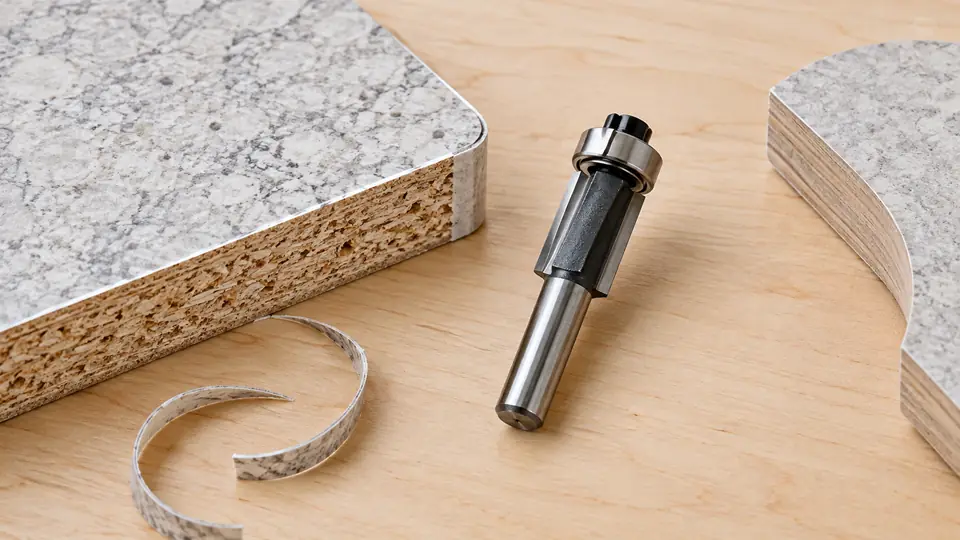
A laminate edge can look crisp from across the room yet reveal every tiny wobble the moment light skims across it. The flush-trim bit controls that final hairline where plastic laminate meets the substrate, so cutter diameter, cutting length, pilot style, and bearing placement matter far more than flashy packaging. A short 1/2-inch cutter is nimble around countertop edges, while a 1-inch cutter reaches deeper work and demands more careful setup.
One common mistake is buying by shank size alone. A 1/4-inch shank may fit a laminate trimmer, but the cutter still needs enough length to cover the overhang without burying the bearing or rubbing the collet against the work. Bearing-guided bits are intuitive because the bearing rides the substrate or template, while self-piloting bits remove the bearing and suit thin plastic laminate particularly well. Top-and-bottom-bearing models add another layer of flexibility for template routing and changing grain direction.
Different shops need different answers. A countertop installer may favor a compact laminate-specific cutter, while a template maker may need longer reach and bearing access from either face. The Freud 42-100 takes the top spot here because its 3/8-inch diameter, 1-inch carbide height, matching bearing, and 1/4-inch shank create a practical balance for laminate, plywood, composition material, and wood projects without becoming bulky.
Quick Answer
- Best overall: Freud 42-100 pairs a 1-inch cutting height with a compact 3/8-inch diameter and matching bearing.
- Best for thin plastic laminate: Freud 64-100 uses a self-piloting solid-carbide design that requires no bearing.
- Best dual-bearing option: Freud 50-501 supports top-guided and bottom-guided trimming with one cutter.
- Best short laminate cutter: Whiteside 2401 offers a 3/8-inch cutter and 1/2-inch cutting length in a compact package.
Best Flush Trim Router Bit For Laminate Comparison Table
| Product | Best For | Shank | Cutter | Guide Style |
|---|---|---|---|---|
| Freud 42-100 | Overall laminate and general flush trimming | 1/4 inch | 3/8-inch diameter, 1-inch carbide height | 3/8-inch bearing |
| Freud 64-100 | Thin plastic laminate | 1/4 inch | 1/4-inch solid carbide | Self-piloting tip |
| Freud 50-501 | Changing bearing position | 1/4 inch | 1/2-inch diameter, two cutters | Top and bottom bearings |
| CMT 807.128.11 | Plastic and aluminum laminate | 1/4 inch | 1/2-inch diameter and cutting length | Delrin bearing |
| Whiteside 2401 | Short laminate edges and templates | 1/4 inch | 3/8-inch diameter, 1/2-inch length | B1 bearing |
| BOSCH 85268MC | Deeper edge trimming | Not clearly specified | 3/8-inch diameter, 1-inch length | Not clearly specified |
| YONICO 14146q | Compact 1/2-inch cuts | 1/4 inch | 1/2-inch diameter and cutting length | Pattern-style guide |
| Wolfride 4PCS Set | Multiple cutter diameters | 1/4 inch | 1/4, 5/16, 3/8, and 1/2 inch | Top bearings |
| UTRUSTTO 4-Piece Set | Multiple cutting heights | 1/4 inch | Four diameters and cutting heights | Top bearings |
The reviews below explain how those dimensions and guide arrangements affect real routing jobs.
1. Freud 42-100 3/8-Inch Bearing Flush Trim Bit — Best Overall
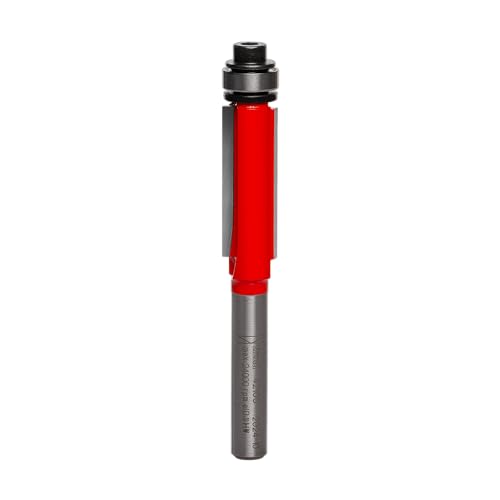
The Freud 42-100 hits a useful middle ground between tiny laminate-only cutters and chunky pattern bits. Its 3/8-inch cutter and matching bearing can trace a substrate edge without removing an unnecessarily wide bite, while the 1-inch carbide height covers thicker assemblies than the short 1/2-inch bits farther down this list. The 1/4-inch shank also fits the collet size commonly found on compact laminate trimmers, provided the router manufacturer supports the bit’s dimensions.
Two cutters handle material ranging from composition board and plywood to hardwood and softwood, which makes this model useful after the countertop job is finished. Freud specifies handheld and table-mounted router use, and the Perma-SHIELD coating addresses pitch and heat buildup. That broad material range is the real attraction. A shop can trim laminate one day and follow a template through plywood the next without reaching for a completely different profile.
Pros
- One-inch carbide height covers deeper edges than many compact laminate bits.
- Matching 3/8-inch bearing provides a clear reference for flush trimming.
- Quarter-inch shank suits routers equipped with a compatible 1/4-inch collet.
- Specified for composition materials, plywood, hardwood, and softwood.
- Suitable for handheld and table-mounted router configurations.
Cons
- The 1-inch cutting height is more cutter than thin laminate alone requires.
- A single bearing position offers less routing flexibility than a dual-bearing bit.
This is the sensible pick for someone who wants one bearing-guided bit to handle laminate plus routine pattern and edge work. Buyers dealing exclusively with very thin plastic laminate may prefer the slimmer Freud 64-100, while projects requiring access from either face point toward the Freud 50-501.
To buy this product, click here.
2. Freud 64-100 Solid Carbide Flush Trim Bit — Best For Thin Plastic Laminate

The Freud 64-100 approaches laminate trimming with a self-piloting tip rather than a separate bearing. That makes the business end slim and simple, with no bearing to collect adhesive residue or eventually require replacement. Its 1/4-inch diameter and 1/4-inch shank fit the compact character of countertop and cabinet laminate work, where a large cutter can feel clumsy beside a thin overhanging sheet.
This is a solid micrograin-carbide bit rated for a maximum of 24,000 RPM, rather than a steel-bodied cutter carrying brazed carbide edges. Freud adds its Black I.C.E. coating, which is intended to limit heat and resin buildup while helping chips clear the cut. The listing supports handheld and table-mounted routers, but the self-piloting layout remains most compelling for controlled plastic-laminate trimming where the tip can reference the underlying edge.
Pros
- Self-piloting tip eliminates the separate guide bearing.
- Solid-carbide construction keeps the cutter compact.
- Quarter-inch cutting diameter is well suited to thin laminate overhangs.
- Black I.C.E. coating addresses heat and residue buildup.
- Documented maximum speed of 24,000 RPM supports clear setup checks.
Cons
- The pilot lacks the rolling contact provided by a bearing-guided bit.
- Its laminate-focused geometry is less flexible than a longer general-purpose flush-trim cutter.
Choose this Freud if plastic laminate is the main job and a bearing feels like needless hardware. Careful setup still matters because the pilot contacts the reference edge directly. For templates, thicker stock, or general woodworking, the bearing-guided Freud 42-100 provides a broader range of documented applications.
To buy this product, click here.
3. Freud 50-501 Top And Bottom Bearing Flush Trim Bit — Best Dual-Bearing Bit
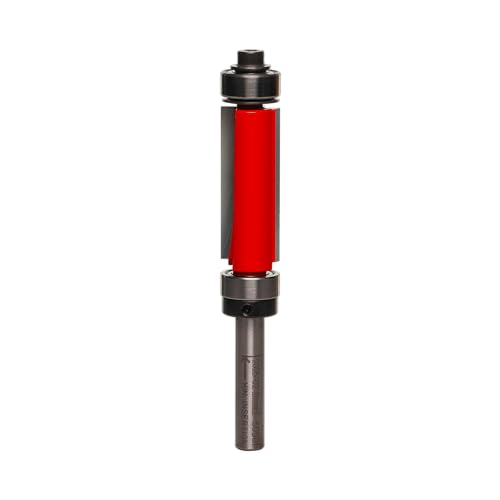
A bearing at each end changes how a flush-trim bit can approach the work. The Freud 50-501 lets the operator reference a pattern or finished edge from above or below, depending on how the workpiece, template, and router are arranged. Its 1/2-inch cutting diameter and 1/4-inch shank make it relevant to laminate trimmers as well as compatible handheld and table-mounted routers.
The practical payoff appears on curved patterns and grain-sensitive work. Freud describes routing part of a curve in one direction, flipping the workpiece, and completing the remaining section from the opposite direction without moving the pattern. The bit uses two TiCo high-density carbide cutters and is rated to a maximum of 24,000 RPM. Supported materials include plastic laminate, veneered plywood, hardwood, and softwood, so its usefulness stretches well beyond a single counter edge.
Pros
- Top and bottom bearings support two template-reference positions.
- Useful for reversing the routing approach around curved patterns.
- Quarter-inch shank fits a compatible 1/4-inch collet.
- Two-cutter, 1/2-inch-diameter configuration suits flush and pattern work.
- Documented for laminate, veneered plywood, hardwood, and softwood.
Cons
- Dual-bearing construction is unnecessary for basic straight countertop trimming.
- The supplied information does not state the cutting length.
This model makes sense for a user who regularly switches between laminate edging and template duplication. Its central trade-off is complexity versus access: two bearings offer more setup choices, but a short single-bearing bit is simpler for repetitive, thin laminate work along an exposed edge.
To buy this product, click here.
4. CMT 807.128.11 3-In-1 Flush Trim Bit — Best For Laminate Surfaces

The CMT 807.128.11 is built around a short, sturdy 1/2-inch cutting diameter and 1/2-inch cutting length. Those proportions make sense where the cutter needs to remove a narrow laminate overhang rather than plunge through a thick template stack. Its overall length is 2-9/64 inches, and the 1/4-inch shank keeps it compatible with routers carrying the matching collet.
The unusual detail is the Delrin bearing. CMT describes it as non-freezing and intended to reduce the risk of bearing failure without damaging the work surface, a useful consideration when that tiny rolling guide is skimming a visible laminate face. Two SinterHip industrial chrome-carbide edges perform the cutting, while the orange coating addresses material adhesion on the steel body. The supplied applications include plastic laminate and aluminum laminate, giving this bit a more surface-focused identity than broader wood-pattern cutters.
Pros
- Half-inch cutting length is proportioned for thin laminate trimming.
- Delrin bearing is intended to reduce freezing and surface damage.
- Two carbide cutting edges provide a conventional double-flute layout.
- Quarter-inch shank works with a correctly sized collet.
- Specified for plastic laminate and aluminum laminate.
Cons
- The short cutting length is unsuitable for edges thicker than its 1/2-inch reach.
- A 1/2-inch cutter is wider than the compact 1/4-inch Freud self-piloting bit.
The CMT is aimed at buyers who care about how the guide contacts a finished laminate face. It is particularly relevant to short edge work in plastic or aluminum laminate, while deeper wood templates call for a longer cutter such as the Freud 42-100 or BOSCH 85268MC.
To buy this product, click here.
5. Whiteside 2401 Two-Flute Laminate Flush Trim Bit — Best Compact Bearing-Guided Bit

At 2-1/8 inches overall, the Whiteside 2401 keeps its proportions tidy. The 3/8-inch cutting diameter sits between the slim Freud 64-100 and the broader 1/2-inch cutters, while the 1/2-inch cutting length targets laminate, veneer, and other relatively shallow trimming jobs. A B1 bearing is included to guide the two-flute cutter along the reference surface.
The bit combines a steel shank and body with carbide cutting edges, balancing body rigidity with replaceable-edge construction rather than using one solid-carbide blank. Whiteside also identifies template following and shape duplication among its uses, including router-table work where the template is positioned above the workpiece. That gives this compact cutter a useful second life after the laminate edges are flush.
Pros
- Compact 2-1/8-inch overall length suits shallow edge work.
- Three-eighths-inch cutter limits the width of material engaged.
- Included B1 bearing guides flush and template cuts.
- Carbide-tipped, two-flute construction is clearly documented.
- Specified for laminate, veneer, templates, and pattern work.
Cons
- The 1/2-inch cutting length cannot cover deeper edges.
- Its single bearing position lacks the access options of the Freud 50-501.
This Whiteside fits a shop that wants a short bearing-guided laminate bit with enough scope for small template jobs. The limited cutting length is part of its appeal around thin material, yet it becomes the firm boundary once substrate and template thickness grow beyond that reach.
To buy this product, click here.
6. BOSCH 85268MC Carbide-Tipped Double-Flute Flush Trim Bit — Best For Deeper Trimming

The BOSCH 85268MC combines a 3/8-inch cutting diameter with a 1-inch cutting length, a practical shape for reaching past thin laminate and into deeper flush-trimming work. BOSCH identifies it as a carbide-tipped, double-flute bit intended for fast, accurate trim cuts. The narrow diameter keeps the profile more compact than a 1/2-inch cutter while retaining the same cutting reach as the top-ranked Freud 42-100.
Micrograin carbide is the highlighted edge material, with wear resistance and reduced chatter among the manufacturer’s stated benefits. Still, some setup details remain unclear in the supplied information. The shank diameter, bearing arrangement, overall length, and maximum RPM are not stated here, so buyers should confirm those specifications against their router and intended operating speed before ordering.
Pros
- One-inch cutting length reaches beyond short laminate-only cutters.
- Three-eighths-inch diameter keeps the cutting profile relatively compact.
- Double-flute layout is documented for trim cutting.
- Carbide-tipped edges provide a wear-resistant cutting material.
- Micrograin construction is intended to reduce chatter during trimming.
Cons
- The supplied specifications do not identify the shank diameter.
- Bearing details and maximum RPM are not clearly specified.
This BOSCH option suits buyers who need a 1-inch cutter and are prepared to verify collet and bearing details before purchase. The Freud 42-100 publishes a fuller dimensional picture, while the BOSCH remains attractive where its 3/8-by-1-inch cutter geometry matches the job.
To buy this product, click here.
7. YONICO 14146q Laminate Flush Trim Pattern Bit — Best Straightforward Short Cutter

The YONICO 14146q keeps its key dimensions easy to parse: a 1/2-inch cutting diameter, 1/2-inch cutting length, 1/4-inch shank, and 2-5/16-inch overall length. That compact geometry suits laminate layers projecting beyond a substrate edge, provided the overhang and reference setup fit within the half-inch cutting reach.
Its cutting edges use C3 micrograin tungsten carbide, attached with silver induction brazing. The manufacturer supports use in handheld and table-mounted routers, so the bit can move between edge trimming and pattern work where the setup permits. Compared with the similarly sized CMT, the YONICO emphasizes conventional carbide construction rather than a Delrin bearing, making the decision largely about guide design and documented material needs.
Pros
- Clear 1/2-inch cutter diameter and cutting-length specifications.
- Quarter-inch shank fits routers with a matching collet.
- Compact 2-5/16-inch overall length keeps the assembly manageable.
- C3 micrograin tungsten-carbide edges are explicitly documented.
- Supported for handheld and table-mounted router use.
Cons
- The 1/2-inch cutting length limits work on thicker edges.
- The supplied details do not specify a maximum RPM.
This is a practical pick for routine laminate overhangs and shallow pattern work where the dimensions line up cleanly. Buyers working against delicate finished surfaces may find the CMT’s documented Delrin bearing more compelling, while longer templates require a cutter with greater reach.
To buy this product, click here.
8. Wolfride 4PCS Top-Bearing Flush Trim Router Bit Set — Best Diameter Variety
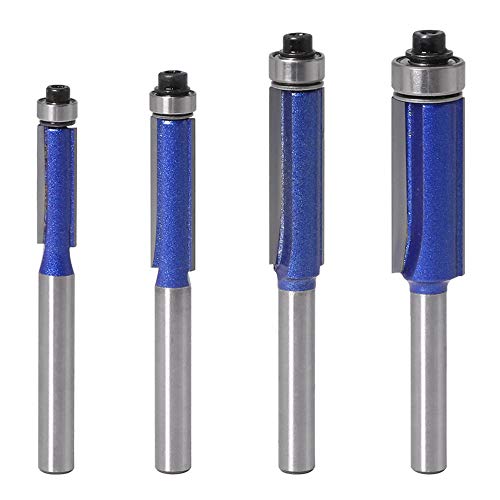
Four cutter diameters give the Wolfride set a different purpose from a single premium bit. The package covers 1/4, 5/16, 3/8, and 1/2 inch, all with 1/4-inch shanks and top bearings. Smaller diameters can navigate tighter curves, while the broader cutters provide another option for straighter, more open profiles. That range is handy when the next template is not shaped like the last one.
The cutters are described as industrial-grade carbide and precision-ground, with supported materials including solid wood, MDF, chipboard, and plywood. Laminate is not explicitly listed in the supplied material line, so this set is better viewed as a general flush-trimming kit that can support adjacent woodworking tasks rather than the most specialized countertop choice. Wolfride also directs users to insert three-quarters of the shank and tighten it securely, while router and collet instructions still govern final installation.
Pros
- Four cutter diameters cover different curve radii and trimming needs.
- Every bit uses a documented 1/4-inch shank.
- Top bearings provide a consistent pattern-reference arrangement.
- Carbide cutters are precision-ground according to the supplied specifications.
- Supported materials include wood, MDF, chipboard, and plywood.
Cons
- Cutting lengths are not clearly specified in the supplied information.
- Laminate is not explicitly included in the documented material list.
This set fits the buyer who wants diameter choices for wood composites and template projects surrounding a laminate installation. A user focused squarely on plastic laminate should lean toward the Freud 64-100, CMT, or Whiteside, whose supplied applications name laminate directly.
To buy this product, click here.
9. UTRUSTTO 4-Piece Straight Flush Trim Router Bit Set — Best Multi-Length Set

The UTRUSTTO set expands both diameter and cutting-height choices. Its four 1/4-inch-shank, top-bearing bits have cutting diameters of 1/4, 5/16, 3/8, and 1/2 inch. Their respective cutting heights are 13/16, 1-1/16, 1-3/16, and 1-7/32 inches, creating a broader reach range than short half-inch laminate cutters.
C3 carbide blades sit on alloy-steel bodies with a heat-resistant Teflon coating. The listed materials include laminate, wood, MDF, particleboard, and plywood, while metal and other non-wood materials are excluded. The set is described for CNC, handheld, and table-mounted routing equipment, but actual fit still depends on a supported 1/4-inch collet, cutter clearance, and the router manufacturer’s limits.
Pros
- Four cutting heights cover shallow and deeper flush-trimming jobs.
- Diameters range from 1/4 inch through 1/2 inch.
- Every bit has a documented 1/4-inch shank and top bearing.
- Laminate, MDF, particleboard, plywood, and wood are named applications.
- C3 carbide edges and a Teflon-coated alloy-steel body are specified.
Cons
- The set is specifically unsuitable for metal and other non-wood materials.
- No maximum RPM is provided in the supplied specifications.
Pick this set if projects genuinely require several cutter diameters and cutting heights. It offers more reach options than the Wolfride package, while a single-bit buyer can avoid storing three extra cutters by choosing the Freud 42-100 or Whiteside 2401 instead.
To buy this product, click here.
Buying Guide
Match The Cutter To The Laminate And Substrate
Plastic laminate is thin, but the router bit must reach past the entire overhang while its pilot or bearing maintains contact with the substrate. A 1/2-inch cutting length often covers straightforward laminate edging, whereas built-up edges, templates, or thicker work may require a 1-inch cutter. More reach is not automatically better. A longer cutting edge leaves more exposed cutter and can be awkward where the job needs only a shallow pass.
Check the complete stack before routing. Laminate, adhesive, substrate, and any template all influence where the cutter and guide sit. The cutting edge should meet the material being removed while the bearing rides a clean, continuous reference surface, with no gap waiting to swallow the guide.
Choose Between Bearing-Guided And Self-Piloting Bits
A bearing-guided bit rolls along the substrate or template. This reduces sliding contact at the guide point and makes the bearing easy to understand at a glance, though adhesive dust and debris can interfere with free rotation. Inspect the bearing before each job and stop if it feels gritty, loose, or reluctant to spin.
A self-piloting laminate bit uses its tip as the reference and removes the separate bearing. The layout is compact and avoids bearing maintenance, but the pilot contacts the edge directly. That design is closely associated with thin laminate trimming rather than broad template-routing duties, which is why the Freud 64-100 occupies a specialized slot here.
Understand Top, Bottom, And Dual Bearings
A top-bearing pattern bit follows a template located above the cutter relative to the shank. A bottom-bearing flush-trim arrangement follows a reference beyond the cutter at its tip. The labels can become confusing once a router is inverted in a table, so picture the bearing’s physical location instead of relying on “top” as a direction in the room.
Dual-bearing bits support either reference position. That flexibility can help with curved patterns where grain direction encourages a different approach along separate sections. It does not remove the need for controlled feed, secure workholding, and shallow passes where the material or router instructions call for them.
Confirm Shank And Collet Compatibility
The reviewed bits with documented 1/4-inch shanks require a proper 1/4-inch collet. A nominally similar metric collet is not a substitute, and an improvised sleeve creates needless risk around a cutter spinning at router speed. Clean the shank and collet, insert the bit according to the router and bit instructions, and avoid bottoming the shank hard inside the collet.
The Freud 42-114 was excluded from the reviewed nine because its 1/2-inch shank makes it less broadly compatible with the compact laminate trimmers often used for this job. A larger shank can suit other routing applications, but compatibility with the intended laminate router is the first gate.
Check Diameter, Cutting Length, And Overall Length Separately
Cutter diameter describes the width of the cutting circle. Cutting length or carbide height describes how much edge the flutes can cover. Overall length measures the full bit from tip to shank end. Mixing those dimensions can produce an unpleasant surprise when a “1/2-inch bit” turns out to describe diameter rather than reach.
Smaller cutter diameters can enter tighter inside curves, while larger diameters require more clearance. Overall length affects how the assembly sits beneath the router base, but it does not reveal safe insertion depth or usable projection by itself. Those points belong to the router and bit instructions.
Respect Speed Limits And Material Restrictions
A listed maximum RPM is a ceiling, not a command to run at that speed. The router, bit diameter, material, and manufacturer guidance all shape the correct setting. Where maximum speed is not clearly supplied, confirm it from current manufacturer documentation before use rather than guessing from another bit with similar dimensions.
Material labels matter too. A bit supported for laminate and plywood is not automatically suitable for aluminum, acrylic, or unknown composites. The CMT specifically lists aluminum laminate, while the UTRUSTTO set excludes metal and non-wood materials. That distinction should control the purchase before coating color or package size enters the conversation.
Plan For Adhesive, Dust, And Safe Handling
Laminate adhesive residue can cling to cutters and bearings, producing that tacky, dirty feel that prevents smooth guidance. Disconnect the router from power before inspection or cleaning, and use a cleaning method approved for the cutter and bearing. A coating may reduce buildup, but it does not make maintenance disappear.
Wear eye and hearing protection, manage fine dust, secure the work, and inspect the bit for damage before routing. Keep hands away from the cutting area and let the cutter stop fully before setting the router down. Handheld and router-table setups require different feed orientation, so follow the equipment manual rather than applying one memorized direction rule everywhere.
Best Flush Trim Router Bit For Laminate FAQ
What Size Flush-Trim Bit Works Best For Plastic Laminate?
A short cutter with enough length to cover the laminate overhang is usually the cleanest match. Half-inch cutting lengths are common among laminate-focused options in this roundup, while a 1-inch cutter adds room for thicker edges and template work. Cutter diameter affects curve access, so tight inside shapes favor smaller diameters where the profile permits.
Is A Bearing Necessary For Trimming Laminate?
No. Bearing-guided bits roll along a substrate or template, but a self-piloting laminate bit such as the Freud 64-100 uses its tip as the guide. Bearings offer rolling contact and familiar visual setup. Self-piloting designs are compact and remove bearing maintenance, although their pilots touch the reference edge directly.
Can A Flush-Trim Bit Cut The Laminate Opening For A Sink?
A flush-trim or pattern bit can follow a suitable template or an established substrate edge, provided its geometry, cutting length, and router compatibility fit the task. Sink openings involve curves, corners, work support, and possible cutter-clearance limits. Follow the sink, router, and bit manufacturers’ instructions, and verify that the cutter diameter can follow the required corner radius.
Can I Use A 1/4-Inch-Shank Bit In Any Router?
No. The router must have a genuine 1/4-inch collet and support the cutter’s diameter, length, speed, and intended operation. Shank fit alone does not prove that the bit clears the base or falls within the router’s limits. Never substitute a different collet size or an improvised adapter.
What Is The Difference Between A Flush-Trim Bit And A Pattern Bit?
Both use a guide to make the work match a reference edge. The usual distinction is bearing position: a pattern bit often places the bearing near the shank, while a conventional flush-trim bit places it near the cutter tip. Product naming varies, so check the bearing’s actual location and plan where the template or finished edge will sit.
Are Two Flutes Better Than One For Laminate?
Flute count changes how cutting edges engage material and how chips move, but it does not establish quality by itself. Several reviewed bits use two cutters, including the Freud 42-100, CMT 807.128.11, and Whiteside 2401. Cutter sharpness, feed control, material support, geometry, and correct router setup remain central to the finished edge.
Can The Same Bit Trim Laminate And Plywood Templates?
Yes, where the manufacturer names both applications and the dimensions fit. The Freud 42-100 supports composition materials, plywood, hardwood, and softwood, while the Whiteside 2401 lists laminate, veneer, and template work. A laminate-only pilot bit may be less convenient for deeper template routing, so buy around the thickest documented job.
How Far Should A Router Bit Shank Enter The Collet?
Use the insertion guidance supplied by the router and bit manufacturers. The shank needs enough engagement for secure clamping but should not be forced against the bottom of the collet. Disconnect power before fitting the bit, keep the shank and collet clean, and tighten with the proper tools.
Final Verdict
The Freud 42-100 is the strongest all-around recommendation among these nine options. Its 3/8-inch cutter and bearing remain compact enough for laminate edges, while the 1-inch carbide height opens the door to plywood, composition material, and wood template work. The documented 1/4-inch shank, two cutters, Perma-SHIELD coating, and support for handheld or table-mounted routing create a clear, practical specification set.
For thin plastic laminate, the self-piloting Freud 64-100 offers a more specialized approach without bearing maintenance. The Freud 50-501 is the more flexible template-routing pick because it places bearings at both ends, while the Whiteside 2401 keeps shallow laminate work compact. Before ordering, measure the required cutting reach, identify where the bearing or pilot will run, and confirm the shank, clearance, material, and RPM requirements against the exact router being used.
