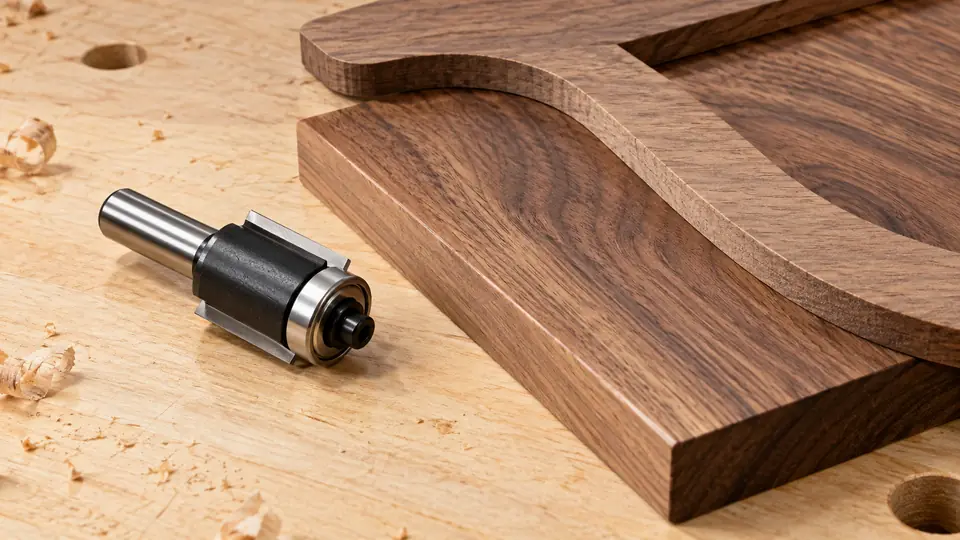
A flush-trim bit can turn a rough bandsawn hardwood blank into an exact copy of a template, but the cutter is doing demanding work. Dense oak and maple expose weak bearings, slender shanks, and poor cutter geometry quickly, often through chatter, scorch marks, or an ugly burst of grain near an edge. The common mistake is buying by cutter diameter alone. Shank size, cutting length, bearing location, cutter construction, and router compatibility all shape how safely and cleanly the job proceeds.
Different projects pull those specifications in different directions. A 1-inch top-bearing bit makes sense when the template sits above a workpiece, while a bottom-bearing configuration supports other routing setups. Thick blanks call for greater cutting length and a rigid router setup. Spiral compression and downcut geometry can help manage surface fibers, yet their cutting direction and bearing placement must match the template arrangement. A small trim router owner also has a hard limit: a 1/2-inch shank cannot enter a 1/4-inch collet, no matter how attractive the bit looks.
The Freud 42-114 is the strongest all-around recommendation here, pairing a 1/2-inch shank with a 1/2-inch cutter, 1-1/2-inch carbide height, and documented support for hardwood in handheld or table-mounted routers. It covers a practical middle ground without becoming excessively long or wide. Buyers working with thick stock may prefer the Freud 42-204, while projects where edge-fiber control matters may point toward one of the EANOSIC spiral options.
Quick Answer
- Best Overall: Freud 42-114 for its 1/2-inch shank, 1-1/2-inch carbide height, and broad router support.
- Best for Thick Hardwood: Freud 42-204, with a 2-inch cutting height and downshear helix.
- Best Compression Geometry: EANOSIC Compression Spiral Flush Trim Bit for a solid-carbide, up-and-down spiral configuration.
- Best Top-Bearing Pick: Freud 50-102, a compact 1/2-inch cutter with a 1/4-inch shank.
Best Flush Trim Router Bit for Hardwood Comparison Table
| Product | Best For | Shank | Cutter | Bearing | Geometry |
|---|---|---|---|---|---|
| Freud 42-114 | General hardwood template work | 1/2 inch | 1/2-inch diameter, 1-1/2-inch carbide height | 1/2-inch diameter, position not clearly specified | Two straight cutters |
| Freud 42-204 | Thick stock and stacked parts | 1/2 inch | 3/4-inch diameter, 2-inch carbide height | 3/4 inch | Downshear helix, two cutters |
| EANOSIC Compression Spiral Flush Trim Bit | Compression cutting | 1/4 inch | 1-inch cutting length | Bottom, dual bearings | Up-and-down compression spiral |
| Freud 50-102 | Top-template routing | 1/4 inch | 1/2-inch diameter, 1-inch carbide height | Top, 1/2 inch | Two straight cutters |
| Freud 50-116 | Wide, rigid top-bearing cuts | 1/2 inch | 3/4-inch diameter, 1-inch carbide height | Top, 3/4 inch | Two straight cutters |
| KEENTECH Long Flush Trim Router Bit | Deep trimming capacity | 1/2 inch | 1/2-inch diameter, 2-1/2-inch cutting depth | Position and size not clearly specified | Carbide-tipped straight cutter |
| Freud 42-100 | Smaller routers and shorter cuts | 1/4 inch | 3/8-inch diameter, 1-inch carbide height | 3/8-inch diameter, position not clearly specified | Two straight cutters |
| EANOSIC Downcut Spiral Flush Trim Bit | Downcut spiral routing | 1/4 inch | 1-inch cutting length | Top, dual bearings | Downcut spiral |
| Wolfride 4-Piece Flush Trim Router Bit Set | Multiple cutter diameters | 1/4 inch | 1/4, 5/16, 3/8, and 1/2-inch diameters | Top | Carbide straight cutters |
The reviews below explain how those dimensions and cutting geometries affect practical hardwood routing.
1. Freud 42-114 — Best Overall
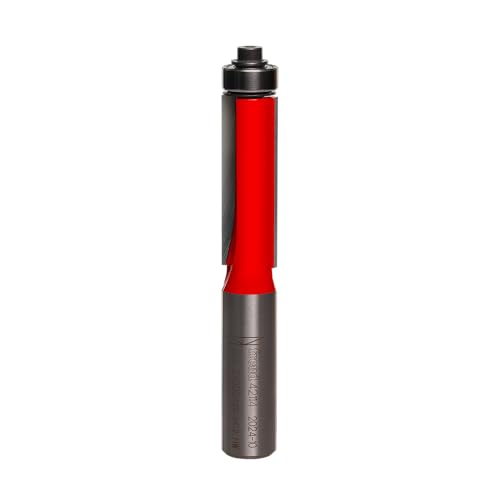
The Freud 42-114 hits a useful balance for hardwood template work. Its 1/2-inch cutter matches a 1/2-inch bearing diameter, while the 1-1/2-inch carbide height can cover many furniture parts, curved rails, and duplicated components without reaching for an unusually long cutter. A 1/2-inch shank requires a matching collet, but that larger shank is a sensible pairing with this cutting length, particularly where dense timber puts sustained sideways pressure on the assembly.
Freud specifies two cutters, hardwood compatibility, and use in handheld or table-mounted routers. The Perma-SHIELD coating is another documented detail, though no coating removes the need for controlled passes and a clean cutting edge. At 3-5/8 inches overall, this is a substantial bit rather than a tiny laminate trimmer. The workpiece, template, and router base must provide enough clearance to place the bearing correctly before the cutter touches wood.
Pros
- Documented for hardwood, plywood, softwood, and composition materials.
- 1/2-inch shank suits routers equipped with a matching collet.
- 1-1/2-inch carbide height handles thicker work than common 1-inch cutters.
- Compatible with handheld and table-mounted router use.
- Two-cutter construction and Perma-SHIELD coating are clearly specified.
Cons
- Cannot fit a router limited to a 1/4-inch collet.
- The supplied specifications do not clearly identify the bearing as top-mounted or bottom-mounted.
This bit fits woodworkers who want one general-purpose cutter for medium-depth hardwood pattern work and already own a 1/2-inch-collet router. Buyers who place templates specifically above or below every workpiece should verify the bearing arrangement before ordering. Its central trade-off is simple: the larger shank supports a capable cutting length, but compact 1/4-inch-only routers are excluded.
To buy this product, click here.
2. Freud 42-204 Downshear Helix Flush Trim Bit — Best for Thick Hardwood

Thick hardwood changes the calculation. The Freud 42-204 supplies a 2-inch carbide height, a 3/4-inch cutting diameter, and a 1/2-inch shank, creating a much larger cutting envelope than the shorter picks in this roundup. Freud describes its downshear action as producing easier, smoother cuts in thick material. That geometry makes the bit particularly interesting for substantial templates or multiple aligned parts, where a short cutter would force a different setup.
The size deserves respect. Overall length is 4-1/8 inches, so cutter exposure, router clearance, and workholding matter more than they do with a compact 1-inch bit. Freud identifies portable and table-mounted router use, along with hardwood, softwood, plywood, and composition-material compatibility. Its two cutters and matching 3/4-inch bearing and body diameter establish the essential flush-trimming dimensions without leaving the buyer guessing about scale.
Pros
- Two-inch carbide height supports thick workpieces and stacked parts.
- Downshear helix is intended to provide easier, smoother cutting in thick material.
- Large 3/4-inch body offers more diameter than the smaller straight bits here.
- 1/2-inch shank matches the demands of its larger dimensions.
- Specified for both portable and table-mounted template routing.
Cons
- Its 4-1/8-inch overall length demands ample setup clearance and careful control.
- The 1/2-inch shank excludes routers fitted solely with a 1/4-inch collet.
Choose the 42-204 for thick hardwood blanks, stacked duplication, or long template edges where its 2-inch capacity is genuinely useful. It is excessive for thin trim and delicate work, where the smaller Freud 50-102 is easier to accommodate. The reward is substantial reach and documented downshear geometry, while the cost is a bulkier cutter that asks more from the router and setup.
To buy this product, click here.
3. EANOSIC Compression Spiral Flush Trim Bit — Best Compression Geometry

Compression geometry combines opposing spiral directions along the cutting edge. Conceptually, that arrangement pushes surface fibers toward the workpiece rather than pulling both faces in one direction, which can be useful where both visible faces matter. This EANOSIC bit has a 1/4-inch shank, 1-inch cutting length, solid-carbide construction, a blue nano coating, and a bottom-bearing configuration.
Two ball bearings are mounted at the tip on steel collars, giving the template-following end a clearly documented arrangement. The manufacturer lists oak, other hardwoods, plywood, and MDF among supported materials, and specifies CNC routers and plunge routers with 1/4-inch collets. Solid carbide can provide a keen spiral edge, but it also calls for sensible handling. Dropping a slender carbide bit on a hard floor is a rather unforgiving accident, so storage and setup deserve care.
Pros
- Compression spiral geometry manages cutting forces from opposing directions.
- Solid-carbide construction is documented rather than inferred.
- One-inch cutting length covers many template-routing tasks.
- Bottom guide uses two ball bearings on steel collars.
- Specified for oak, other hardwoods, plywood, and MDF.
Cons
- Bottom-bearing placement will not suit a setup that requires the template above the workpiece.
- Supported handheld use is limited in the supplied information to plunge routers with 1/4-inch collets.
This EANOSIC model makes sense for a 1/4-inch-collet plunge router or compatible CNC setup where compression geometry and a bottom template are deliberate choices. Skip it if the jig places its guide above the stock, since the top-bearing EANOSIC downcut model aligns with that arrangement. The key decision is geometry and bearing location, rather than assuming every spiral flush-trim bit behaves the same way.
To buy this product, click here.
4. Freud 50-102 Top Bearing Flush Trim Bit — Best Top-Bearing Pick

A top bearing is straightforward when the pattern sits above the workpiece, where it remains visible and accessible during setup. The Freud 50-102 follows that familiar layout with a 1/2-inch bearing, 1/2-inch cutter diameter, and 1-inch carbide height. Its 1/4-inch shank broadens compatibility with smaller routers, provided the router manual and base clearance support the bit.
The bit measures 2-5/8 inches overall and uses two cutters, so it is more compact than Freud’s thick-stock options. Hardwood, plywood, softwood, and composition materials are all listed applications, and Freud supports handheld and table-mounted routers. The Perma-SHIELD coating rounds out a well-documented specification sheet. For a template-guided curve in 3/4-inch hardwood, these proportions are pleasantly uncomplicated, assuming the remaining waste is kept modest.
Pros
- Top bearing works with templates positioned above the workpiece.
- 1/4-inch shank fits routers with the corresponding collet.
- Matching 1/2-inch bearing and cutter diameters support flush duplication.
- One-inch carbide height suits common board thicknesses.
- Approved for handheld and table-mounted routing across several wood materials.
Cons
- One-inch carbide height is too short for work requiring a deeper continuous cut.
- A 1/4-inch shank provides less cross-sectional mass than the 1/2-inch-shank Freud options.
The 50-102 fits top-template work, smaller routers, and moderate cutting depths. It is a more practical companion for compact setups than the long Freud 42-204, though it cannot match that bit’s reach. Buyers should choose it for its clearly stated top-bearing arrangement and manageable dimensions, then remove heavy waste before routing so the bit is trimming rather than hogging through a full blank.
To buy this product, click here.
5. Freud 50-116 Top Bearing Flush Trim Bit — Best Large-Diameter Cutter

The Freud 50-116 keeps cutting height to 1 inch but increases cutter and bearing diameter to 3/4 inch. That wider body distinguishes it from the 1/2-inch and 3/8-inch straight bits, and the 1/2-inch shank gives it a proportionate foundation. A larger cutter also needs suitable router-base clearance and an operating speed permitted by both the router and bit documentation.
Its top bearing places the template above the hardwood, a useful arrangement for pattern work where the guide needs to remain visible. Freud specifies two cutters, handheld and table-mounted router use, and compatibility with hardwoods, softwoods, plywood, and composition materials. Overall length is 2-13/16 inches, keeping the assembly relatively compact beside the much longer Freud 42-204.
Pros
- Clearly documented top-bearing configuration.
- 3/4-inch cutter and matching bearing provide a broad cutting diameter.
- 1/2-inch shank suits routers equipped with the corresponding collet.
- One-inch carbide height covers many thinner templates and workpieces.
- Perma-SHIELD coating and two-cutter construction are specified.
Cons
- Requires enough router-base opening and clearance for a 3/4-inch cutter.
- One-inch cutting height limits deep hardwood duplication.
This model suits woodworkers who want a broad, top-bearing cutter without the length of a thick-stock bit. It fits table and handheld work where a 1/2-inch collet is available, but the 50-102 is the more accessible option for a 1/4-inch-only router. Check cutter clearance and permitted speed before use, since shank fit alone does not confirm that a router can accept every cutter body.
To buy this product, click here.
6. KEENTECH Long Flush Trim Router Bit — Best for Deep Trimming

KEENTECH’s defining specification is a 2-1/2-inch cutting depth, the longest documented cutting dimension among these picks. The cutter diameter and shank are both 1/2 inch, and the construction combines tungsten-carbide cutting material with a steel body. Hardwood, softwood, plywood, MDF, laminate, and plastics appear in the supported applications, alongside template routing and pattern duplication.
That long cutting section solves a real capacity problem, but it also raises the stakes around setup. The router needs a true 1/2-inch collet, the work must be secured, and the cut should remain controlled rather than burying the full edge in dense hardwood at once. The supplied details do not clearly identify bearing position or bearing diameter, both of which are central to template placement. Verify those points against the intended jig before treating the impressive reach as the deciding factor.
Pros
- 2-1/2-inch cutting depth provides substantial reach for thick work.
- 1/2-inch cutter diameter supports common template-routing layouts.
- Uses a 1/2-inch shank and solid steel body.
- Tungsten-carbide cutting material is explicitly documented.
- Listed for hardwood, plywood, MDF, laminate, and several other materials.
Cons
- Bearing position and diameter are not clearly specified in the supplied information.
- The long cutting depth requires a more demanding setup than a compact 1-inch bit.
Consider this KEENTECH bit when reach is the main constraint and the router, template, and workholding can support a long cutter. Buyers who need a clearly documented top bearing should favor the Freud 50-102 or 50-116 instead. The extra depth is meaningful, but only after confirming that the bearing arrangement matches the job and that the router accepts the 1/2-inch shank.
To buy this product, click here.
7. Freud 42-100 — Best Compact Straight Bit
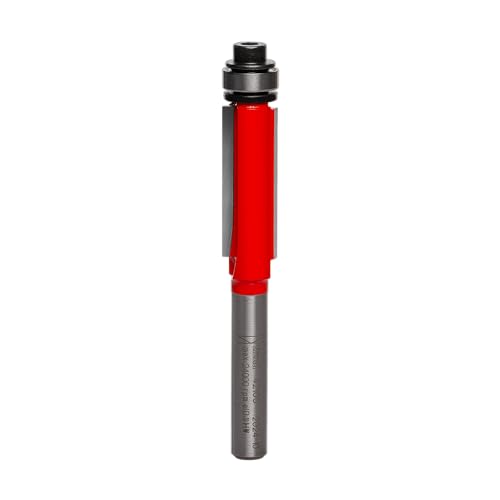
With a 3/8-inch cutter, 1-inch carbide height, and 1/4-inch shank, the Freud 42-100 occupies the compact end of this list. The matching 3/8-inch bearing diameter keeps the guide and cutting path aligned, while the 2-13/16-inch overall length is easier to accommodate than an extended thick-stock cutter. It is a sensible scale for smaller pattern work where a broad 3/4-inch body would feel clumsy.
Freud lists two cutters, Perma-SHIELD coating, hardwood compatibility, and use in handheld or table-mounted routers. The supplied specifications do not state whether the bearing sits above or below the cutter, so template orientation still needs confirmation. Its modest diameter does not make careless routing acceptable. Dense hardwood should be rough-cut close to the pattern, leaving the bit to perform controlled trimming rather than heavy stock removal.
Pros
- Compact 3/8-inch cutter suits smaller-radius template work.
- 1/4-inch shank supports routers equipped with that collet size.
- One-inch carbide height covers many thin and medium-thickness parts.
- Documented for hardwood and table-mounted or handheld routing.
- Matching 3/8-inch bearing and cutter diameters are clearly specified.
Cons
- Bearing position is not clearly identified in the supplied specifications.
- One-inch cutting height cannot cover thick blanks in a single full-depth setup.
The 42-100 fits smaller components, restrained cutting depths, and routers with 1/4-inch collets. It gives up the reach and larger shank of the 42-114, but its narrower body may suit tighter template curves. Confirm bearing placement first, then choose it where the compact cutter dimensions provide a genuine geometric advantage.
To buy this product, click here.
8. EANOSIC Downcut Spiral Flush Trim Bit — Best Downcut Spiral
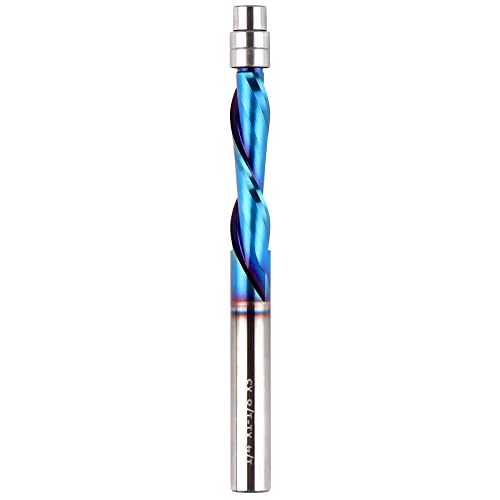
A downcut spiral directs its cutting action toward the top surface of the workpiece, a geometry often selected when controlling those upper fibers is the priority. This EANOSIC model combines that profile with a top bearing, 1-inch cutting length, 1/4-inch shank, solid-carbide construction, and a blue nano coating. The top bearing makes its template arrangement clear before the router ever touches wood.
The guide uses two independent ball bearings mounted on steel collars. EANOSIC lists oak, other hardwoods, plywood, and MDF, plus use in CNC and plunge routers with 1/4-inch collets. Downcut geometry changes chip movement compared with an upcut bit, so dust extraction and shallow, controlled passes remain relevant. Buyers should select this geometry for its specific cutting direction, rather than treating “spiral” as a universal upgrade for every template job.
Pros
- Downcut spiral geometry targets the upper workpiece surface.
- Top bearing supports templates located above the stock.
- Solid-carbide construction and nano coating are documented.
- Dual ball bearings are secured on steel collars.
- One-inch cutting length and 1/4-inch shank suit many compact setups.
Cons
- Downward chip direction can make chip removal more demanding in deeper cuts.
- The supplied tool compatibility names CNC and 1/4-inch-collet plunge routers, rather than all handheld router types.
This bit suits top-template routing where upper-surface fiber control matters and the router matches the documented 1/4-inch setup. The compression model offers opposing cutting directions and a bottom bearing, making it materially different rather than interchangeable. Choose between them by template position and desired spiral action, then keep chip evacuation in mind as the cut deepens.
To buy this product, click here.
9. Wolfride 4-Piece Flush Trim Router Bit Set — Best Diameter Variety
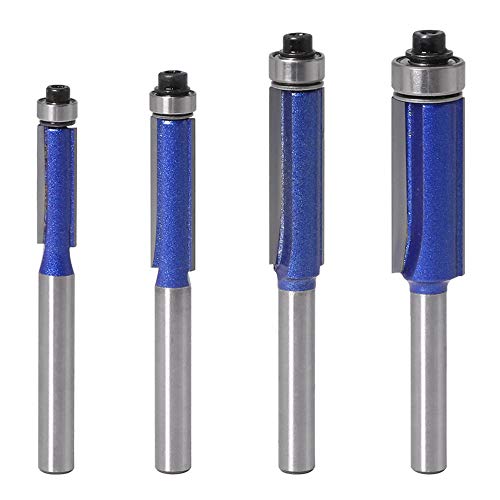
The Wolfride set addresses cutter diameter rather than cutting length. Its four top-bearing bits have 1/4-inch, 5/16-inch, 3/8-inch, and 1/2-inch cutting diameters, all carried on 1/4-inch shanks. That range can be useful across templates with different inside curves, where a broad cutter cannot physically follow a tight radius. Carbide cutters and precision-ground edges are documented across the set.
Supported materials include solid wood, MDF, chipboard, and plywood. Wolfride also states that three-quarters of the shank should be inserted and securely tightened, a practical reminder that proper collet engagement matters. Cutting lengths, bearing diameters, overall lengths, and maximum RPM are not clearly specified in the supplied details, so this is less transparent than the dimension-heavy Freud listings. The attraction is variety, with some specification gaps attached.
Pros
- Includes four distinct cutter diameters for different template curves.
- Every bit uses a 1/4-inch shank.
- Top-bearing arrangement is clearly identified.
- Carbide cutters and precision-ground edges are documented.
- Suitable materials include solid wood, plywood, MDF, and chipboard.
Cons
- Cutting lengths and overall lengths are not clearly specified.
- No maximum operating RPM is provided in the supplied information.
This set fits a woodworker who values diameter choice and uses top-mounted templates with a 1/4-inch-collet router. It is less compelling for a buyer seeking one thoroughly specified hardwood bit for repeated production. Verify the missing dimensions and operating limit before use, especially if a template requires a particular cutting depth or the router runs at a high fixed speed.
To buy this product, click here.
Buying Guide
Start With the Bearing Position
The bearing determines where the template sits. A top-bearing bit follows a pattern above the workpiece, which can make alignment easy to see during handheld routing. A bottom bearing follows a pattern below the cutter and suits different jigs or router-table arrangements. Neither layout is universally better. Match the bearing to the fixture you already use, since flipping the assembly may change work support, visibility, and safe access.
Match the Shank to the Actual Collet
A 1/4-inch shank belongs in a true 1/4-inch collet, and a 1/2-inch shank requires a true 1/2-inch collet. Never force one into the other or rely on an improvised sleeve. Larger shanks provide more cross-sectional mass, which is attractive on long or wide cutters, but they also exclude compact routers that accept only 1/4-inch tooling. Check the router manual before placing any order.
Choose Cutting Length Without Excess
The cutting edge must cover the intended workpiece thickness at the planned bit height, yet extra length is not automatically helpful. A 2-inch or 2-1/2-inch cutter can reach thick stock, while a 1-inch cutter forms a more compact assembly for thinner parts. Long bits magnify setup demands and require enough base clearance. Select the shortest cutter that safely completes the intended operation.
Understand Straight, Downcut, and Compression Geometry
Straight two-cutter bits are familiar, broadly useful tools. A downcut spiral directs its cutting action downward and can prioritize the upper surface, though chips may be pushed deeper into the cut. Compression geometry combines upcut and downcut sections to direct fibers inward from both faces. Its benefit depends on placing the workpiece relative to the transition between those sections, so a shallow board may not engage the geometry as intended.
Use Cutter Diameter Deliberately
A small cutter can follow tighter inside curves, while a larger diameter cannot enter a radius smaller than its own geometry permits. Wider cutters also require enough opening in the router base and may carry different speed restrictions. Cutter diameter, bearing diameter, and shank diameter describe separate parts of the bit. Reading “1/2 inch” without checking which dimension it identifies is an easy and costly mistake.
Prepare Hardwood Before the Final Pass
A flush-trim bit works best after most waste has been removed by a bandsaw, jigsaw, or another appropriate method. Leaving a modest margin asks the cutter to trim rather than excavate a full-width channel through dense stock. Secure the template and workpiece, inspect the bearing and cutting edge, wear eye and hearing protection, manage dust, and disconnect router power before changing bits. Follow the router and cutter manufacturers’ limits for speed, cutter exposure, and operating direction.
Check Router and Table Clearance
Collet fit proves only that the shank can be held. The cutter body must also clear the base opening, insert ring, fence, and surrounding hardware. Long bits need adequate vertical adjustment without unsafe shank extension. For table routing, confirm that the bearing and template remain accessible while the work receives stable support. A dry setup with the router unplugged can expose collisions before they become loud, expensive surprises.
Best Flush Trim Router Bit for Hardwood FAQ
Is a 1/2-Inch Shank Better for Hardwood?
A 1/2-inch shank has more material than a 1/4-inch shank and is a logical pairing for long or large-diameter cutters. That does not make every 1/2-inch bit superior, and many compact routers accept only 1/4-inch tooling. Cutter geometry, cutting length, bearing placement, router condition, and work preparation still matter.
What Is the Difference Between a Flush-Trim Bit and a Pattern Bit?
Both use a bearing to copy an existing edge, but naming often reflects bearing location. “Pattern bit” commonly refers to a top-bearing configuration, while “flush-trim bit” often describes a bearing beneath the cutter. Product names are not perfectly consistent, so rely on the documented bearing position rather than the label alone.
Can a Flush-Trim Bit Remove All the Waste From a Hardwood Blank?
That approach places a heavy load on the cutter and can increase heat, chatter, and loss of control. Rough-cut the blank close to the template first, then use the router for the final guided trim. The appropriate remaining margin depends on the cutter, stock, router, grain, and manufacturer guidance, so there is no universal depth or feed rate.
Which Geometry Helps With Tear-Out on Both Faces?
Compression geometry combines opposing spiral directions and is intended to direct fibers toward the workpiece from both faces. Its transition point must sit correctly within the material for that action to work as intended. A downcut bit prioritizes the upper surface, while a straight bit offers a simpler general-purpose arrangement.
Can These Bits Be Used in a Router Table?
Several Freud models here explicitly support table-mounted use, and the Wolfride listing does not provide comparable table details. Router-table suitability still depends on cutter clearance, insert opening, template arrangement, speed limits, and stable work support. Check both the bit and router-table documentation rather than relying on shank fit.
Why Does Cutting Length Matter So Much?
The cutting edge must overlap the portion of the workpiece being trimmed while the bearing contacts the template. A cutter that is too short cannot reach the full edge. A much longer cutter introduces extra exposure and may require a larger router setup, so matching length closely to the material is the sounder approach.
How Can Burning Be Reduced in Dense Hardwood?
Begin with a sharp, clean cutter and remove most waste before template routing. Keep the bit moving at a controlled pace, avoid lingering in one spot, and use multiple controlled operations where the manufacturer permits them. Excessive stock removal, resin buildup, a dull edge, or unsuitable speed can generate heat. Follow the documented RPM limit for the specific cutter.
Should the Bearing Be Checked Before Every Use?
Yes. Confirm that the bearing rotates freely, its retaining hardware is secure, and no debris interferes with template contact. Inspect the cutting edge and shank at the same time. Disconnect the router from power before inspection or adjustment, and replace damaged components rather than attempting a questionable cut.
Final Verdict
The Freud 42-114 is the most balanced hardwood flush-trim bit in this group. Its 1/2-inch shank, 1/2-inch cutter, and 1-1/2-inch carbide height cover a useful range of template-routing work without the extreme length of a deep-cut model. Freud also documents hardwood compatibility and both handheld and table-mounted use. Confirm its bearing position for your template arrangement, then check that the router has a proper 1/2-inch collet.
For thick parts, the Freud 42-204 offers a 2-inch downshear cutting section and a substantial 3/4-inch body. The EANOSIC compression bit is the more specialized pick for a bottom-bearing spiral setup, while the Freud 50-102 suits top-bearing work with a 1/4-inch shank. Let template position, material thickness, collet size, and cutter clearance settle the decision. Those four details matter far more than a flashy label once dense hardwood starts pressing back.
