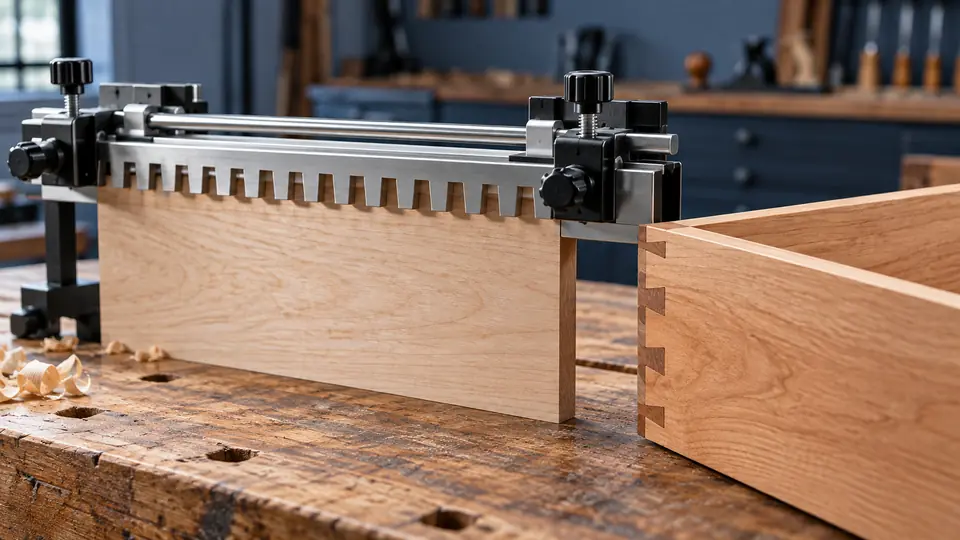
A drawer jig has to control pin-and-tail spacing while keeping the drawer front and side firmly registered. Half-blind joints hide the ends at the front; through dovetails serve a different appearance and setup. A useful comparison therefore starts with the joint, stock thickness and board width, rather than the number of accessories in the box.
For drawer work, establish the front/side orientation and make a test joint in stock of the same thickness. A correct template still needs matching cutter geometry, guidance and depth settings.
Quick Answer
- Best Overall: POWERTEC 12 Inch Dovetail Jig.
- Best Premium: Leigh D4R-PRO Dovetail Jig.
- Best Template Selection: VEVOR 12 Inch Three-Template Dovetail Jig.
- Best For Half-Blind Drawers: VEVOR 12 Inch Half-Blind Dovetail Jig.
- Best Simple Design: Woodstock D2796 Dovetail Jig.
- Best Cam-Clamp Setup: Dovetail Jig, 12in Width, Router Jig With Bit And Template.
- Best For Larger Drawer Parts: 24-Inch Dovetail Jig Mini Template Kit.
- Unlimited-width through dovetails: Keller 1601 PRO Dovetail Jig.
- Clamped half-blind drawer setup: CMT300 Dovetail Jig.
Best Dovetail Jig for Drawers Comparison Table
| Product | Best For | Documented Joint Types | Width Capacity | Included Routing Hardware |
|---|---|---|---|---|
| POWERTEC 12 Inch Dovetail Jig | Overall drawer and box joinery | Half-blind, rabbeted half-blind, sliding, through dovetails, box joints | Up to 12 inches | Two bits and two guide bushings |
| Leigh D4R-PRO Dovetail Jig | Premium and wide work | Dovetail pins and tails | Up to 24 inches | Three carbide router bits |
| VEVOR 12 Inch Three-Template Dovetail Jig | Multiple template sizes | Half-blind, through, and sliding dovetails | Specified processing ranges up to 12 inches | Router-bit count is inconsistent in the listing |
| VEVOR 12 Inch Half-Blind Dovetail Jig | Traditional drawer fronts | 1/2-inch half-blind dovetails | Specified processing ranges up to 12 inches | Two 1/2-inch dovetail bits |
| Woodstock D2796 | Simple half-blind drawer joints | 1/2-inch half-blind dovetails | Not clearly specified | Required bit and bushing sold separately |
| 12in Width Dovetail Jig | Cam-clamp convenience | 1/2-inch dovetails | Conflicting width information in the listing | 1/4-inch-shank dovetail bit |
| 24-Inch Dovetail Jig Mini Template Kit | Larger drawer components | Dovetails | Listed work width of 11.8 to 19.69 inches | Dovetail cutter |
| Keller 1601 PRO Dovetail Jig | Unlimited-width through dovetails | Through dovetails; pins and tails | No fixed board-width limit | Straight and dovetail bearing bits; 1/4-inch shanks |
| CMT300 Dovetail Jig | Clamped half-blind drawer setup | 1/2-inch half-blind; other templates optional | Check template work-width specification | Standard half-blind template and template guide |
Compare the options below by the features and setup that matter for your project.
1. POWERTEC 12 Inch Dovetail Jig — Best Overall

The POWERTEC 72069 covers the joint styles a drawer maker is most likely to explore after mastering a basic half-blind corner. One template supports half-blind, rabbeted half-blind, and sliding dovetails, while the second handles through dovetails and box joints. That breadth matters in a mixed project. A false-front kitchen drawer may call for a straightforward half-blind joint, but a jewelry box with exposed corners invites through dovetails, and the same jig can address both ideas.
The package is unusually complete within this group. It includes a 13/32-inch straight bit, a 17/32-inch dovetail bit, two dedicated guide bushings, and an Allen wrench. Engraved alignment lines help establish the layout, while the depth-adjustment knob provides a reference for setting the bit. The quick-clamp arrangement holds the pin and tail boards, and stock capacity runs from 1/4 inch to 1-1/8 inches thick at widths up to 12 inches. That range suits many cabinet and furniture drawers without turning the jig into a bench-hogging slab of metal.
Pros
- Supports half-blind, rabbeted half-blind, sliding, and through dovetails.
- Second template adds box-joint capability for drawer and box projects.
- Includes straight and dovetail bits plus two dedicated guide bushings.
- Handles stock from 1/4 inch to 1-1/8 inches thick and up to 12 inches wide.
- Mounting holes, an L-shaped base, and quick clamps support permanent or temporary setups.
Cons
- Requires a router that accepts a Porter-Cable-style guide bushing and a 1/2-inch-shank bit.
- The number of templates and adjustments creates more setup decisions than a half-blind-only jig.
This is the best fit for a woodworker who expects drawer construction to lead into decorative boxes, exposed joinery, or sliding dovetails. The central trade-off is complexity. A first test cut and careful manual reading remain necessary, but the included hardware removes much of the compatibility scavenger hunt that can sour a first dovetail project.
To buy this product, click here.
2. Leigh D4R-PRO Dovetail Jig — Best Premium

The Leigh D4R-PRO takes a different route from the familiar fixed-spacing comb template. Its headline attraction is the ability to produce pins and tails with a handmade appearance, rather than locking every project into an obviously repetitive pattern. That distinction becomes visually meaningful on exposed drawer sides, blanket chests, and wide casework. Instead of a steady row that looks stamped out, the joint layout can become part of the furniture’s character.
Capacity is another major separator. The one-piece aluminum extrusion base accepts boards up to 24 inches wide, twice the nominal width of many drawer-focused jigs here, and the documented maximum pin thickness is 1-1/4 inches. Three carbide router bits are supplied. That broad working width is useful for more than oversized drawers. It also provides room for case sides and panels that a 12-inch jig cannot accept without redesigning the work, though the larger format asks for more storage space and a more substantial commitment.
Pros
- Accepts boards up to 24 inches wide.
- Produces variable-looking dovetail pins and tails with a handmade visual character.
- Uses a one-piece aluminum extrusion base.
- Supports a maximum documented pin thickness of 1-1/4 inches.
- Includes three carbide router bits.
Cons
- Its premium positioning is difficult to justify for occasional standard-width drawers.
- Router and guide-bushing compatibility details are not clearly specified in the listing.
Choose the D4R-PRO if exposed dovetails are a design feature or 12-inch capacity feels restrictive before the first board is clamped. A hobbyist making a few utility drawers may find its scope excessive. For furniture makers who want wider work and less mechanical-looking spacing, however, it addresses needs the simpler comb jigs largely leave untouched.
To buy this product, click here.
3. VEVOR 12 Inch Three-Template Dovetail Jig — Best Template Selection

This VEVOR package is aimed at buyers who want more than one dovetail format without stepping up to a 24-inch premium system. Its documented template selection includes a 1/2-inch through template, a 1/2-inch half-blind template, and a 1-inch through template. For drawer work, that creates a meaningful fork in the road. Half-blind joints keep the joinery out of sight at the front, while through dovetails leave the joint visible and allow its spacing to contribute to the design.
Eccentric-wheel handles provide quick clamping, reducing the amount of knob-twisting needed while boards are being aligned. The supplied capacity figures specify top work from 5.5 to 12 inches wide and side work from 5.9 to 11 inches, with thickness limits of 1.57 inches on top and 1.42 inches on the side. The aluminum-alloy body has an electrostatic-spray finish. One caveat lurks in the package description: the supplied title and feature text disagree over whether four or five router bits are included, so the current package contents deserve verification before purchase.
Pros
- Includes separate 1/2-inch through, 1/2-inch half-blind, and 1-inch through templates.
- Supports half-blind, through, and sliding-dovetail work according to the listing.
- Eccentric-wheel handles clamp work with a quick lever action.
- Accepts comparatively thick stock based on the documented top and side limits.
- Aluminum-alloy construction uses an electrostatic-spray finish for corrosion resistance.
Cons
- The supplied listing information conflicts on the number of included router bits.
- Top and side processing ranges differ, so board dimensions require careful checking before layout.
This VEVOR suits a maker who wants fixed-spacing half-blind and through dovetails from one 12-inch platform. It offers more template choices than the half-blind-only VEVOR, but the package discrepancy makes a pre-purchase contents check sensible. Buyers seeking a clearly documented bushing standard may find the POWERTEC package easier to match with a router.
To buy this product, click here.
4. VEVOR 12 Inch Half-Blind Dovetail Jig — Best For Half-Blind Drawers

Plenty of drawer projects do not need a library of templates. This VEVOR concentrates on 1/2-inch half-blind dovetails, the familiar construction that joins a drawer side to the front without exposing the joint across the front face. That narrow remit can be refreshing. Once the stock, stops, bit depth, and offset are dialed in, repeat drawer parts can follow the same setup rather than tempting the user to pay for templates that may collect a fuzzy coat of shop dust.
The jig includes two 1/2-inch dovetail router bits and uses eccentric-wheel clamping handles. Its stated processing ranges are 5.5 to 12 inches across the top and 5.9 to 11 inches on the side. Documented thickness limits are 1.57 inches on top and 1.42 inches on the side. The aluminum-alloy structure receives an electrostatic-spray finish, while the fixed template provides regular tooth spacing. That produces an orderly machine-cut layout, which is exactly what many cabinet drawers need, although it offers less visual flexibility than an adjustable-finger system.
Pros
- Purpose-focused 1/2-inch half-blind template suits common drawer construction.
- Includes two 1/2-inch dovetail router bits.
- Eccentric-wheel handles speed up clamping and release.
- Documented stock-thickness limits accommodate substantial drawer components.
- Aluminum-alloy construction has a corrosion-resistant electrostatic-spray finish.
Cons
- The supplied template is limited to 1/2-inch half-blind dovetails.
- Router guide-bushing requirements are not clearly documented in the listing.
Buy this version for batches of conventional half-blind drawers where consistency matters more than decorative variation. Skip it if through dovetails or box joints are already on the project list. The lower complexity is its attraction, but confirming the router, base, and required guide hardware before cutting stock remains part of a sensible setup.
To buy this product, click here.
5. Woodstock D2796 Dovetail Jig — Best Simple Design

The Woodstock D2796 strips the job down to one classic operation: cutting 1/2-inch half-blind dovetail joints. Its aluminum template guides a repeated pattern suited to drawer construction, where a clean front face and mechanically interlocking corners are the main goals. There is less to sort through than on a multi-template package. That simplicity can make the manual and setup feel less intimidating, particularly for a woodworker who has already settled on the joint style.
Yet this is not a ready-to-route kit. The router requires a 7/16-inch guide bushing and a 1/2-inch, 14-degree dovetail bit with a 1/2-inch shank, and those pieces are sold separately. Those numbers matter. A bit that merely looks close is not an acceptable substitute because angle, cutter dimensions, template opening, and guide-bushing relationship establish the joint geometry. The extra shopping is a nuisance, but the requirements are documented clearly enough to build a compatible setup rather than gamble on mystery parts.
Pros
- Purpose-built for 1/2-inch half-blind dovetails used in drawer construction.
- Includes an aluminum template.
- Simple single-template format keeps joint selection straightforward.
- Required guide-bushing and bit specifications are clearly documented.
- Fixed template spacing supports repeatable layouts across matching drawers.
Cons
- The required 7/16-inch guide bushing is sold separately.
- The required 1/2-inch, 14-degree dovetail bit with a 1/2-inch shank is also sold separately.
The D2796 makes sense for a buyer who already owns the specified routing hardware or prefers selecting those components separately. It is less appealing if the goal is opening one box and beginning setup immediately. Its limited joint range is deliberate, making it a practical drawer specialist rather than a broad joinery station.
To buy this product, click here.
6. Dovetail Jig, 12in Width, Router Jig With Bit And Template — Best Cam-Clamp Setup

This jig combines an aluminum-and-steel body with a 1/2-inch CNC-machined template and eccentric cam clamps. Pressing the levers secures the boards, while sandpaper-backed gripping surfaces help resist movement during routing. That arrangement is appealing during repetitive drawer work, where loosening and tightening slow screw clamps can become a tiresome little ritual. A supplied depth gauge helps establish cutter height, and the package includes a dovetail bit with a documented 1/4-inch shank.
The capacity claims need a cautious reading. The product name describes a 12-inch-width jig, yet the supplied details also say it machines boards up to 19.69 inches wide and 1.18 inches thick. Those figures do not align cleanly, so the usable width should be confirmed rather than assumed from either statement. The joint description centers on a 1/2-inch template, making this more suitable for repeatable fixed-spacing drawer joinery than for users chasing irregular, hand-cut-looking layouts.
Pros
- Eccentric cam levers provide quick board clamping.
- Sandpaper-backed grips are intended to reduce stock movement.
- Includes a CNC-machined 1/2-inch template with regular tooth spacing.
- Supplied depth gauge assists with cutter-height setup.
- Includes a dovetail bit with a documented 1/4-inch shank.
Cons
- The stated 12-inch format conflicts with a separate claim of accepting boards up to 19.69 inches wide.
- The exact supported dovetail variations are not clearly specified beyond the 1/2-inch template.
This model fits a buyer who values lever clamping and already has a router that accepts the included 1/4-inch-shank bit. The uncertain width documentation is the key trade-off, especially for drawer parts approaching or exceeding 12 inches. For projects safely below that mark, its cam clamps and depth gauge remain the more persuasive features.
To buy this product, click here.
7. 24-Inch Dovetail Jig Mini Template Kit — Best For Larger Drawer Parts

The attraction here is room for larger components. While the product name says 24 inches, the supplied work-capacity figures specify widths from 11.8 to 19.69 inches and thicknesses from 0.512 to 1.18 inches. That documented range reaches beyond the common 12-inch class and may suit broad drawer parts or furniture panels. Still, the mismatch between the title and stated working width deserves a pause before anyone cuts a 23-inch board expecting it to fit.
A CNC-made template provides regular tooth spacing, and cam-type locking levers use sandpaper backing to hold the work. The package also includes a dovetail cutter, while a depth gauge helps set the bit without starting from an unmarked reference. Setup reportedly involves fitting the operating handles before use. Those are practical touches, but detailed router compatibility, cutter dimensions, and supported dovetail variants are not clearly supplied, leaving more homework than the POWERTEC system requires.
Pros
- Documented working width extends to 19.69 inches.
- Handles stock from 0.512 to 1.18 inches thick according to the supplied capacity.
- Cam-type locking levers provide quick work holding.
- Sandpaper-backed clamping surfaces help resist board movement.
- Includes a depth gauge and dovetail cutter.
Cons
- The 24-inch product name conflicts with the stated maximum working width of 19.69 inches.
- Router interface, cutter dimensions, and specific joint options are not clearly documented.
This kit is most relevant when ordinary 12-inch capacity is too restrictive but the Leigh system reaches beyond the project’s needs or budget. Confirm both usable width and router compatibility before committing. Its stated capacity can serve broad components, yet those unresolved specifications make it a less straightforward first jig.
To buy this product, click here.
8. Keller 1601 PRO Dovetail Jig — Unlimited-width through dovetails

This template-and-bearing system provides a different setup from a clamped half-blind drawer jig. The router follows the templates with the specified bearing-guided bits, and the supporting wooden blocks form part of the working arrangement.
For drawer work, establish the front/side orientation and make a test joint in stock of the same thickness. A correct template still needs matching cutter geometry, guidance and depth settings.
Pros
- Two 16-inch aluminum templates guide pins and tails.
- Templates are 1/2 inch thick.
- No fixed limit is specified for board width or length.
- Includes a bearing-guided straight bit and 7-degree dovetail bit.
- Standard bit set serves stock from 3/8 to 3/4 inch thick.
Cons
- A wooden backing block must be prepared separately.
- Thinner-stock work can require the optional small-bit set.
The Keller 1601 PRO Dovetail Jig is a useful option for unlimited-width through dovetails. A wooden backing block must be prepared separately.
To buy this product, click here.
9. CMT300 Dovetail Jig — Clamped half-blind drawer setup

The CMT300 is a dedicated joint-making jig, not a dovetail-track guide. Its standard half-blind arrangement is relevant to drawer fronts, but a buyer should not assume that every optional template or cutter is supplied with this listing.
For drawer work, establish the front/side orientation and make a test joint in stock of the same thickness. A correct template still needs matching cutter geometry, guidance and depth settings.
Pros
- Steel jig body supports a clamped setup.
- Clamping bars hold the workpieces.
- Material stops assist repeat positioning.
- Listed stock thickness range is 7/16 to 1 inch.
- Standard package supplies a 1/2-inch half-blind template and template guide.
Cons
- Other joint templates are separate options.
- Router-bit and bushing compatibility must be checked before setup.
The CMT300 Dovetail Jig is a useful option for clamped half-blind drawer setup. Other joint templates are separate options.
To buy this product, click here.
Buying Guide
Choose the actual drawer joint
Half-blind and through dovetails use different template and cutter arrangements. Check which joint the selected package makes as supplied, and which options require extra templates.
Measure the stock and work width
Check drawer-side thickness, front thickness and the complete routed width. A long template does not automatically give the same capacity as a clamped 12-inch jig.
Match bits and guidance
Bearing-following systems and bushing-guided jigs are different setups. Keep the specified bit, bearing or guide-bushing combination together.
Test the fit before a batch
Use matching scrap to set depth and joint fit, then lock the setup and preserve a consistent reference face.
Best Dovetail Jig for Drawers FAQ
What should I check when I choose the actual drawer joint?
Half-blind and through dovetails use different template and cutter arrangements. Check which joint the selected package makes as supplied, and which options require extra templates.
What should I check when I match bits and guidance?
Bearing-following systems and bushing-guided jigs are different setups. Keep the specified bit, bearing or guide-bushing combination together.
Which accessories should I plan for?
Plan the router attachment, specified cutter and guidance hardware as one setup. Included templates, bushings and bits vary by jig, so choose the package that covers the joint or groove you want to make.
Should I test the setup before using finished stock?
Yes. Use matching scrap to verify fit, depth, guidance and support, following the router, accessory and cutter instructions.
Final Verdict
For an accessory-equipped drawer-joint setup, choose the POWERTEC 12 Inch Dovetail Jig. The Leigh D4R-PRO suits wider work with its 24-inch capacity, while the Keller 1601 PRO offers a bearing-guided through-dovetail system without a fixed board-width limit. Choose the joint style first, then match the jig to the drawer stock.
