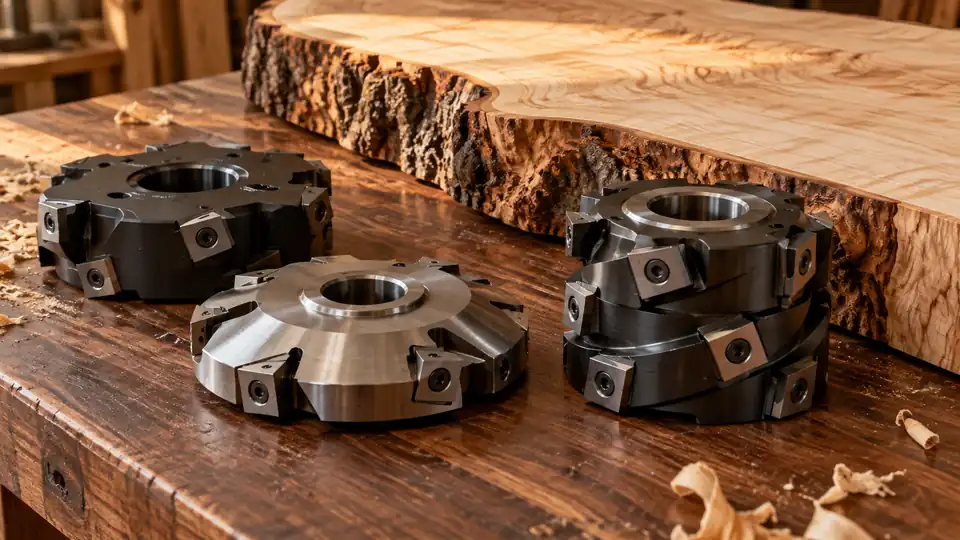
A slab can look wonderfully rustic until it rocks like a café table on a crooked floor. A flattening router bit fixes the geometry by sweeping across the work in a router sled or CNC machine, but cutter diameter, shank size, insert layout, and operating limits shape the experience. A broad cutter clears each lane quickly, while a smaller one trades speed for easier handling and greater clearance around some router bases.
The expensive mistake is buying by diameter alone. A 2-inch or 3-inch cutter must fit the router’s collet, clear its base opening, stay within the documented RPM limit, and suit the machine’s capacity. Insert cutters offer replaceable or rotatable edges, whereas brazed carbide-tipped bits have a simpler body but eventually require sharpening or replacement. The sled matters too. Loose rails, an out-of-square carriage, or an ambitious first pass can leave ridges across a slab regardless of how impressive the cutter looks.
Different shops need different answers. A frequent slab worker may value indexable inserts, while someone resurfacing an occasional glue-up may prefer a straightforward carbide-tipped bit. The SICWOOD 2-inch six-wing bit is the strongest overall package here because its 1/2-inch shank, six replaceable inserts, broad material support, and clearly documented 18,000 RPM ceiling create a useful foundation for careful router-sled work.
Quick Answer
- Best overall: SICWOOD 2-Inch Six-Wing Slab Flattening Router Bit for a well-documented six-insert design and 1/2-inch shank.
- Best for wide surfacing: Akylin 3-Inch Six-Wing Router Bit for its unusually broad cutting diameter and indexable inserts.
- Best 1/2-inch-shank value: POWERTEC 73055 for a conventional 2-inch carbide-tipped cutter with a stated operating range.
- Best compact insert option: BINSTAK 1-3/8-Inch 2+2 Insert Bit for replaceable edges in a smaller 1/4-inch-shank format.
Best Router Bits For Slab Flattening Comparison Table
| Product | Best For | Shank | Cutter | Cutting Design | Operating Information |
|---|---|---|---|---|---|
| SICWOOD 2-Inch Six-Wing Bit | Overall router-sled use | 1/2 inch | 2-inch diameter | Six four-sided carbide inserts | 18,000 RPM maximum; 2 HP minimum stated |
| BINSTAK 2-Inch Six-Wing Insert Bit | TiN-coated insert edges | 1/2 inch | 2-inch diameter | Six four-sided inserts | RPM limit not clearly specified |
| Akylin 3-Inch Six-Wing Bit | Wide surfacing passes | 1/2 inch | 3-inch diameter | Six primary plus two additional inserts | 12,000 RPM stated |
| BINSTAK 1-1/2-Inch Four-Wing Bit | Basic 1/4-inch-collet setups | 1/4 inch | 1-1/2-inch diameter, 1/4-inch cut length | Four carbide-tipped wings | RPM limit not clearly specified |
| BINSTAK 2-Inch Four-Wing Bit | Deeper documented cutting length | 1/2 inch | 2-inch diameter, 1/2-inch cut length | Four carbide-tipped wings | RPM limit not clearly specified |
| POWERTEC 73056 | Full-size routers with 1/4-inch collets | 1/4 inch | 2-inch diameter, 1/2-inch cutting depth | Tungsten carbide-tipped edges | 14,000 to 16,000 RPM; excludes compact routers |
| BINSTAK 1-3/8-Inch 2+2 Insert Bit | Compact replaceable-insert format | 1/4 inch | 1-3/8-inch diameter | Four indexable carbide inserts | RPM limit not clearly specified |
| Mikniri 1-1/2-Inch Four-Wing Bit | Occasional surfacing and grooving | 1/4 inch | 1-1/2-inch diameter, 1/4-inch cut length | Four-wing carbide cutter | RPM limit not clearly specified |
| POWERTEC 73055 | Straightforward 1/2-inch-shank value | 1/2 inch | 2-inch diameter, 1/2-inch cutting depth | Tungsten carbide-tipped edges | 14,000 to 16,000 RPM |
The detailed reviews below explain where each cutter fits and which specifications deserve a second look before the router starts humming.
1. SICWOOD 2-Inch Six-Wing Slab Flattening Router Bit — Best Overall

The SICWOOD combines a practical 2-inch cutting diameter with a reassuringly stout 1/2-inch shank and six indexable carbide inserts. Each 12 by 12 by 1.5 mm insert has four usable edges, so a dull edge can be rotated rather than forcing replacement of the entire cutter. That maintenance model makes sense for a bit likely to chew through dusty hardwood, plywood glue lines, MDF, or cured epoxy.
Its documentation is unusually specific about setup. SICWOOD lists an 18,000 RPM maximum, calls for a router rated at least 2 HP, and advises beginning a test run below 10,000 RPM before increasing speed gradually. It also warns that small insert-height deviations can create vibration. That may sound fussy, yet a six-wing cutter spinning above a valuable slab is exactly where fussy setup pays dividends. Check every screw, square the sled, and keep those first passes shallow.
Pros
- Six carbide inserts distribute cutting around a 2-inch body.
- Four usable edges on each insert extend service before replacement.
- A 1/2-inch shank suits routers equipped with the matching collet.
- The stated material range includes hardwood, softwood, MDF, plywood, acrylic, and epoxy resin.
- Maximum RPM and minimum router-power guidance are explicitly documented.
Cons
- All six inserts require careful seating and tightening to limit imbalance.
- The stated 2 HP minimum rules out lighter routers regardless of collet availability.
This SICWOOD is aimed at users with a stable sled, a capable 1/2-inch-collet router, and the patience to inspect an indexable cutter before every session. Its central trade-off is setup complexity: six serviceable edges offer flexible maintenance, but they create six points that must sit flat and remain secure.
To buy this product, click here.
2. BINSTAK 2-Inch Six-Wing Carbide Insert Slab Flattening Router Bit — Best Coated Insert Design

BINSTAK takes the same useful 2-inch and 1/2-inch-shank formula in a different direction by fitting six 10 by 10 by 2.2 mm carbide inserts with a TiN coating. The listing claims longer life than uncoated inserts, though actual service depends heavily on material, pass depth, debris, and setup. The meaningful fact is simpler: the edges are coated, replaceable, and indexable on four sides.
The steel body incorporates an anti-kickback profile, and the supplied applications span slab flattening, spoilboard resurfacing, hardwood, softwood, MDF, plywood, laminate, particleboard, and acrylic. BINSTAK also identifies CNC, automatic, handheld, and table-mounted routers as supported tool types. That broad language still does not replace a base-clearance or router-capacity check, especially with a cutter this wide. Shank fit is merely the first gate.
Pros
- Six inserts provide multiple cutting edges around the 2-inch body.
- TiN-coated carbide inserts are documented rather than inferred from appearance.
- Each insert has four usable edges for rotation and eventual replacement.
- The 1/2-inch shank is well matched to many full-size router-sled setups.
- Supported applications include slab work, spoilboards, sheet goods, wood, laminate, and acrylic.
Cons
- A maximum or recommended RPM range is not clearly specified in the supplied information.
- Six insert screws add inspection time before cutting.
Choose this model if coated indexable edges are more appealing than a brazed carbide body and your router can safely accommodate a 2-inch cutter. Buyers who want explicit speed guidance may feel more comfortable with the SICWOOD or either POWERTEC model, whose listings provide operating figures.
To buy this product, click here.
3. Akylin CNC Slab Flattening Router Bit 3-Inch Cutting Diameter — Best For Wide Surfacing Passes

A 3-inch cutter covers considerably more width per lane than the 1-3/8-inch, 1-1/2-inch, and 2-inch alternatives here. That makes the Akylin intriguing for broad glue-ups, spoilboards, and large slabs where repeated sled passes become tedious. Its 1/2-inch shank supports the large steel body, while the specified 12,000 RPM figure gives users a concrete operating limit to reconcile with their router and manual.
The cutting head carries six primary inserts plus two additional inserts, with 14 by 14 by 2 mm dimensions listed for the cutting flutes. Each indexable insert offers four edges, and a screwdriver is supplied for rotation or replacement. The body is documented as 42CrMo4 steel with a black bronzed surface. Big diameter brings a big caveat, though. Base-opening clearance, router capacity, sled rigidity, and secure workholding all demand closer scrutiny before this broad cutter goes anywhere near the stock.
Pros
- A 3-inch cutting diameter reduces the number of lanes across broad workpieces.
- Indexable inserts provide four usable edges apiece.
- The eight-insert arrangement includes cutters positioned for bottom surfacing and corner clearance.
- A solid-steel 1/2-inch shank accompanies the large cutter body.
- The supplied specification identifies 12,000 RPM.
Cons
- The 3-inch diameter requires more clearance and careful capacity checks than smaller cutters.
- Eight inserts and their screws require methodical inspection before operation.
This Akylin fits a rigid, appropriately sized system where fewer, wider passes carry real value. Skip it if the router manual, base opening, or sled leaves any doubt about a 3-inch cutter. A 2-inch option is less dramatic, but its smaller sweep can make setup and overlap management more approachable.
To buy this product, click here.
4. BINSTAK 1-1/2-Inch Four-Wing Slab Flattening Router Bit — Best Simple 1/4-Inch-Shank Option

This BINSTAK uses a conventional carbide-tipped, four-wing layout rather than replaceable inserts. Its 1-1/2-inch diameter sits in a sensible middle ground: wider than a basic 1-inch spoilboard cutter, yet less demanding in sweep than the 2-inch and 3-inch picks. A 1/4-inch cutting length supports shallow surfacing work, which is where a router sled should usually begin anyway.
The hardened-steel body has an anti-kickback design and a heat-resistant Teflon coating intended to reduce resin buildup. Supported materials include solid wood, MDF, laminate, particleboard, plywood panels, and acrylic, while the listing excludes metal and other unsupported nonwood materials. BINSTAK names CNC, handheld, and table-mounted routers, but users must still verify that their particular router permits the cutter diameter and intended operation.
Pros
- A 1/4-inch shank fits matching collets without an adapter.
- The 1-1/2-inch diameter balances pass width with a smaller sweep than 2-inch cutters.
- Four carbide-tipped wings create a straightforward cutter layout.
- The Teflon-coated body is intended to make resin cleanup easier.
- The bit can also perform documented trimming, slotting, and grooving tasks.
Cons
- The carbide tips are not documented as indexable or replaceable inserts.
- No operating RPM limit is clearly supplied in the product information.
This is a practical match for occasional flattening, spoilboard cleanup, or shallow bottom-cleaning work with a compatible 1/4-inch-collet router. Frequent slab work may justify an insert cutter whose worn edges can be rotated, while this simpler design asks for less insert maintenance at the outset.
To buy this product, click here.
5. BINSTAK 2-Inch Four-Wing CNC Spoilboard Surfacing Router Bit — Best Conventional 2-Inch BINSTAK

For woodworkers who prefer a fixed carbide-tipped head over multiple insert screws, this BINSTAK pairs a 2-inch cutting diameter with a 1/2-inch shank and 1/2-inch cutting length. The four-wing body is coated with heat-resistant Teflon, and its anti-kickback geometry provides a more conventional alternative to the company’s six-insert model.
The stated uses cover slab flattening, spoilboard resurfacing, trimming, slotting, and grooving in wood, MDF, laminate, particleboard, plywood panels, and acrylic. A collet reduction sleeve is included, but that accessory should not blur the core requirement: the flattening bit itself has a 1/2-inch shank and belongs in a correctly sized 1/2-inch collet. Never use an improvised arrangement simply because an extra sleeve appears in the package.
Pros
- The 2-inch cutter clears a useful width on each sled pass.
- A 1/2-inch shank provides direct fit in a matching collet.
- The 1/2-inch cutting length is clearly documented.
- Four carbide-tipped wings avoid the maintenance of multiple indexable inserts.
- The supported material list includes common woods, sheet goods, laminate, and acrylic.
Cons
- Worn cutting edges cannot be rotated like four-sided indexable inserts.
- The supplied details do not clearly identify an operating RPM range.
Pick this BINSTAK if you want a broad 2-inch cutter and would rather clean a coated, fixed-tip body than manage six removable blades. The six-wing BINSTAK offers serviceable insert edges, while this version counters with a simpler head and a documented 1/2-inch cutting length.
To buy this product, click here.
6. POWERTEC 73056 2-Inch Slab Flattening Router Bit — Best 1/4-Inch Shank For Full-Size Routers

The POWERTEC 73056 presents an unusual combination: a broad 2-inch cutter on a 1/4-inch shank. POWERTEC removes some ambiguity by explicitly positioning it for CNC machines, router sleds, router tables, and full-size routers, while stating that it is unsuitable for trim, compact, or palm routers. That restriction matters far more than the fact that many small routers happen to accept 1/4-inch shanks.
Its hardened-steel body carries tungsten carbide-tipped cutting edges, with a 1/2-inch cutting depth and anti-kickback design. POWERTEC specifies an optimal range of 14,000 to 16,000 RPM and recommends shallow or gradually increasing passes. The supplied clamping instruction calls for seating the shank fully and then withdrawing it 2 to 3 mm before tightening, which keeps the bit from bottoming out in the collet.
Pros
- A documented 14,000 to 16,000 RPM range aids router setup.
- The 2-inch diameter covers more width than the smaller 1/4-inch-shank options.
- A 1/2-inch cutting depth is explicitly stated.
- Tungsten carbide-tipped edges are mounted on a hardened-steel body.
- Supported uses include slab flattening, spoilboard surfacing, live-edge planing, dados, and grooves.
Cons
- POWERTEC expressly excludes trim, compact, and palm routers.
- The fixed carbide-tipped design lacks rotatable insert edges.
The 73056 fits buyers whose full-size router has a 1/4-inch collet and whose manual permits this cutter diameter. Its clear restriction is actually helpful. Anyone using a compact router should move past this model rather than treating collet fit as permission to spin a 2-inch surfacing head.
To buy this product, click here.
7. BINSTAK 1-3/8-Inch 2+2 Insert Slab Flattening Router Bit — Best Compact Insert Cutter

At 1-3/8 inches across, this BINSTAK is the smaller indexable cutter in the group. It has a 1/4-inch shank and a 2+2 arrangement of four 12 by 12 mm carbide inserts. That layout gives users replaceable cutting edges without stepping up to the broad 2-inch or 3-inch bodies, an appealing combination where base clearance or controlled overlap favors a modest diameter.
All four edges of each insert can be used, so routine maintenance involves rotating a dull edge outward and tightening the screw correctly. Supported work includes slabs, spoilboards, hardwood, softwood, MDF, plywood panels, particleboard, laminate, and acrylic. BINSTAK lists CNC, automatic, handheld, and table-mounted routers, though the router manufacturer’s cutter-capacity and speed guidance remains the deciding authority.
Pros
- The 1-3/8-inch cutter is more compact than the 2-inch and 3-inch insert models.
- A 1/4-inch shank fits routers with the corresponding collet.
- Four indexable inserts provide four usable edges apiece.
- The super-strength steel body incorporates anti-kickback geometry.
- Supported materials range from hardwood and softwood to MDF, laminate, and acrylic.
Cons
- The smaller diameter requires more lanes across a broad slab than larger cutters.
- No maximum or recommended RPM is clearly documented in the supplied data.
This cutter suits someone who wants indexable maintenance in a smaller format and is willing to make additional passes across wide stock. It may be easier to accommodate than the 2-inch insert models, but shank size alone never confirms that a particular router can safely handle the operation.
To buy this product, click here.
8. Mikniri 1-1/2-Inch Four-Wing Slab Flattening Router Bit — Best For Occasional Surfacing

The Mikniri follows a familiar recipe: a 1/4-inch shank, 1-1/2-inch cutting diameter, four-wing carbide cutter, and 1/4-inch cutting length. Its carbon-steel body has anti-kickback geometry and a heat-resistant Teflon coating intended to limit resin accumulation. Those dimensions put it near the BINSTAK 1-1/2-inch model, making it suitable for shallow surfacing rather than deep excavation.
Documented materials include solid wood, hardwood, softwood, particleboard, plywood, and MDF. The listing also identifies handheld, desktop, and CNC routers, along with flattening, spoilboard resurfacing, trimming, slotting, and grooving. A bit may support several operations, but slab work still calls for a rigid sled and restrained passes. Trying to erase a large cup in one plunge is a recipe for chatter, heat, and a rather memorable noise.
Pros
- The 1/4-inch shank fits the corresponding router collet directly.
- A 1-1/2-inch cutting diameter offers useful coverage without a 2-inch sweep.
- The four-wing carbide layout is simple to inspect.
- Teflon coating is intended to reduce resin buildup on the body.
- Documented applications extend beyond flattening to trimming, grooves, and slots.
Cons
- The supplied details do not identify a clear RPM range or maximum.
- The 1/4-inch cutting length is shallower than the 1/2-inch depth documented for both POWERTEC cutters.
The Mikniri makes the most sense for occasional slab cleanup, spoilboard maintenance, and general bottom-cutting tasks in supported wood products. Buyers planning regular resurfacing may prefer indexable inserts, while this fixed four-wing head offers a less complicated starting point.
To buy this product, click here.
9. POWERTEC 73055 2-Inch Slab Flattening Router Bit — Best 1/2-Inch-Shank Value
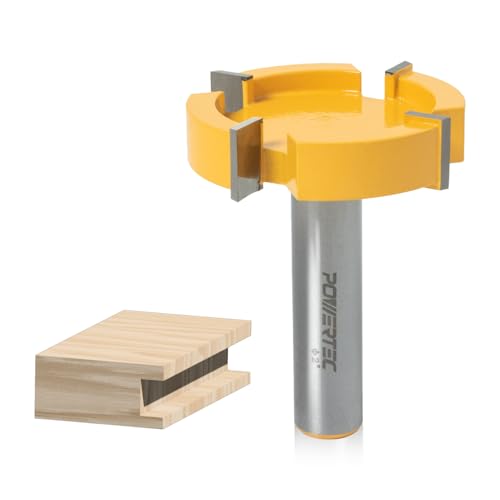
The POWERTEC 73055 shares the 2-inch diameter and 1/2-inch cutting depth of the 73056, but moves to a 1/2-inch shank. That is the more natural pairing for many full-size router-sled setups, provided the router manual allows a cutter of this size. The hardened-steel body carries tungsten carbide-tipped edges and anti-kickback geometry rather than serviceable insert knives.
POWERTEC documents compatibility with CNC machines, handheld routers, router sleds, and table-mounted routers. It also provides the same 14,000 to 16,000 RPM operating range and advises shallow or gradually increasing cuts. Those details remove some of the guesswork that hangs over cutters with no published range in the supplied information. Base clearance, collet condition, workholding, and sled stability still need an individual check before use.
Pros
- The 1/2-inch shank suits routers equipped with a matching full-size collet.
- A 2-inch cutting diameter provides broad coverage for sled passes.
- The documented cutting depth is 1/2 inch.
- POWERTEC supplies an operating range of 14,000 to 16,000 RPM.
- The cutter supports slab flattening, spoilboard surfacing, wood milling, dados, slots, and grooves.
Cons
- Fixed carbide tips lack the rotatable edges found on indexable cutters.
- A 2-inch diameter still requires verified router capacity and base-opening clearance.
This POWERTEC fits buyers seeking an uncomplicated 1/2-inch-shank surfacing cutter with clearly stated speed guidance. It sacrifices the replaceable-edge economy of the SICWOOD and BINSTAK insert models, but the simpler head may appeal to users who flatten slabs only occasionally.
To buy this product, click here.
Buying Guide
Match The Shank To The Actual Collet
A 1/4-inch shank belongs in a sound 1/4-inch collet, and a 1/2-inch shank belongs in a sound 1/2-inch collet. The larger size is common on full-size routers used for sled work, while 1/4-inch shanks appear on several cutters here. Collet fit does not establish that the router can handle the cutter’s diameter. The POWERTEC 73056 proves the point neatly: it has a 1/4-inch shank but is expressly excluded from compact, trim, and palm routers.
Choose Cutter Diameter With The Whole System In Mind
A broad cutter makes fewer lanes across a tabletop, which sounds glorious when a slab is several feet wide. Yet the 3-inch Akylin demands more base clearance and careful capacity verification than a 1-3/8-inch BINSTAK. Wider heads also magnify the importance of rigid rails and consistent overlap. If the sled flexes or the router tilts slightly, every broad sweep can leave a ridge that must be removed later.
Understand Insert Versus Carbide-Tipped Bodies
Indexable cutters such as the SICWOOD and six-wing BINSTAK carry small carbide inserts secured by screws. Once one edge dulls, the insert can be rotated to a fresh side. That is handy around abrasive MDF, resinous lumber, or epoxy-filled work, but every insert must sit flat and remain tight. Fixed carbide-tipped cutters have fewer removable parts to inspect, though their edges cannot be indexed in the same fashion.
Respect Published RPM Information
Large-diameter cutters have operating limits that cannot be replaced by a universal rule of thumb. The SICWOOD lists an 18,000 RPM maximum, the Akylin states 12,000 RPM, and both POWERTEC models identify 14,000 to 16,000 RPM as their operating range. For products without clear speed data here, consult current manufacturer instructions before use. Never assume the router’s highest dial setting is appropriate merely because the bit fits its collet.
Use Shallow, Controlled Passes
Flattening removes high spots until the entire face lies in one plane. A badly cupped slab may require several passes, possibly followed by flipping and treating the second face. Shallow cuts reduce the load on the bit and router while giving the operator a better chance to spot vibration, loose workholding, or a sled problem. Forcing full correction in one pass saves little if the result is chatter or scorched wood.
Build Accuracy Into The Sled
The cutter follows the router, and the router follows the rails. If those rails twist, sag, or sit out of parallel, the finished face inherits the error. Secure the slab so it cannot rock, shim it without introducing stress, and confirm that the router carriage moves freely across the full width. Dust collection also deserves planning because a wide surfacing bit can throw an astonishing volume of chips in a hurry.
Inspect Before Every Session
Disconnect power before touching the bit. Check the collet, shank, carbide edges, insert screws, and cutter body for contamination or damage, then confirm that the bit clears the base throughout the intended movement. Wear eye and hearing protection, control dust, and keep hands away from the cutting path. With insert bits, inspect every knife rather than assuming the screw that felt tight last time remains tight today.
Best Router Bits For Slab Flattening FAQ
Is A 1/2-Inch Shank Better For Slab Flattening?
A 1/2-inch shank is a sensible match for many full-size routers and broad surfacing cutters, but “better” depends on the documented router and bit combination. Several eligible 1/4-inch-shank cutters support flattening, including the POWERTEC 73056, although that specific model still requires a full-size router. Match the shank exactly and verify cutter capacity separately.
What Cutter Diameter Works Best In A Router Sled?
Two-inch cutters offer a useful compromise between pass width and physical size, which explains why they appear so often in this group. A 3-inch cutter can reduce the number of passes, while 1-3/8-inch and 1-1/2-inch cutters may be easier to accommodate. The router manual, base opening, sled rigidity, and bit speed limit should settle the decision.
Are Replaceable Inserts Worth Buying?
They can be worthwhile for frequent surfacing because four-sided inserts provide multiple usable edges before the cutter body needs new knives. They also introduce maintenance. Each insert must be clean, correctly seated, and securely tightened, and a multi-wing cutter has several screws to inspect. Occasional users may prefer a fixed carbide-tipped body for its simpler layout.
Can A Slab Flattening Bit Be Used In A Compact Router?
Only where the router and bit manufacturers support that combination. A 1/4-inch shank does not automatically make a wide cutter suitable for a palm router. POWERTEC explicitly excludes compact, trim, and palm routers from use with its 2-inch 73056, which is a valuable warning against choosing by collet size alone.
How Deep Should Each Flattening Pass Be?
No single depth suits every router, cutter, wood species, and slab condition. Begin with a restrained pass that removes the highest areas, then increase only within the manufacturer’s guidance and the router’s capability. The POWERTEC instructions specifically recommend shallow passes or gradual depth increases, a sound approach for keeping the cut controlled.
Why Does A Flattening Bit Leave Ridges?
Ridges can come from uneven rails, router tilt, inconsistent overlap, loose workholding, cutter deflection, or inserts seated at slightly different heights. Check the sled before blaming the carbide. On an insert head, clean each pocket and verify that every knife is seated uniformly. A final light pass with steady overlap can help, but it cannot correct twisted rails.
Can These Bits Cut Epoxy-Filled Slabs?
The SICWOOD explicitly lists epoxy resin among its supported materials. Other products should be used only in materials named by their manufacturers. Epoxy can create fine dust and may behave differently from surrounding wood, so effective dust control, shallow cuts, and regular edge inspection remain prudent.
Do I Need To Flatten Both Sides Of A Slab?
Often, yes. The first face establishes a flat reference, and the slab can then be flipped so the opposite face becomes parallel. The exact sequence depends on the stock and finished thickness. Support and shim the first setup carefully because a rocking slab can shift under cutting pressure and spoil that reference face.
Final Verdict
The SICWOOD 2-Inch Six-Wing Slab Flattening Router Bit is the best overall recommendation among these nine cutters. Its 1/2-inch shank, six four-sided carbide inserts, 2-inch diameter, broad documented material range, and explicit 18,000 RPM ceiling make it a well-defined option for a capable router and rigid sled. The setup demands care, particularly around insert seating and the stated 2 HP minimum, but those instructions clarify the system it expects.
For maximum coverage, the 3-inch Akylin is the more ambitious pick, provided the router, base, and sled can safely support its size and 12,000 RPM specification. The POWERTEC 73055 offers a simpler 1/2-inch-shank alternative with a documented 14,000 to 16,000 RPM range, while the BINSTAK 1-3/8-inch insert bit brings indexable edges to a smaller format. Start with collet fit, cutter clearance, router capacity, and published speed guidance. Pass width comes after those fundamentals, no matter how tempting a giant cutter looks.
