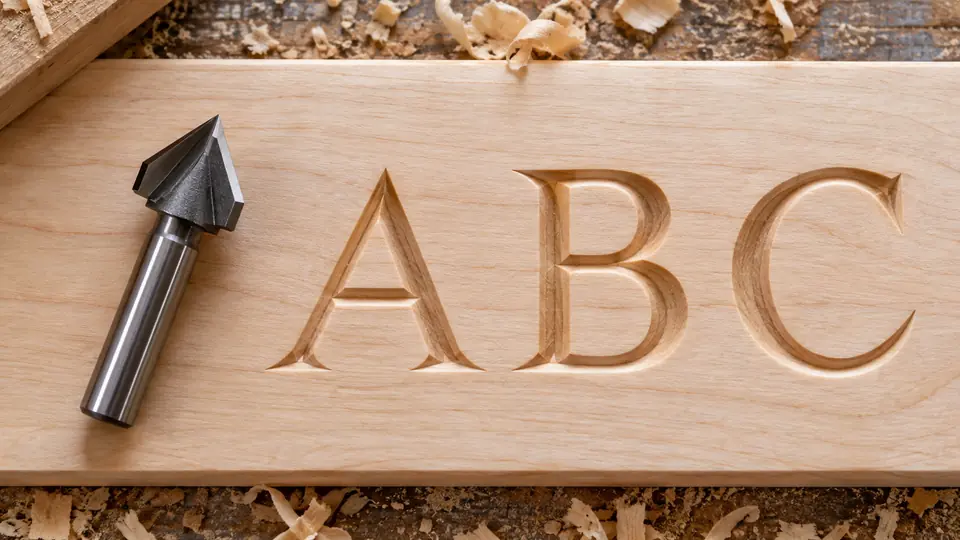
A lettering bit can turn a plain board into a crisp house sign, or leave it looking like a fuzzy trench map. The difference often begins with geometry. A narrow 20-degree cutter traces small characters and tight corners, while a 90-degree V-bit opens broad, readable grooves as cutting depth increases. Shank size matters just as much. A 1/8-inch CNC collet cannot accept a 1/4-inch shank, regardless of how tempting the bit set looks.
Common buying mistakes include selecting angles without thinking about letter size, confusing shank diameter with cutting diameter, and assuming every CNC engraving cutter belongs in a handheld router. Material claims also deserve restraint. MDF, hardwood, acrylic, and aluminum place different demands on an edge, so compatibility stated for one cutter should never be transferred to another. For most signmaking projects, the useful checkpoints are shank fit, included angles, tip geometry, cutter construction, documented operating limits, and whether the job calls for delicate outlines or chunky V-carved lettering.
Different shops will land on different answers. A desktop CNC owner may favor 1/8-inch bits with 0.1 mm tips, while someone cutting larger wooden signs may want a stiffer 1/4-inch shank. The Genmitsu 10-piece flat and triangular V-bit set is the strongest overall recommendation here because it supplies five angles in two distinct geometries, giving CNC users considerable room to tune letter width and detail without collecting bits one at a time.
Quick Answer
- Best Overall: Genmitsu 10-piece flat and triangular V-bit set for varied CNC lettering geometry.
- Best Angle Selection: Genmitsu 10-piece conical V-bit set for angles ranging from 10 to 90 degrees.
- Best 1/4-Inch CNC Set: EANOSIC five-piece carving set for common detail, profile, and V-groove work.
- Best Focused Cutter Pack: SpeTool five-piece 30-degree set for repeated work with one angle.
Best Router Bit For Engraving Letters Comparison Table
| Product | Best For | Profile | Shank | Key Specification |
|---|---|---|---|---|
| Genmitsu Flat and Triangular Set | Overall CNC lettering flexibility | Flat and triangular V-bits, 20° to 90° | 1/8 inch | 10 pieces, 0.1 mm tips |
| Genmitsu Conical V-Bit Set | Broad angle selection | Conical V-bits, 10° to 90° | 1/8 inch | 10 pieces, 0.1 and 0.3 mm tips |
| EANOSIC Five-Piece Set | Common 1/4-inch CNC profiles | 15°, 20°, 30°, 60°, and 90° | 1/4 inch | 2-1/2-inch overall length, 24,000 maximum RPM |
| SpeTool 30-Degree Set | Repeated 30-degree engraving | Four-flute 30° V-bit | 1/4 inch | Five solid-carbide, TiAlN-coated bits |
| MNA Signmaking Set | V-grooves and rounded relief | 90° V-groove and round nose | 1/4 inch | C3 carbide, two profiles |
| Jiiolioa V21201 | Narrow letter outlines | 20° V-point | 1/4 inch | 2-inch overall length |
| Five-Piece Multi-Angle Set | Handheld and CNC routing | 30°, 45°, 60°, 90°, and 120° | 1/4 inch | Carbide-tipped, 16,000 to 24,000 recommended RPM |
| SILIVN Four-Piece Set | Detailing plus wider grooves | 15°, 20°, 60°, and 90° | 1/4 inch | Tungsten-steel cutters, individual cases |
| FoxAlien Triangular Set | Duplicate bits for CNC production | Triangular 20° to 90° | 1/8 inch | 10 pieces, two per angle, 0.1 mm tips |
The detailed reviews below clarify how each geometry, shank, and package fits a different style of lettering.
1. Genmitsu 10 Pcs 1/8” Shank CNC Router Bits Set — Best Overall

Genmitsu combines five angles with two cutting geometries in this 10-piece kit. The flat V-bits and triangular V-bits come in 20, 30, 45, 60, and 90-degree versions, each using a 0.1 mm tip and 1/8-inch shank. That pairing is genuinely useful for CNC signmaking. A narrow angle can trace fine lettering, while a wider cutter can form bolder grooves whose visible width grows quickly with depth.
The advertised material range covers hardwood, plywood, acrylic, plastic fiber, resin, PCB, and aluminum. Alloy-steel construction and a blue nano coating are documented, although those details do not replace appropriate toolpaths and machine settings. Picture a design containing tiny subtitle text beneath a large family name. This set lets the operator assign different geometry and angle combinations rather than forcing one cutter through both parts of the layout.
Pros
- Includes five practical engraving angles from 20 to 90 degrees.
- Supplies both flat and triangular V-bit geometries.
- All 10 cutters use CNC-friendly 1/8-inch shanks.
- Each cutter has a documented 0.1 mm tip.
- Specified for lettering across wood, acrylic, resin, PCB, and aluminum.
Cons
- The 1/8-inch shanks require a matching collet and will not fit a 1/4-inch collet directly.
- Maximum RPM and overall cutter length are not clearly specified.
This is the most rounded option for a desktop CNC owner who wants to experiment with letter proportions, 2D work, and 3D carving. Buyers committed to 1/4-inch tooling should move toward the EANOSIC set, but the Genmitsu kit offers a more varied geometry lesson in one compact package.
To buy this product, click here.
2. Genmitsu 10 Pcs 1/8″ Shank V-Groove CNC Router Bits — Best Angle Selection

Angle choice is the headline here. This Genmitsu set includes 10, 15, 20, 25, 30, 40, 45, 60, and 90-degree conical cutters, plus a second 90-degree bit. Most carry a 0.1 mm tip, while one 90-degree cutter has a broader 0.3 mm tip. That progression lets a CNC user make small adjustments to the relationship between cutting depth and the width visible at the surface.
For example, tightly spaced script may benefit from a narrow included angle because the groove stays slender as the tool descends. Large block letters can use a wider angle to produce a more open V with less depth. Genmitsu specifies alloy-steel construction, blue nano coating, and suitability for hardwood, plywood, acrylic, resin, PCB, and aluminum. The package is especially appealing for design work where 20 and 30 degrees feel too far apart.
Pros
- Provides nine distinct angles spanning 10 to 90 degrees.
- Fine 0.1 mm tips cover most cutters in the set.
- A 0.3 mm 90-degree bit adds a broader-tip option.
- All cutters share a 1/8-inch shank for compatible CNC collets.
- Documented applications include signmaking, lettering, and V-groove work.
Cons
- The set concentrates on conical V-bits rather than mixing cutter geometries.
- Its small shank excludes machines equipped solely with a 1/4-inch collet.
Choose this kit when subtle angle changes matter more than having flat and triangular alternatives. It suits CNC lettering, fine line art, and test cuts used to determine which angle gives a chosen font enough visual weight without crowding adjacent strokes.
To buy this product, click here.
3. EANOSIC 5PCS CNC Wood Carving Router Bits Set — Best 1/4-Inch CNC Set

EANOSIC covers the familiar signmaking sequence with a 15-degree detail carving liner, 20-degree profile cutter, and 30, 60, and 90-degree V-groove bits. Every tool has a 1/4-inch shank and 2-1/2-inch overall length. The supplied maximum speed is 24,000 RPM, a useful specification that should still be read alongside the router or CNC manual and the requirements of the workpiece.
The manufacturer identifies the 30-degree bit as solid carbide with a blue nACo coating. It does not clearly state that every cutter has identical construction, so that claim should remain attached to the 30-degree tool. Supported materials include softwood, hardwood, particleboard, MDF, plywood, compact panel, laminate, and acrylic. A sign with thin boundary lines and a broad central name could put several of these profiles to work without changing shank systems.
Pros
- Includes five angles suited to detail lines, profiles, and broad V-grooves.
- Uses a consistent 1/4-inch shank across the set.
- Overall length is documented at 2-1/2 inches.
- Maximum speed is clearly listed as 24,000 RPM.
- The 30-degree cutter is specified as solid carbide with a blue nACo coating.
Cons
- The solid-carbide specification is stated specifically for the 30-degree cutter, not clearly for every bit.
- Only five angles are included, fewer than either Genmitsu assortment.
This set fits CNC users whose machines accept 1/4-inch shanks and whose work shifts between fine outlines and conventional V-carved letters. The central trade-off is straightforward: fewer angle increments than the 1/8-inch Genmitsu kits, paired with a larger shank and a documented operating limit.
To buy this product, click here.
4. SpeTool 5pcs 30 Degree V Groove Router Bit — Best Focused Cutter Pack
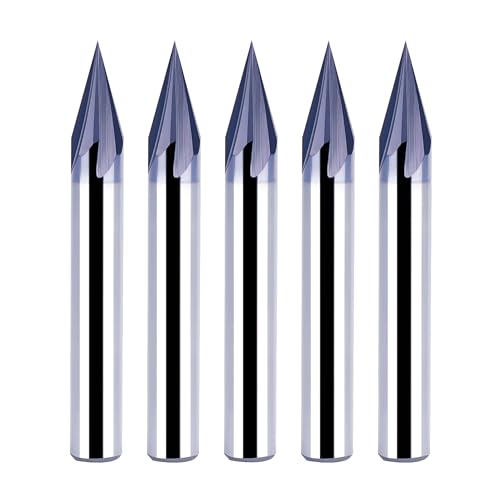
Rather than spreading five slots across five angles, SpeTool supplies five copies of the same 30-degree cutter. Each is a four-flute, solid-carbide V-bit with a TiAlN coating, 1/4-inch shank, and 2-inch overall length. That repetition makes sense for a shop running recurring lettering files or keeping identical replacement tooling ready for a repeatable CNC setup.
A 30-degree angle sits in useful territory for narrow letter strokes, chamfers, and detailed V-grooves. SpeTool lists hardwood, plywood, softwood, oak, MDF, and metals below HRC 55 among the supported materials. Material compatibility alone does not establish a safe toolpath, particularly in metal, but it does show that the cutter is presented for more than decorative softwood signs. Four flutes also distinguish it from the two-flute and triangular options elsewhere in this roundup.
Pros
- Five matching cutters support repeat jobs and replacement planning.
- Four-flute geometry is clearly documented.
- Each bit is specified as solid carbide with a TiAlN coating.
- The 1/4-inch shank and 2-inch overall length are stated.
- Supported uses include engraving, lettering, carving, and chamfering.
Cons
- Every bit has the same 30-degree angle, limiting lettering-width options.
- No maximum or recommended RPM is clearly supplied in the product data.
This pack makes the most sense after 30 degrees has already proven suitable for the font, stock, and toolpath. A buyer still exploring angle choices will learn more from a mixed set, while repeated production work can benefit from five cutters sharing the same documented geometry.
To buy this product, click here.
5. MNA 90 Degree V Groove and Round Nose Router Bit Set — Best For Mixed Groove Shapes

MNA takes a different route with two complementary profiles: a 90-degree V-groove bit and a round-nose bit. The V-cutter can create angular letter channels and decorative grooves, while the round-nose profile supports relief work with a softer, curved floor. Both use 1/4-inch shanks and are specified for handheld router instruments and CNC machines.
The cutters use C3 carbide, and MNA identifies MDF, hardwood, softwood, and particleboard as compatible wood materials. This is less of an angle-testing set and more of a compact signmaking pair. Think of lettering cut with crisp V-shaped strokes, surrounded by a recessed background or decorative line that benefits from the round-nose profile. That combination can produce more visual contrast than several near-identical V-bit angles.
Pros
- Combines a 90-degree V-groove cutter with a round-nose cutter.
- Both bits use common 1/4-inch shanks.
- C3 carbide construction is explicitly documented.
- Specified for MDF, hardwood, softwood, and particleboard.
- Listed for use with CNC machines and major router types accepting the shank.
Cons
- The package provides only two profiles.
- Cutter diameters, cutting lengths, and operating speed limits are not clearly specified.
Pick the MNA pair for wooden sign projects requiring angular letters and rounded relief rather than a ladder of V-bit angles. It is less suited to tiny, sharply detailed text, where a 15 or 20-degree cutter offers a narrower included angle.
To buy this product, click here.
6. Jiiolioa V21201 V-Point Router Bit — Best For Narrow Letter Outlines

The Jiiolioa V21201 is a single 20-degree V-point bit aimed squarely at outlining letters and tracing lines. Its 1/4-inch shank and 2-inch overall length are documented, as is carbide construction. A 20-degree profile keeps a groove relatively narrow for a given depth, making it conceptually better aligned with fine borders and compact lettering than a broad 90 or 120-degree cutter.
Listed materials include stainless steel, aluminum, brass, MDF, wood panels, and plastic. Those broad claims should be approached through the limits of the router or CNC, correct setup, and material-specific instructions. The attraction here is simplicity. If a design repeatedly calls for thin V-lines, buying one targeted profile avoids paying for angles that may stay in their cases.
Pros
- The 20-degree profile is well suited to narrow engraved lines.
- A 1/4-inch shank is clearly specified.
- Overall length is documented at 2 inches.
- Carbide construction is stated.
- The listed applications directly include letter outlining and line tracing.
Cons
- A single angle offers no built-in option for broader lettering.
- Tip width, cutting length, and maximum RPM are not clearly specified.
This cutter fits users who already know that a 20-degree profile matches their lettering style. For exploratory work, the EANOSIC or Genmitsu assortments offer more room to adjust the groove, but this focused bit keeps the purchase lean and specific.
To buy this product, click here.
7. 5-Piece V-Groove Router Bits Set — Best For Handheld Router Flexibility

This five-piece set covers 30, 45, 60, 90, and 120 degrees, all on 1/4-inch shanks. The supplied cutting diameters are 3/8 and 1/2 inch, with cutting lengths ranging from 1/2 to 3/4 inch. Unlike tiny 0.1 mm CNC engraving tips, these carbide-tipped tools lean toward visible V-grooves, larger lettering, chamfers, and decorative woodworking.
The listing supports CNC machines, handheld routers, and router tables, which gives this set broader documented tool compatibility than many fine-tip assortments. Its recommended range is 16,000 to 24,000 RPM, subject to the router and workpiece instructions. A 120-degree cutter can create a broad, shallow letter channel, while the 30-degree bit handles narrower strokes. That range is handy for signs intended to be read from across a room rather than examined like tiny engraving.
Pros
- Includes five angles from 30 through 120 degrees.
- Documented for CNC, handheld router, and router-table use.
- Uses 1/4-inch shanks across the complete set.
- Cutting diameters and cutting-length ranges are supplied.
- A recommended operating range of 16,000 to 24,000 RPM is stated.
Cons
- The 30-degree minimum is less specialized for very fine lettering than 10, 15, or 20-degree bits.
- Carbide-tipped construction differs from the solid-carbide options in this roundup.
This assortment suits larger signs, general woodworking, and users switching between handheld and CNC routing. Buyers concentrating on miniature text should favor finer tips and narrower angles, while broad decorative lettering plays directly to this set’s strengths.
To buy this product, click here.
8. Engraving CNC Wood Carving Router Bit Set 1/4 Shank 15°/20°/60°/90° — Best Compact Angle Set

SILIVN packages four purposeful cutters rather than filling a box with tiny angle increments. The 15-degree liner addresses detail carving, the 20-degree profile bit is intended for lettering outlines and tracing, and the 60 and 90-degree cutters handle wider V-grooves. Every bit uses a 1/4-inch shank and arrives in an individual storage case.
The tools are described as tungsten steel and intended for 2D and 3D carving. The listing emphasizes sharp edges and smooth cutting, but no independent cutting results are supplied, so geometry and compatibility are firmer reasons to buy. The sequence makes practical sense for a sign containing small line details beside larger recessed characters. One collet size covers both ends of that job.
Pros
- The 15-degree bit addresses fine detail carving.
- The 20-degree profile supports outlines and traced lines.
- 60 and 90-degree bits cover wider V-groove lettering.
- All four cutters use 1/4-inch shanks.
- Each bit includes an individual storage case.
Cons
- No intermediate 30 or 45-degree cutter is included.
- Tip dimensions, overall lengths, and operating limits are not clearly specified.
This four-piece kit works for a CNC owner who wants a clean jump from detail work to conventional V-carving without sorting through 10 cutters. The missing middle angles matter for users who fine-tune lettering width through small geometric changes.
To buy this product, click here.
9. FoxAlien 20/30/45/60/90deg 0.1mm Triangular CNC Router Bits Set — Best Duplicate-Angle Set
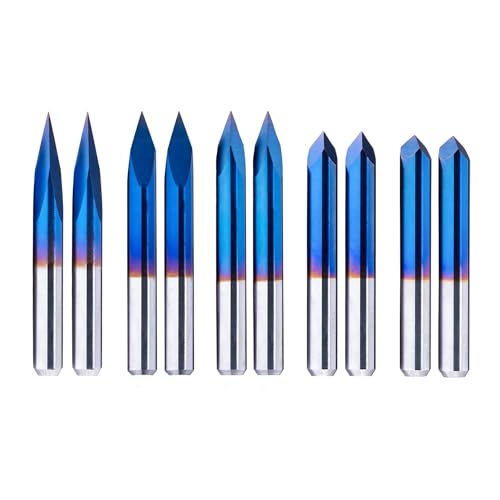
FoxAlien supplies two triangular cutters at each of five angles: 20, 30, 45, 60, and 90 degrees. All 10 bits have 1/8-inch shanks and 0.1 mm tips. Keeping duplicates can be genuinely convenient for a CNC shop that returns to the same lettering files, since a matching spare is already in the package rather than being sourced later.
The triangular shape is promoted for 2D and 3D carving, with chip clearance presented as one of its practical attributes. The stated material list includes hardwood, plywood, acrylic, plastic fiber, resin, PCB, and aluminum. Ultrafine carbide and a blue nano coating are also documented. Compared with the overall Genmitsu pick, this package gives up the alternative flat geometry in exchange for two copies of every triangular angle.
Pros
- Includes two cutters for each of five commonly used angles.
- Every bit has a documented 0.1 mm tip.
- All cutters use 1/8-inch shanks.
- Triangular geometry is specified for 2D and 3D carving.
- Material support includes wood, acrylic, resin, PCB, and aluminum.
Cons
- The package contains triangular cutters only.
- Maximum RPM, overall length, and cutting length are not clearly specified.
This set is a sensible match for users who favor triangular engraving tools and value immediate duplicates. Someone comparing geometry rather than stocking replacements will get broader experimentation from Genmitsu’s mixed flat and triangular package.
To buy this product, click here.
Buying Guide
Start With The Letter Style
Small serif text, thin script, and closely spaced outlines usually call for a narrower included angle. The groove remains comparatively slim as the cutter moves deeper, helping preserve space between adjacent strokes. Large block letters can take advantage of 60, 90, or 120-degree profiles, which create broader surface openings without requiring the same depth as a narrow cutter. A sample cut in scrap reveals far more than judging the angle by eye.
Match The Shank To The Collet
The selected shank must match a documented collet size. The 1/8-inch Genmitsu and FoxAlien sets target CNC machines equipped for small engraving tools, while the 1/4-inch choices fit a different collet category. Never clamp a mismatched shank or assume an improvised adapter makes it appropriate. Shank diameter also says nothing by itself about cutter clearance, permissible depth, or suitable speed.
Understand Angle, Tip, And Cutting Depth
A V-bit produces a wider groove as it cuts deeper, and the included angle controls how quickly that width expands. Tip size also matters. A 0.1 mm point can represent fine design detail, while a broader or flat tip leaves a different groove floor. CNC V-carving software can vary depth to follow letter width, but its output still depends on entering the cutter geometry accurately.
Choose Cutter Construction From Documented Facts
Solid carbide, carbide-tipped, alloy steel, and broadly described tungsten-steel tools should not be treated as identical. SpeTool clearly specifies solid carbide, while the five-piece 30-to-120-degree set is carbide-tipped. EANOSIC specifically identifies its 30-degree bit as solid carbide. Coatings such as TiAlN and blue nano finishes are product details, yet they do not establish an exact lifespan across different stock and toolpaths.
Check Tool And Material Compatibility
A bit described for CNC use should not automatically be placed in a handheld router merely because the shank fits. The five-piece multi-angle set explicitly supports handheld routers, CNC machines, and router tables, while several fine-tip sets are positioned around CNC engraving. Material claims also require context. Cutting wood, acrylic, or metal involves distinct chip loads, dust or chip control, workholding, and machine capabilities.
Respect Speed Limits And Setup Requirements
Use the cutter’s documented limit, router or spindle manual, and material guidance together. EANOSIC lists a 24,000 maximum RPM, while the five-piece multi-angle set recommends 16,000 to 24,000 RPM. Missing speed data is a prompt to consult the manufacturer rather than guess. Secure the work, inspect the bit, insert the shank correctly, tighten the proper collet, manage dust, wear appropriate eye and hearing protection, and disconnect power before cutter changes.
Best Router Bit For Engraving Letters FAQ
What Bit Angle Is Best For Engraving Small Letters?
Angles around 10 to 30 degrees are commonly represented among fine-lettering sets because they keep grooves comparatively narrow as depth increases. The best result still depends on font size, spacing, tip geometry, and cutting depth. Test the exact design on scrap stock before cutting the finished sign.
Is A 60 Or 90-Degree V-Bit Better For Large Letters?
Both can work. A 90-degree bit opens the groove more rapidly with depth, which suits broad, bold characters and shallower V-shaped channels. A 60-degree bit provides a narrower profile at the same depth. The preferred appearance depends on letter width and the amount of shadow or paint contrast desired.
Can A 1/8-Inch Engraving Bit Fit A 1/4-Inch Collet?
No, the sizes do not match directly. Use the collet size explicitly supported by the machine and cutter. Avoid makeshift sleeves or substitutions. If a machine offers interchangeable manufacturer-approved collets, follow its documentation for installation and permissible tooling.
What Is The Difference Between A V-Bit And A Round-Nose Bit?
A V-bit cuts an angular groove whose width changes with depth. A round-nose bit creates a curved-bottom channel and is useful for relief carving or softer decorative recesses. The MNA set includes both profiles, making the visual difference available within one package.
Are More Flutes Always Better For Letter Engraving?
No. Flute count affects cutting engagement and chip space, but it cannot be judged apart from material, machine rigidity, speed, and feed. The SpeTool cutter uses four flutes, while other listed products use triangular or two-flute geometry. Follow the tool and machine guidance rather than selecting purely by the largest flute count.
Can These Bits Engrave Acrylic Or Aluminum?
Several supplied listings state compatibility with acrylic or aluminum, including both Genmitsu sets and the FoxAlien set. That does not mean every router, spindle, or toolpath is appropriate for those materials. Confirm the machine’s capability, secure the workpiece, manage chips, and use manufacturer-supported parameters.
How Deep Should Letter Engraving Be?
There is no universal depth. A V-bit’s angle means depth directly changes visible groove width, so the correct value depends on the font, cutter geometry, stock thickness, and desired appearance. Use shallow, controlled trials in scrap and remain within the cutter and machine limits.
Should Lettering Be Cut In One Pass?
That decision depends on the cutter, material, machine, and required depth. Controlled passes can reduce the load for deeper work, while CNC V-carving toolpaths may vary depth continuously across each character. Avoid a blanket pass rule and follow the software, machine, and cutter instructions.
Final Verdict
The Genmitsu 10-piece flat and triangular V-bit set is the best overall router-bit package here for CNC letter engraving. Its 1/8-inch cutters combine 20, 30, 45, 60, and 90-degree angles with two geometries, all using documented 0.1 mm tips. That breadth gives a curious signmaker useful control over fine outlines, broader characters, and the different groove shapes produced by flat and triangular tools.
For 1/4-inch CNC tooling, the EANOSIC five-piece set offers a practical progression from a 15-degree detail liner through a 90-degree V-bit, plus a documented 24,000 maximum RPM. SpeTool is the sharper fit for repeated 30-degree work, while the five-piece 30-to-120-degree assortment better serves large lettering and documented handheld-router use. Before buying, match the shank to the exact collet, choose an angle around the font and letter size, and verify that the cutter, machine, and material are explicitly compatible.
