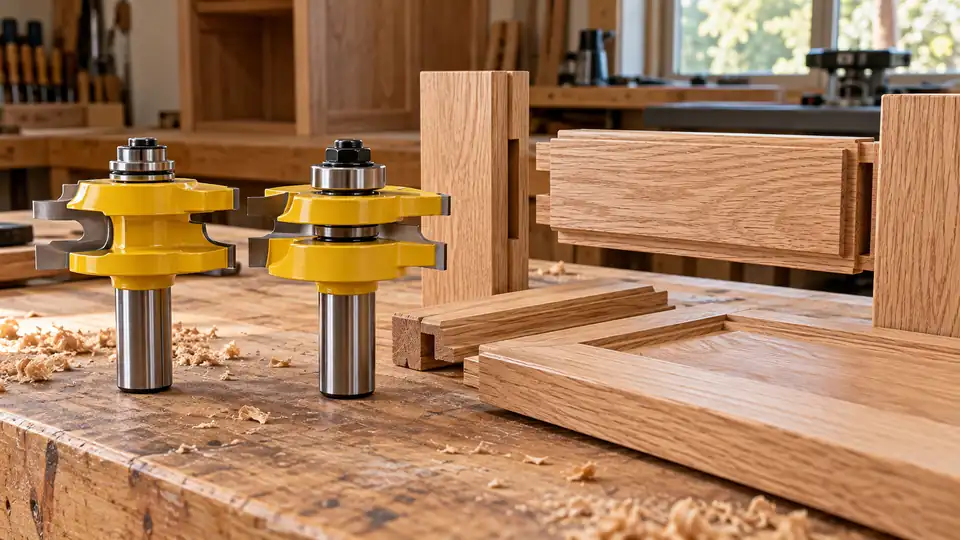
A rail-and-stile cutter can turn square lumber into a cabinet-door frame with crisp profiles and interlocking cope-and-stick joints, but tiny specification mismatches can spoil the whole job. A 1/4-inch panel may rattle in an oversized groove, thick stock may exceed a cutter’s stated range, and a beautiful ogee profile can look wildly out of place on a restrained Shaker kitchen. The best rail and stile router bit set must match the door style, panel thickness, frame stock, router collet, and intended joint geometry before a board touches carbide.
The biggest buying mistake is treating these cutters like ordinary handheld edge bits. Every selected option here is intended for a router table, where a fence, featherboards, backer board, and accurately milled test stock help keep that reassuring shhhk of a controlled cut from becoming chatter or tear-out. Shank diameter matters too. A 1/2-inch cutter cannot go into a 1/4-inch collet, while the cutter diameter and manufacturer’s operating limits influence router speed and setup.
Different shops need different answers. A cabinetmaker working with variable panel thicknesses gains useful flexibility from the Freud 99-762, our top overall recommendation, while a builder committed to Shaker doors may prefer Rockler’s matched two-piece set. Decorative doors call for roundover, bead, or ogee geometry, and small furniture doors may benefit from a junior profile rather than a visually heavy cutter, so the right pick begins with the drawing on your bench.
Quick Answer
- Best Overall: Freud Premier Adjustable Rail & Stile Bit 99-762 for its adjustable groove and broad documented stock range.
- Best Shaker Set: Rockler Shaker Rail and Stile Router Bit Set for bearing-guided, matched cope-and-stick work.
- Best Contemporary Profile: Whiteside 6009 15 Degree Shaker Stile & Rail Router Bit for actual 1/4-inch panels and a sloped Shaker detail.
- Best Complete Raised-Panel Set: YONICO 12345 3 Bit Ogee Set for cutting the frame and center-panel profile with one package.
Best Rail and Stile Router Bit Set Comparison Table
| Product | Best For | Profile | Shank | Documented Capacity |
|---|---|---|---|---|
| Freud 99-762 | Adjustable grooves | Premier adjustable | 1/2 inch | 5/8 to 1-1/4 inch stock; 7/32 to 3/8 inch groove |
| Rockler Shaker Set | Classic Shaker doors | Chamfered Shaker | 1/2 inch | Not clearly specified |
| Whiteside 6009 | Contemporary Shaker doors | 15-degree Shaker | 1/2 inch | 1/4-inch tongue; 3/8-inch tongue depth |
| Freud 99-763 | Rounded traditional detail | Roundover bead, 9/32-inch radius | 1/2 inch | 5/8 to 1-1/4 inch stock |
| YONICO 12345 | Complete raised-panel doors | Ogee frame and panel | 1/2 inch | Not clearly specified |
| YONICO 12249 | Straightforward Shaker frames | Shaker | 1/2 inch | 3/8-inch depth; stock up to 7/8 inch |
| YONICO 12241 | Soft rounded frames | Roundover | 1/2 inch | 3/8-inch depth; stock up to 1 inch |
| YONICO 12236 | Deep decorative detail | Large ogee | 1/2 inch | 7/16-inch depth; stock up to 7/8 inch |
| YONICO 12272 | Small doors and furniture | Junior roundover | 1/2 inch | 5/16-inch depth; stock up to 3/4 inch |
The detailed reviews below connect those specifications to the doors each cutter is suited to build.
1. Freud Premier Adjustable Rail & Stile Bit 99-762 — Best Overall

The Freud 99-762 addresses one of cabinetmaking’s most irritating little problems: panel material rarely obeys its nominal label. Precision shims adjust the groove from 7/32 to 3/8 inch, allowing the cutter to accommodate anything from thin veneered plywood to a thicker solid-wood panel within the documented range. That adjustment takes careful setup, but it offers meaningful control when a nominal quarter-inch sheet measures something else at the calipers.
Its 1-11/16-inch cutter rides on a 1/2-inch shank and is specified for doors from 5/8 to 1-1/4 inches thick. Freud lists hardwood, softwood, veneered plywood, doors, and windows among its applications, all through a table-mounted router. TiCo carbide and the Perma-SHIELD coating address edge life, friction, pitch accumulation, and corrosion, while the patented joint design forms an extended tenon for greater glue area.
Pros
- Groove adjusts from 7/32 to 3/8 inch with supplied precision shims.
- Supports a broad documented stock range from 5/8 to 1-1/4 inches thick.
- Specified for hardwood, softwood, and veneered plywood.
- Extended-tenon geometry provides additional joint engagement.
- TiCo carbide and Perma-SHIELD coating address wear, resin buildup, and corrosion.
Cons
- Shim adjustment adds setup work compared with a fixed-groove matched pair.
- The 1/2-inch shank requires a compatible 1/2-inch collet.
This cutter fits builders who regularly switch between panel materials or door thicknesses and are willing to make test joints before production. A shop making one fixed Shaker design may find the Rockler pair simpler, but the Freud’s adjustable groove gives mixed-material cabinet projects far more breathing room.
To buy this product, click here.
2. Rockler Shaker Rail and Stile Router Bit Set, 1/2 in Shank, 2 Piece — Best Shaker Set

Rockler’s pair cuts the cope and stick portions of a Shaker frame while adding a restrained chamfer around the panel opening. That little bevel catches a fine line of shadow without turning a clean Shaker door into an ornate raised-panel design. Separate cutters also mean the cope and profile setups can remain conceptually distinct, which is handy during a batch of rails and stiles.
Both cutters use 1/2-inch shanks, high-grade carbide, precision balancing, and bearing guidance. Rockler specifically recommends cutting the cope first, while the rail still has long square edges that can register against a flat backer board. That backer supports the fibers as the cutter exits, reducing the opportunity for the end grain to burst away with an ugly crack. The set belongs in a table-mounted router operated at the manufacturer’s reduced-speed guidance.
Pros
- Matched two-piece format separates cope and profile operations.
- Chamfered Shaker detail adds definition without a heavily ornamented edge.
- Bearing guidance helps maintain the intended cutter relationship to the stock.
- High-grade carbide is paired with sturdy 1/2-inch shanks.
- Manufacturer instructions provide useful setup and cope-cut sequencing guidance.
Cons
- Supported stock-thickness and groove-width ranges are not clearly specified in the supplied information.
- Table routing at reduced RPM is required, so a handheld setup is unsuitable.
This set suits builders committed to Shaker doors who value documented operating guidance and a subtle chamfer. It is less adaptable than the adjustable Freud 99-762, yet its matched two-cutter layout makes excellent sense for repeat batches where the same frame and panel dimensions return door after door.
To buy this product, click here.
3. Whiteside 6009 15 Degree Shaker Stile & Rail Router Bit — Best Contemporary Profile

A conventional Shaker frame presents a flat, square transition, while the Whiteside 6009 introduces a 15-degree slope around the field. The effect is still restrained, but light rolls across that bevel rather than stopping at a hard ledge. That makes the profile appealing for cabinetry that needs more movement than a square Shaker door without the curls and hollows of an ogee.
The supplied specifications are unusually helpful: a 1/2-inch shank, 1-inch cutting length, 1-5/8-inch large diameter, 1/4-inch tongue thickness, and 3/8-inch tongue depth. It is intended for actual 1/4-inch panels, a crucial distinction since nominal panel dimensions can wander. The carbide-tipped cutter is documented for natural and composite woods, giving builders a clear starting point for material planning.
Pros
- Distinctive 15-degree Shaker profile creates a clean sloped transition.
- Specified for actual 1/4-inch panels rather than an ambiguous nominal size.
- Creates a documented 1/4-inch tongue with a 3/8-inch depth.
- Uses a 1/2-inch shank for compatible 1/2-inch router collets.
- Suitable for documented use with natural and composite woods.
Cons
- The fixed 1/4-inch tongue is less adaptable than an adjustable-groove system.
- The 15-degree detail will not match projects calling for a square or traditional ogee profile.
Choose the Whiteside for contemporary furniture and cabinet doors built around actual 1/4-inch panels. Its fixed geometry rewards standardized material and careful milling, while shops routinely changing panel thickness should look toward the adjustable Freud instead.
To buy this product, click here.
4. Freud Premier Adjustable Rail & Stile Bit 99-763 — Best Roundover Bead

The Freud 99-763 swaps severe square lines for a roundover bead with a 9/32-inch radius. That rounded shoulder feels at home on traditional kitchen doors, built-ins, and furniture where a flat Shaker profile seems a touch too plain. At 1-11/16 inches in diameter and 3-3/4 inches long, this is substantial table-router tooling rather than a cutter meant to be steered freehand.
Freud specifies a 1/2-inch shank and support for five profile configurations across door thicknesses from 5/8 to 1-1/4 inches. Its patented system produces extended-tenon joints, while TiCo high-density carbide and Perma-SHIELD coating address cutter life, friction, resin, and corrosion. Hardwood and softwood are documented applications, giving the bit useful reach across common frame species.
Pros
- Roundover-bead geometry supplies a softer traditional frame detail.
- Documented 9/32-inch radius makes the visible profile predictable.
- Supports door stock from 5/8 to 1-1/4 inches thick.
- Extended-tenon design increases joint engagement at rail ends.
- Perma-SHIELD coating helps resist friction, pitch buildup, and corrosion.
Cons
- The rounded bead is visually busier than a square Shaker treatment.
- Its 1-11/16-inch diameter requires a suitable table-router setup and adherence to cutter-speed guidance.
This Freud is the refined pick for builders who want adjustable rail-and-stile capability with a visible rounded bead. It fits traditional doors better than minimalist slab-adjacent designs, and its large cutter dimensions make router-table clearance and speed planning part of the setup rather than an afterthought.
To buy this product, click here.
5. YONICO Raised Panel Cabinet Door Rail and Stile Router Bits Set 3 Bit Ogee 1/2-Inch Shank 12345 — Best Complete Raised-Panel Set

Most entries here shape the frame joint and leave the center panel to separate tooling. The YONICO 12345 packages three cutters for the rail, stile, and raised center panel, all tied together by an ogee design. For a builder starting a traditional door project, that coordinated package avoids pairing a restrained frame profile with a center panel that looks like it wandered in from another cabinet.
The cutters use 1/2-inch shanks, C3 micro-grain tungsten-carbide blades, and silver induction brazing. YONICO specifies table-mounted routing only, which is sensible for controlling the broad panel cutter and maintaining consistent fence registration. The supplied information does not state the supported stock thickness, groove width, panel-raising diameter, or operating-speed limit, so those details need confirmation before lumber is milled.
Pros
- Three-cutter package covers frame joinery and center-panel profiling.
- Coordinated ogee styling keeps the frame and raised panel visually consistent.
- Uses 1/2-inch shanks across the set.
- C3 micro-grain tungsten-carbide cutting edges are explicitly specified.
- Silver induction brazing secures the carbide to the cutter bodies.
Cons
- Key capacity details, including stock range and panel-cutter dimensions, are not clearly specified.
- The complete set is intended exclusively for table-mounted routing.
This package makes sense for traditional raised-panel doors where one coordinated ogee treatment is the goal. Skip it for flat-panel Shaker work, and verify the missing dimensional and speed information against your stock, router table, and machine manual before setup.
To buy this product, click here.
6. YONICO Cabinet Door Rail and Stile Router Bits Set 2 Bit Shaker 1/2-Inch Shank 12249 — Best Straightforward Shaker Pair

The YONICO 12249 keeps its assignment narrow: make Shaker rail-and-stile frames with a matched two-bit arrangement. It cuts to a stated depth of 3/8 inch in frame stock up to 7/8 inch thick, giving the builder concrete boundaries for milling rails and stiles. That clarity is welcome when test pieces are stacked beside the router table and a few thousandths can decide whether a joint slides together or needs a mallet.
Each cutter has a 1/2-inch shank and C3 micro-grain tungsten-carbide blades attached through silver induction brazing. The wooden storage box keeps the matched cutters together and shields the cutting edges from knocking against loose wrenches in a drawer. As with the other rail-and-stile options here, YONICO specifies a table-mounted router rather than handheld operation.
Pros
- Matched two-bit arrangement is dedicated to Shaker cabinet-door frames.
- Documented 3/8-inch cutting depth simplifies stock and joint planning.
- Accepts frame stock up to 7/8 inch thick.
- Uses C3 micro-grain tungsten-carbide cutting edges on 1/2-inch shanks.
- Wooden box protects and organizes the pair between projects.
Cons
- The fixed profile offers less adjustment than the Freud 99-762.
- Stock thicker than the documented 7/8-inch limit falls outside its stated capacity.
This is a practical fit for standard Shaker frames made from stock no thicker than 7/8 inch. It lacks the Rockler set’s supplied bearing and setup details and the Freud’s groove adjustability, but its documented depth, stock limit, and storage box make the intended use refreshingly clear.
To buy this product, click here.
7. YONICO Router Bits Set Rail and Stile 2 Bit Round Over 1/2-Inch Shank 12241 — Best Soft-Edge Profile

A roundover profile softens the transition around a cabinet panel without introducing the multiple curves of an ogee. The YONICO 12241 brings that treatment to frame stock as thick as 1 inch, the largest documented stock limit among the fixed-profile YONICO pairs selected here. Its 3/8-inch cutting depth also creates a useful point of comparison with the shallower junior version.
The two cutters carry 1/2-inch shanks, C3 micro-grain tungsten-carbide blades, and silver induction brazing. They arrive in a wooden box and require a table-mounted router. Exact radius and groove-width specifications are not included in the supplied data, so matching an existing door from appearance alone would be risky. For a new batch, test stock will reveal the actual visual scale before valuable rails are committed.
Pros
- Roundover geometry gives cabinet frames a softer visual transition.
- Supports documented stock thicknesses up to 1 inch.
- Cuts to a stated depth of 3/8 inch.
- Uses 1/2-inch shanks and C3 micro-grain tungsten-carbide edges.
- Includes a wooden storage box for the matched pair.
Cons
- The exact roundover radius and groove width are not clearly specified.
- Table-mounted operation is required.
The 12241 fits new doors that call for rounded detailing and relatively substantial frame stock. Builders reproducing an existing profile should avoid assuming that every “roundover” is identical, while small furniture doors may look better with the scaled-down YONICO 12272.
To buy this product, click here.
8. YONICO Cabinet Door Rail and Stile Router Bits Set 2 Bit Large Ogee 1/2-Inch Shank 12236 — Best Deep Ogee Profile

The large ogee on YONICO’s 12236 is the bold dresser of this group. Its concave and convex transitions create a deeper shadow line than a Shaker chamfer or simple roundover, making the pair more natural for traditional cabinetry, display furniture, and doors intended to carry visible architectural detail. The cut reaches 7/16 inch deep in stock up to 7/8 inch thick.
Both bits use 1/2-inch shanks and C3 micro-grain tungsten-carbide blades secured with silver induction brazing. A wooden box provides storage, while the table-only requirement keeps this profile tied to a fence-guided setup. Because large decorative cutters remove considerable material, controlled passes, secure work support, and the manufacturer’s operating limits deserve serious attention rather than a hurried first cut.
Pros
- Large ogee profile creates pronounced traditional frame detail.
- Documented 7/16-inch cutting depth is deeper than the selected YONICO Shaker and roundover pairs.
- Supports stock up to 7/8 inch thick.
- Uses C3 micro-grain tungsten-carbide blades on 1/2-inch shanks.
- Supplied wooden box keeps the matched cutters protected together.
Cons
- The deep decorative profile can overpower small or minimalist doors.
- Its table-only operation and larger profile demand a carefully controlled setup.
Pick the 12236 for a deliberately ornate door rather than as a default cabinet cutter. The central trade-off is visual scale: the deep ogee brings rich shadow and shape to a broad frame, while the same geometry can feel crowded around a tiny panel.
To buy this product, click here.
9. YONICO Router Bits Set Rail and Stile 2 Bit Junior Roundover 1/2-Inch Shank 12272 — Best For Small Doors

Full-size profiles can swallow the visual space around a narrow drawer front or jewelry-cabinet door. The YONICO 12272 scales the roundover concept down, cutting a junior frame profile to a depth of 5/16 inch in stock up to 3/4 inch thick. That smaller geometry leaves more visible face on narrow rails and stiles, keeping the panel from looking pinched.
The pair uses 1/2-inch shanks, C3 micro-grain tungsten-carbide cutting edges, and silver induction brazing, with a wooden box included for storage. YONICO specifies table-mounted use. The 3/4-inch stock ceiling is a real design boundary rather than a suggestion, so builders working with heavier entry-door-style frames should move to a cutter with a suitable documented capacity.
Pros
- Junior roundover profile is proportioned for smaller frame-and-panel work.
- Documented 5/16-inch cutting depth keeps the profile relatively restrained.
- Supports frame stock up to 3/4 inch thick.
- Features C3 micro-grain tungsten-carbide edges and 1/2-inch shanks.
- Wooden storage box helps prevent the matched pair from becoming separated.
Cons
- The 3/4-inch stock limit is restrictive for thicker cabinet and furniture frames.
- The scaled-down profile may look too delicate on broad doors.
This junior set fits small cabinets, furniture doors, and drawer-front frames where ordinary profiles seem chunky. Its compact geometry is the attraction and the limitation, so sketching the frame widths at full scale can prevent a delicate roundover from landing on a door that needed more visual weight.
To buy this product, click here.
Buying Guide
Match The Profile To The Door Design
Shaker cutters create restrained lines suited to simple frame-and-panel doors, while roundover and bead profiles soften the inside edge. Ogee cutters carve deeper curves and stronger shadow lines, which can look handsome on broad traditional doors but fussy around a narrow drawer front. Draw the rail, stile, and panel at full size before buying. A 7/16-inch-deep ogee occupies far more visual territory than a 5/16-inch junior roundover, and paper makes that difference obvious before the router starts growling.
Verify Shank And Router-Table Compatibility
Eight selections above use 1/2-inch shanks, and that dimension must match a proper 1/2-inch collet. Never force a shank into a mismatched collet or improvise an adapter. These cutters are specified for table routing, where the motor, insert opening, fence, collet, and cutter clearance must all be compatible. Disconnect power before cutter changes, leave the shank positioned according to the cutter and router instructions, and rotate the bit by hand to check clearance before switching on.
Measure Real Panel Thickness
A sheet sold as quarter-inch plywood may not measure exactly 1/4 inch, and that discrepancy can turn a snug groove into a sloppy one. Measure the actual panel with calipers at several locations. The Whiteside 6009 specifically calls for an actual 1/4-inch panel, while the Freud 99-762 adjusts from 7/32 to 3/8 inch using shims. Adjustable cutters offer flexibility, but they still require careful assembly and scrap-stock verification.
Respect The Stock-Thickness Range
Frame thickness affects cutter alignment, tongue location, and the amount of wood surrounding the joint. The selected products span documented ceilings from 3/4 inch on the junior YONICO through 1-1/4 inches on the Freud models. Do not assume a cutter will handle thicker stock because its shank fits the router. Mill rails and stiles to consistent thickness first, then save offcuts from that same batch for setup pieces.
Plan The Cope-And-Stick Sequence
Cutting rail ends first is a practical sequence because the long edges remain square for support against a backer board. The backer helps control breakout as the cutter exits end grain and gives the narrow rail a larger registration surface. Profile the long edges after completing the cope cuts, then test the joint dry. A proper setup should assemble without a crushing hammer blow or a loose, wobbling tongue.
Use Controlled Passes And Appropriate Speed
Cutter diameter affects safe operating speed, and the router or cutter manufacturer’s limits should govern the setting. Rockler explicitly calls for reduced RPM, while the other supplied listings do not provide universal speed values. Secure the fence, use featherboards and guards where appropriate, wear eye and hearing protection, manage dust, and keep hands clear. Large profiles may call for staged material removal rather than one heroic pass that makes the stock chatter.
Keep Matched Cutters And Setup Samples Together
A wooden case protects carbide edges, but a labeled setup block can be equally valuable. Save one short coped rail and one profiled stile from a successful batch, mark the stock thickness and panel size, and store them with the cutter pair. Months later, those physical references make it easier to reproduce the joint without chasing the original height through repeated test cuts.
Best Rail and Stile Router Bit Set FAQ
What Is The Difference Between A Rail Bit And A Stile Bit?
The stile cutter profiles the long inside edges of the rails and stiles while forming the groove that receives the panel. The rail cutter copes the ends of the horizontal rails, producing the mating tongue and reverse profile. Together they create a cope-and-stick joint whose faces align around the door frame.
Can Rail-And-Stile Bits Be Used In A Handheld Router?
The products selected here are specified for table-mounted routers. A router table provides fence registration and work support for narrow frame pieces, especially during end-grain cope cuts. Follow the cutter and router manuals rather than treating a compatible shank as proof that handheld operation is acceptable.
Should The Cope Or Profile Cut Come First?
Rockler recommends making the cope cuts first. At that stage, the rail still has flat, square long edges that register cleanly against a backer board. The profile and groove can then be cut along the long edges after the rail ends are complete.
Why Does Actual Panel Thickness Matter?
The panel must fit inside the groove without rattling or binding. Plywood marketed by a nominal thickness may measure differently, while solid-wood panels also require suitable construction and room for seasonal movement. Measure the real panel and compare it with the cutter’s documented groove range before routing the frame.
Is A 1/2-Inch Shank Better Than A 1/4-Inch Shank?
A 1/2-inch shank provides more steel cross-section, but “better” still depends on the cutter, router, collet, and supported application. The key requirement is an exact collet match. Nearly every selected product uses a 1/2-inch shank, so a router lacking the correct collet cannot use them safely.
Can One Set Make Both Flat-Panel And Raised-Panel Doors?
A standard two-piece rail-and-stile set makes the frame and groove, but it does not shape a raised center panel. The three-piece YONICO 12345 includes frame cutters plus a center-panel cutter. Flat panels need no raised profile, provided their thickness suits the groove and the overall door design.
How Can Tear-Out Be Reduced On Rail Ends?
Use square, consistently milled stock and support the rail with a flat backer board during the cope cut. The backer supports fibers as the cutter exits and gives the workpiece a broader bearing surface. Sharp, clean tooling and controlled feed also matter, but no setup eliminates the need for scrap-stock trials.
How Do I Know Whether A Shaker Or Ogee Profile Will Look Better?
Shaker profiles suit clean, restrained doors, while ogees create deeper curves and stronger shadows. Door size matters as much as taste. A broad ogee can look balanced on a large cabinet door yet cramped on a small furniture panel, so draw the profile and frame widths at full scale before committing.
Final Verdict
The Freud Premier Adjustable Rail & Stile Bit 99-762 is the strongest overall option because its groove adjusts from 7/32 to 3/8 inch and its documented stock range stretches from 5/8 to 1-1/4 inches. That flexibility has genuine workshop value when plywood thickness varies or a project mixes panel materials. Its TiCo carbide, Perma-SHIELD coating, and extended-tenon system round out a technically well-documented cutter, though the shim setup rewards patience and careful test cuts.
For dedicated Shaker production, the Rockler two-piece set offers a matched, bearing-guided approach with useful setup instructions, while the Whiteside 6009 brings a crisp 15-degree profile to doors built around actual 1/4-inch panels. Traditional raised-panel work points toward the three-bit YONICO 12345. Whichever profile fits the drawing, verify shank size, stock range, panel thickness, cutter clearance, and operating limits first. Those quiet measurements are what lead to the satisfying final moment when the dry joint slips together with a snug little thunk.
