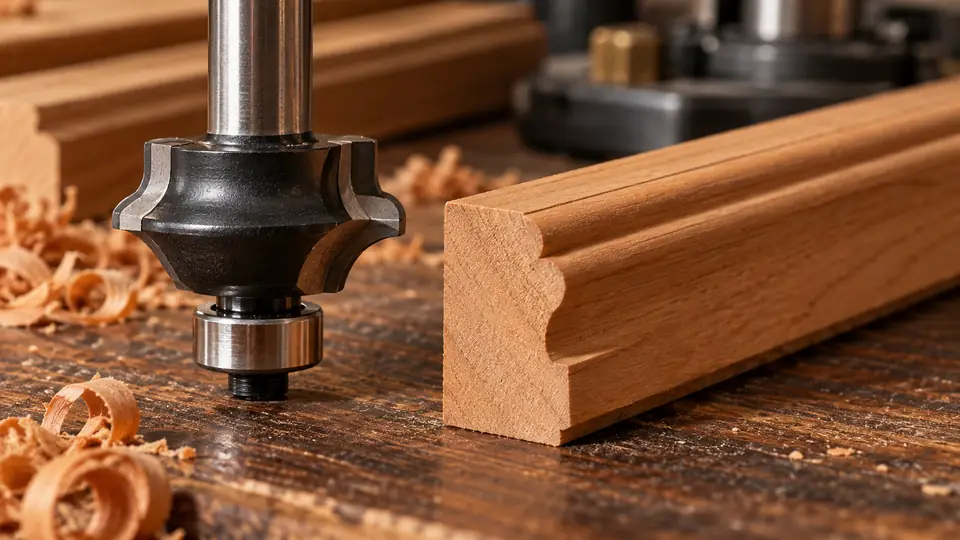
A beading bit can turn a flat, forgettable board edge into a crisp half-round detail with a square shoulder, but the geometry has to match the job. A 1/8-inch radius leaves a restrained line that suits narrow trim, while a 1/4-inch radius makes a bolder statement on furniture and molding. Bullnose sets, traditional beading bits, and multi-bead cutters may share a family resemblance, yet the profiles they leave behind are quite different.
The usual buying mistakes begin with mixing up bead diameter and radius, followed closely by overlooking shank size. A 1/4-inch shank cannot go directly into a 1/2-inch-only collet, and a broad 3/4-inch bead removes far more material than a delicate decorative cutter. Cutter material, bearing guidance, router compatibility, workpiece thickness, and documented maximum RPM also matter once the chips start flying.
Different shops need different answers. A cabinetmaker may favor a traditional shoulder-and-bead profile, a furniture restorer might need paired decorative beads, and an occasional DIY user may prefer several radii in one compact set. The Freud 80-106 is the strongest overall pick here because its 1/4-inch radius, 1/4-inch shank, bearing-guided traditional profile, and clearly documented dimensions create a useful balance for common molding and furniture work.
Quick Answer
- Best overall: Freud 80-106 Traditional Beading Bit for a clearly specified 1/4-inch-radius bead with a square shoulder.
- Best premium set: Whiteside 502 Roundover & Beading Set for multiple radii, interchangeable bearings, and organized storage.
- Best bullnose set: WSOOX 5PCS Bullnose Beading Router Bit Set for five radii covering modest to broad edge profiles.
- Best ornamental set: Akylin Triple Beading Router Bit Set for columns, posts, furniture trim, and layered traditional detail.
Best Beading Router Bits Comparison Table
| Product | Best For | Profile | Shank | Key Specification |
|---|---|---|---|---|
| Freud 80-106 | General furniture and molding | Traditional bead with square shoulder | 1/4 inch | 1/4-inch radius; 1/2-inch bearing |
| Whiteside 502 | Multi-radius cabinet work | Roundover and beading set | 1/4 inch | Five listed radii; bearing assortment and case |
| WSOOX 5PCS Set | Broad radius selection | Bullnose and half-round edges | 1/4 inch | 1/4 to 3/4-inch radii |
| Akylin Triple Beading Set | Ornamental trim | Triple bead | 1/2 inch | 3/32 to 3/16-inch radii; 21,000 maximum RPM |
| Akylin Double Beading Set | Restoration and narrow molding | Single, double, or corner beads | 1/2 inch | Three radius pairs; 28,000 maximum RPM |
| Freud 80-122 | Fine traditional detail | Traditional bead with square shoulder | 1/2 inch | 1/8-inch radius; 1-inch cutter diameter |
| YONICO 13195 | Large shelf and tabletop edges | Bullnose bead | 1/2 inch | 3/8-inch radius; 3/4-inch bead |
| YONICO 13192q | Compact-router collets | Corner bullnose bead | 1/4 inch | 3/16-inch radius; 1/4-inch cutting depth |
| BINSTAK Point Cutting Roundover Bit | Grooves, signs, and carving | Point-cutting roundover | 1/4 inch | 1/4-inch radius; 1/2-inch cutting diameter |
The reviews below explain where each profile fits and which dimensional trade-offs deserve a closer look.
1. Freud 80-106 Traditional Beading Bit — Best Overall

The Freud 80-106 cuts a half-round bead with a square shoulder, the familiar profile that gives furniture edges and molding a crisp, deliberate shadow line. Its 1/4-inch radius is substantial enough to register visually without reaching the scale of a broad bullnose. Freud documents an overall diameter of 1-1/8 inches, a 7/8-inch carbide height, and a 1/2-inch bearing, so the relevant dimensions are refreshingly clear.
A 1/4-inch shank makes this model accessible to many handheld and table-mounted routers with the correct collet. The listed material range includes hardwood, softwood, plywood, and composites, while the two cutters handle the actual profile. Freud also applies its Perma-SHIELD coating. That coating is a product-specific feature, though it should not be read as permission to neglect routine cleaning or cutter inspection.
Pros
- Creates a defined half-round bead with a square shoulder.
- Useful 1/4-inch radius suits furniture edges and molding.
- Documented for hardwood, softwood, plywood, and composites.
- Compatible with handheld and table-mounted routers using the proper 1/4-inch collet.
- Dimensions include bearing diameter, overall diameter, carbide height, and overall length.
Cons
- The single 1/4-inch radius offers no profile-size flexibility by itself.
- The 1/4-inch shank will not directly fit a 1/2-inch-only collet.
This Freud bit fits woodworkers seeking one traditional, clearly specified bead rather than a box of loosely related profiles. It is especially sensible for repeating a medium-size edge treatment across furniture parts or molding. Buyers who need tiny restoration beads or a sweeping bullnose should choose a different radius, since profile scale determines the visual result.
To buy this product, click here.
2. Whiteside 502 Roundover & Beading Set — Best Premium Set

The Whiteside 502 is aimed at shops that regularly move between subtle easing and much fuller edge treatments. Its listed radius range covers 1/8, 3/16, 1/4, 3/8, and 1/2 inch, all for 1/4-inch collets. That spread is practical for cabinet doors and drawers, where a restrained inside edge may sit near a broader outside treatment and consistency matters across several components.
Bearings are central to this package. The supplied information lists five B2 bearings and a 3/32-inch hex key, giving users the hardware needed to change the resulting relationship between cutter and guide where supported by the set. A hardened plastic case keeps the bits, bearings, and wrench together. Natural wood, composite wood, and hard plastic are listed applications, giving this kit a broader documented material range than many single-profile options.
Pros
- Radius selection runs from 1/8 inch through 1/2 inch.
- Uses 1/4-inch shanks for routers equipped with matching collets.
- Includes five B2 bearings for roundover and beading configurations.
- Comes with a hex key for bearing changes.
- Protective case organizes the cutters and small accessories.
Cons
- The supplied description conflicts on the precise bit count, so package contents merit confirmation before ordering.
- A multi-radius set requires more storage and setup attention than one dedicated cutter.
This set fits a cabinet or furniture shop that expects to use several radii rather than buying a cutter for one immediate edge. The richer assortment carries little benefit for someone who already knows that every project needs the same 1/4-inch bead. Its appeal lies in documented range, bearing options, and organized storage, provided the current package contents match the profiles required.
To buy this product, click here.
3. WSOOX 5PCS Bullnose Beading Router Bit Set — Best Bullnose Set

Five radii make the WSOOX set appealing for woodworkers who want rounded edge profiles at several scales. The lineup covers 1/4, 3/8, 1/2, 5/8, and 3/4 inch on 1/4-inch shanks. Those larger members are intended for bold bullnose or half-round treatments on surfaces such as shelves, tabletops, flooring components, and wainscot panels, where a tiny decorative bead could disappear visually.
WSOOX specifies hardened steel bodies, carbide cutting material, and an anti-kickback body design. The listed router range includes CNC, other automatic systems, handheld routers, and table-mounted portable routers. Material support extends across hardwood, softwood, MDF, particleboard, plywood, and panels, but metal is expressly excluded. The manufacturer also calls for multiple passes with the larger cutters or in hardwood, a sensible constraint to carry into setup.
Pros
- Five included radii span 1/4 to 3/4 inch.
- Creates bullnose and half-round treatments for broad furniture and panel edges.
- Uses carbide cutting material on hardened steel bodies.
- Listed for CNC, automatic, handheld, and table-mounted routing systems.
- Documented for solid wood and several wood-based sheet materials.
Cons
- All five cutters require a 1/4-inch collet.
- Larger radii and hardwood applications call for multiple passes rather than one deep cut.
Choose this set if project scale changes frequently and full, rounded edges matter more than a traditional bead with a sharply defined shoulder. It has the broadest bullnose radius spread among these picks, yet that range also demands careful attention to cutter clearance and router limits. Users focused on narrow period molding should look toward the Freud 80-122 or Akylin decorative sets instead.
To buy this product, click here.
4. Akylin Triple Beading Router Bit Set — Best For Ornamental Trim

Triple beads produce a busier, more traditional profile than a single bullnose. This five-piece Akylin set lists 3/32, 1/8, 5/32, and 3/16-inch bead radii, giving furniture trim, columns, posts, and ornamental molding a layered surface that catches light across several small curves. It is a specialized visual effect, and that specificity is precisely why the set makes sense for restoration-style work.
Each cutter uses a 1/2-inch shank and a bearing guide, a combination suited to routers with a matching collet and adequate clearance. Akylin identifies YG6X tungsten carbide-tipped construction and supports handheld or table-mounted use in hardwood, softwood, plywood, and composites. The documented ceiling is 21,000 RPM, so router speed must be set within that limit rather than assumed safe at maximum motor speed.
Pros
- Produces triple-bead ornamental profiles rather than a plain rounded edge.
- Includes several small radii for varied decorative scale.
- Uses bearing guides to follow the workpiece edge.
- Documented for handheld and table-mounted routers.
- Supports hardwood, softwood, plywood, and composite materials.
Cons
- The 1/2-inch shanks exclude routers limited to 1/4-inch collets.
- The 21,000 maximum RPM requires careful speed-limit compliance.
This set is best for builders and restorers who actually need repeated decorative beads on trim, posts, or furniture components. A triple profile can look fussy on minimalist work, and it removes more visual space than a simple edge bead. For cleaner, quieter detailing, the single-profile Freud cutters are easier to match to contemporary furniture.
To buy this product, click here.
5. Akylin Double Beading Router Bit Set — Best For Restoration Profiles

The Akylin double-beading set sits between a simple edge bead and the more elaborate triple-bead package. Its three cutters provide radius pairs of 1/4, 5/32, and 1/8 inch, with listed cutting lengths of 1-3/8, 7/8, and 3/4 inch. That dimensional variety supports single, double, or corner-bead details on narrow molding, shelf edges, columns, and posts.
YG6X tungsten carbide-tipped cutters and bearing guides form the working core of the set. Akylin lists compatibility with handheld and table-mounted routers for hardwood, softwood, plywood, and composites. The documented maximum is 28,000 RPM, but each setup still has to respect router guidance, cutter clearance, and the particular workpiece. A bearing can guide an edge; it cannot compensate for an unsecured board or an incorrect feed approach.
Pros
- Supports single, double, and corner-bead applications.
- Three radius pairs cover several decorative scales.
- Different cutting lengths suit varied molding and edge proportions.
- Bearing guides provide direct edge-following guidance.
- Listed for four common solid and engineered wood categories.
Cons
- Requires a router with a compatible 1/2-inch collet.
- Paired-bead geometry is less useful for plain roundovers or simple bullnose edges.
This is the more flexible Akylin option for renovation work because it can create several bead arrangements without committing every project to a triple pattern. It suits narrow trim and traditional details particularly well. Buyers pursuing broad tabletop bullnoses will get a more appropriate radius range from the WSOOX set, while this package remains focused on ornamental line work.
To buy this product, click here.
6. Freud 80-122 Traditional Beading Bit — Best For Fine Beading

A 1/8-inch radius gives the Freud 80-122 a restrained character. It mills a half-round bead with a square shoulder, making it useful where the profile should add a fine line rather than dominate the workpiece. Freud specifies a 1-inch overall cutter diameter, 9/16-inch carbide height, 1/2-inch bearing, and 2-7/16-inch overall length, which helps users assess the bit against their router and intended edge.
The 1/2-inch shank distinguishes this model from Freud’s larger-radius 80-106, which uses a 1/4-inch shank. Two cutters form the profile, and supported materials include hardwood, softwood, plywood, and composites. Handheld and table-mounted router use are both documented. Perma-SHIELD coating is included, adding a defined product feature without changing the need to inspect the carbide and bearing before routing.
Pros
- Fine 1/8-inch radius suits restrained traditional detailing.
- Leaves a square shoulder beside the half-round bead.
- Uses a 1/2-inch shank for compatible router collets.
- Works in documented handheld and table-mounted applications.
- Provides detailed cutter, bearing, shank, and overall dimensions.
Cons
- The 1/8-inch radius may look undersized on thick shelves or broad tabletops.
- It cannot fit routers limited to 1/4-inch collets.
The Freud 80-122 fits fine furniture details, narrow molding, and work where a broad bullnose would feel clumsy. Its substantial shank and small bead radius make it a distinct option rather than a duplicate of the 80-106. The trade-off is obvious at a glance: this cutter favors subtle definition over a large, tactile rounded edge.
To buy this product, click here.
7. YONICO Bullnose Beading Router Bit 13195 — Best Large Bullnose

The YONICO 13195 forms a 3/4-inch bead from a 3/8-inch radius, producing a broad bullnose suited to substantial shelf, tabletop, and furniture edges. That scale is its defining feature. Rather than buying five radii, a woodworker with one repeatable profile can select this dedicated cutter and avoid storing several smaller options that may never leave the case.
YONICO specifies two C3 micro-grain tungsten carbide cutters, a 1/2-inch shank, and silver induction brazing. The bit is listed for both handheld and table-mounted routers. Because the supplied details focus on cutter geometry and construction rather than operating speed, users need to follow the current manufacturer instructions and router limits for setup, especially with a cutter this broad.
Pros
- Creates a pronounced 3/4-inch bullnose bead.
- Uses a 3/8-inch radius for substantial edge shaping.
- Two carbide cutters form the profile.
- Silver induction brazing is documented in the bit construction.
- Suitable for listed handheld and table-mounted router use.
Cons
- The 1/2-inch shank rules out 1/4-inch-only routers.
- A single large profile lacks the flexibility of a multi-radius set.
This YONICO is a focused buy for thick shelves, tabletops, or furniture edges that need a full rounded bead. It is a poor match for dainty molding, where the Freud 80-122 would preserve more of the original edge. Confirm collet fit, available cutter clearance, and operating limits before choosing it merely because the larger profile looks appealing.
To buy this product, click here.
8. YONICO Bullnose Beading Router Bit 13192q — Best 1/4-Inch-Shank Single Bit

The YONICO 13192q offers a middle-size profile without requiring a whole set. Its 3/16-inch radius produces a 3/8-inch bead, while the listed cutting depth is 1/4 inch. That combination suits furniture tops and shelf edges needing more visual weight than a fine 1/8-inch bead, yet less bulk than the 3/4-inch profile of the YONICO 13195.
This model pairs a 1/4-inch shank with two C3 micro-grain tungsten carbide cutters. Silver induction brazing is listed as part of its construction, and YONICO supports handheld and table-mounted router use. The shank gives owners of compatible compact routers another option, but shank fit alone does not confirm that every router base has sufficient clearance for every setup.
Pros
- Balanced 3/8-inch bead suits many medium-scale furniture edges.
- Clearly documented 3/16-inch radius and 1/4-inch cutting depth.
- Uses a common 1/4-inch shank format.
- Includes two C3 micro-grain carbide cutters.
- Listed for handheld and router-table operation.
Cons
- Provides only one bead size.
- Documented product data does not state an operating RPM range.
This bit fits users who know they need a 3/8-inch bead and would rather buy one cutter than a multi-profile kit. Its moderate scale works across shelf and furniture edges without reaching the visual heft of the 13195. Check the current speed guidance and router clearance during setup, since a compatible shank is only one part of safe cutter selection.
To buy this product, click here.
9. BINSTAK Point Cutting Roundover Router Bit — Best For Decorative Grooves

The BINSTAK cutter differs from the bearing-guided edge bits elsewhere in this roundup. Its point-cutting roundover geometry combines a thin tip with a rounded form, allowing it to mill a rounded V-style groove for lettering, signmaking, fluting, carving, and decorative trimming. The documented dimensions are a 1/4-inch radius, 1/2-inch cutting diameter, 1/4-inch shank, and two flutes.
Carbide-tipped cutting edges sit on a high-strength steel body, according to the supplied specifications. Supported equipment includes CNC, table-mounted, and handheld routers, though each method demands a setup appropriate to the operation. This is a groove-forming and engraving-oriented cutter rather than a direct substitute for the Freud traditional beading bits, which use bearings and create square-shouldered edge beads.
Pros
- Point-cutting geometry supports rounded decorative grooves.
- Useful for lettering, signmaking, fluting, and carving.
- Documented 1/4-inch radius and 1/2-inch cutting diameter.
- Uses a 1/4-inch shank and two-flute cutter arrangement.
- Listed for CNC, table-mounted, and handheld routing.
Cons
- Its pointed geometry does not replace a bearing-guided traditional edge-beading bit.
- The thin tip calls for careful setup in detailed routing operations.
This BINSTAK model fits signmakers and decorative woodworkers who interpret “beading” as a rounded groove or carved detail rather than a bearing-guided furniture edge. It opens applications that the other eight picks do not address, but that specialization cuts both ways. Buyers seeking a conventional half-round bead with a shoulder should stay with the Freud models.
To buy this product, click here.
Buying Guide
Match The Profile To The Intended Detail
“Beading bit” covers several related geometries. A traditional beading bit forms a half-round bead beside a square shoulder, while a bullnose cutter creates a fuller rounded edge. Double- and triple-beading bits lay several curved lines together, and a point-cutting roundover can carve rounded grooves away from an edge. Study the desired cross-section before comparing brands because a similar-looking cutter may leave a markedly different shadow line.
Separate Radius From Bead Diameter
Radius describes the distance from the center of a curve to its outer edge, while bead diameter spans the full curve. The YONICO 13195, for example, pairs a 3/8-inch radius with a 3/4-inch bead. Confusing those values can produce a profile twice the expected scale, which is a painful discovery after routing a finished component.
Confirm Shank And Collet Compatibility
The selected shank must match a documented router collet. This roundup includes both 1/4-inch and 1/2-inch shanks, and they are not interchangeable without a manufacturer-approved collet arrangement. A 1/2-inch shank may appeal for a substantial cutter, while a 1/4-inch shank fits many compact-router configurations. Neither size proves that the router can safely handle a particular cutter diameter.
Use Bearings And Guides For Their Intended Purpose
A bearing-guided bit follows the edge of a workpiece or an appropriate template arrangement, depending on the cutter and setup. Bearing diameter can also affect whether compatible cutters work as roundover or beading profiles. Point-cutting groove bits behave differently because the cutting path comes from router guidance, a fence, a jig, or CNC programming rather than a bearing rolling along the edge.
Check Cutter Material And Construction
Carbide-tipped bits use carbide cutting edges attached to a separate body, while solid carbide and HSS are distinct constructions. The products reviewed here specify carbide or carbide-tipped cutters, with some identifying grades or brazing methods. Those labels can aid comparison, but they do not establish a universal service life because wood species, adhesives, contamination, feed technique, and maintenance all affect wear.
Respect Maximum RPM And Cutter Scale
A documented maximum RPM is a ceiling, not a suggested target. The Akylin triple-beading set lists 21,000 maximum RPM, while its double-beading set lists 28,000. Where a listing does not supply a limit, consult the current cutter and router instructions rather than guessing. Larger cutters also require attention to base openings, table inserts, work holding, and controlled pass depth.
Plan The Cut Before Switching On The Router
Inspect the cutter and bearing, secure the workpiece, wear eye and hearing protection, and manage dust according to the material and equipment. Disconnect power before bit changes, insert the shank according to the router manual, and tighten the correct collet. Multiple controlled passes are often more manageable for large profiles or hard stock, particularly where the cutter manufacturer explicitly recommends them.
Best Beading Router Bits FAQ
What Is The Difference Between A Beading Bit And A Roundover Bit?
A traditional beading bit leaves a rounded bead with a square shoulder or fillet beside it. A roundover bit mainly rounds the corner. Some bearing-based sets can create either treatment through supported bearing changes, but the exact result depends on cutter geometry and bearing diameter.
Can A Bullnose Bit Replace A Traditional Beading Bit?
Only if a full rounded edge is the desired profile. A bullnose or half-round treatment lacks the same sharply defined shoulder produced by a traditional beading bit. On period molding, that missing shoulder can change the character of the piece quite noticeably.
Should I Buy A 1/4-Inch Or 1/2-Inch Shank?
Start with the collets documented for the router. A 1/4-inch shank suits routers equipped with a matching 1/4-inch collet, while a 1/2-inch shank requires a proper 1/2-inch collet. Never force a mismatch or treat a makeshift sleeve as a universal solution.
Can Beading Bits Be Used In Handheld Routers?
Many can, including several products reviewed above, but only where the manufacturer documents handheld use. Cutter diameter, base clearance, work holding, shank fit, router capacity, and operating limits still need verification. Table routing can provide a different control arrangement for narrow or repetitive parts, provided the setup supports the cutter.
Which Bead Radius Works Best For Furniture Edges?
There is no single furniture radius. A 1/8-inch bead adds a fine accent to narrow trim, a 1/4-inch radius creates a more visible furniture detail, and a 3/8-inch radius forms a broad 3/4-inch bead. Match the curve to stock thickness and the surrounding design rather than choosing the largest cutter available.
Can These Bits Cut MDF And Plywood?
Material support varies by product. The WSOOX set lists MDF, particleboard, plywood, and panels, while the Freud and Akylin products include plywood or composites among their supported materials. Sheet goods can generate fine dust, so suitable dust control and respiratory protection remain part of the setup.
Do Larger Beading Bits Need Multiple Passes?
Controlled passes can reduce the amount removed at one time, and WSOOX specifically recommends multiple passes with its larger bits or in hardwood. There is no universal pass depth for every cutter and router. Follow the cutter and router instructions while accounting for profile size and material.
Can A Beading Bit Be Used In A CNC Router?
Only where CNC use is documented and the cutter geometry suits the programmed operation. The WSOOX set and BINSTAK point-cutting bit list CNC support, but a supported shank size alone does not establish suitability. Toolpaths, work holding, clearance, and RPM must remain within the equipment and cutter limits.
Final Verdict
The Freud 80-106 Traditional Beading Bit is the most balanced recommendation for a classic furniture or molding bead. Its 1/4-inch radius has useful visual presence, the square shoulder distinguishes it from a plain roundover, and Freud supplies enough dimensional information to make compatibility checks less murky. Its single radius is a limitation, but that focus is attractive when one repeatable profile is the real requirement.
For a broader toolkit, the Whiteside 502 offers several radii, bearings, and a storage case, while the WSOOX set is better aligned with large bullnose profiles. Ornamental work points toward the Akylin double- or triple-beading sets, and carved grooves call for the BINSTAK point-cutting geometry. Before buying, sketch the desired cross-section, confirm the router’s collet and cutter clearance, then choose the radius that fits the stock rather than forcing the stock to fit the cutter.
